Effect of Temperature on Reaction Rates & the Concept of Activation Energy (Cambridge (CIE) AS Chemistry): Exam Questions

Exam code: 9701

1 hour19 questions
1a
2 marks

This question is about the following general reaction

A + B ⇌ C + D

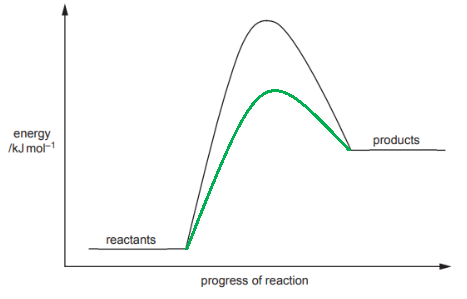
The reaction pathway diagram for the reaction is shown in Fig. 1.1.

1-8-2a-e-reaction-profile-a-and-b

  Fig. 1.1

 Explain whether the forward reaction is exothermic or endothermic. 

1b
1 mark

Define the term activation energy.

1c
Sme Calculator
2 marks

Use Fig. 1.1 to calculate the activation energy for the forward and backward reactions.

1d
3 marks

Explain, using Fig. 1.2, how the addition of a catalyst affects the rate of reaction.

3-5_q2d-ocr-a-as--a-level-easy-sq

Fig. 1.2

2a
2 marks

This question is about Boltzmann distribution curves.

The Boltzmann distribution curve of molecular energies for a general reaction at a given temperature is shown in Fig. 2.1.


3-5_5a-ocr-a-as--a-level-easy-sq

Fig. 2.1

 State what will happen to the curve when the temperature of the reaction is decreased.  

2b
1 mark

Comment on how, if at all, the total area under a Boltzmann distribution curve changes with temperature.

2c
2 marks

State what happens to the Boltzmann distribution curve in Fig. 2.1 when a catalyst is added to the reaction.

2d
1 mark

The Boltzmann distribution of energies for a gas is shown in Fig. 2.2.

3-5_5d-ocr-a-as--a-level-easy-sq

Fig. 2.2

 State what the shaded area of Fig. 2.2 represents. 

1a
3 marks

Fig. 1.1 below shows, for a given temperature T, a Boltzmann distribution of the kinetic energy of the molecules of a mixture of two gases that will react together.

The activation energy for the reaction, Ea, is marked.

1-8m-q1-boltzmann

Fig. 1.1

On Fig. 1.1 above,

i) draw a new distribution curve, clearly labelled T2, for the same mixture of gases at a lower temperature, T2.

[2]

ii) mark clearly, as H, the position of the activation energy of the reaction at the lower temperature, T2.

[1]

1b
2 marks

Explain the meaning of the term activation energy.

1c
2 marks

i) On the energy axis in Fig. 1.1, mark the position, clearly labelled C, of the activation energy of the reaction when a catalyst is used.

[1]

ii) Use your answer to (i) to explain how the use of a catalyst results in reactions occurring at a faster rate.


[1]

1d
4 marks

Two reactions involving aqueous NaOH are given below.

CH3CHBrCH3 + NaOH → CH3CH(OH)CH3 + NaBr reaction 1 H2SO4 + 2NaOH → Na2SO4 + 2H2O reaction 2

The reagents in reaction 1 must be heated together for some time for the reaction to occur. Whereas, reaction 2 is almost instantaneous at room temperature.

Suggest brief explanations why the rates of these two reactions are very different.

2a
4 marks

Ammonia can be produced by the reaction of nitrogen and hydrogen.

N2 (g) + 3H2 (g) rightwards harpoon over leftwards harpoon 2NH3 (g)          ΔH = -92 kJ mol-1

The reaction can be catalysed and the activation energy for this catalysed reaction is +109 kJ mol-1

Complete the reaction pathway diagram in Fig. 2.1 for the uncatalysed and the catalysed reaction between nitrogen and hydrogen.

You should label the following:

  • products

  • the enthalpy change of reaction, ΔH

  • the activation energy of the forward, uncatalysed reaction, Ea

  • the activation energy of the forward, catalysed reaction, Ec

1-8-reaction-kinetics-5a-a

Fig. 2.1

2b
Sme Calculator
1 mark

Calculate the value of the activation energy of the catalysed decomposition of ammonia into nitrogen and hydrogen. Show your working.

activation energy .............................................. kJ mol-1

2c
1 mark

Catalysts, such as iron used in the production of ammonia, increase the rate of reaction.

Explain why. Use a labelled Boltzmann distribution to explain your answer.

2d
3 marks

Platinum is used as a catalyst in catalytic converters which are fitted to vehicle exhaust systems to remove nitrogen oxide from the exhaust gases.

2NO (g) + 2CO (g) → N2 (g) + 2CO2 (g)

i) State the type of catalyst that platinum is in a catalytic converter

[1]

ii) Explain, using oxidation numbers, if nitrogen is being oxidised or reduced in this reaction.

[2]

3a
4 marks

In any chemical reaction, the particles will all be moving in different directions, at different speeds and with different amounts of energy. Maxwell-Boltzmann distributions show the distribution of energy amongst particles within a chemical reaction. 

Fig. 3.1 below shows the Maxwell-Boltzmann distribution in a sample of a gas at a fixed temperature, T1

1-3

Fig. 3.1

i) Label the x and y axes of the graph.  

[2] 

ii) Sketch a distribution for a sample of the same gas at a higher temperature, T2

[2]

3b
2 marks

State why a Maxwell-Boltzmann distribution curve always starts at the origin and what the area under the curve represents. 

3c
6 marks

Some changes were made individually to the experiment completed in part (a).

Consider your Maxwell-Boltzmann distribution curve from part (a). For each of the changes in parts (i), (ii) and (iii) below, state and explain the effect that the change would have on:

  • The area under the curve

  • The value of the most probably energy of the molecules (Emp)

  • The proportion of molecules with energy greater than or equal to Ea

i) The temperature of the original reaction is increased, but no other changes are made. 

[2]

 ii) The number of molecules in the original reaction mixture is increased, but no other changes are made. 

[2]

 iii) A catalyst is added to the original reaction mixture, but no other changes are made. 

[2]

1a
4 marks

A Maxwell-Boltzmann distribution curve is shown below in Fig 1.1 

1-8-3a-h-q3a-botlzman-distribution-curve

Fig 1.1

For the changes detailed in part (i) and (ii) state and explain the effect the change would have on:

  • The area under the curve 

  • The value of the most probable energy of the molecules, Emp

  • The proportion of molecules with greater than or equal to E

i) The temperature of the original reaction is increased, but no other changes are made.

[2]

ii) A catalyst is added to the original reaction mixture, but no other changes are made.

[2]

1b
4 marks

A chemist performed a reaction at three different temperatures, 100 K, 300 K and 700 K as shown by the Maxwell-Boltzmann distribution graph in Fig 1.2.

maxwell-boltzman-three-diff-temps

Fig 1.2

i) Label each curve in Fig 1.2 with the correct temperature values, 100 K, 300 K and 700 K.

[1]

 ii) Consider the following statement, ‘All reacting molecules have higher kinetic energy at 700 K than they do at 300 K’.

State whether you agree this statement is correct and justify your reasons.

[3]

1c
5 marks

Hydrogen will react with chlorine to form the hydrogen halide, hydrogen chloride, a colourless gas.

H2 (g) + Cl2 (g) → 2HCl (g)

i) Give one reason why most collisions between hydrogen and chlorine molecules do not lead to the formation of hydrogen chloride. 

[1]

ii) Apart from changing the temperature, state and explain two ways of speeding up the formation of hydrogen chloride.

[4]