Carboxylic Acids (Cambridge (CIE) AS Chemistry): Exam Questions

Exam code: 9701

1 hour20 questions
1a
1 mark

This question is about carboxylic acids. 

State the general formula of a carboxylic acid

1b
1 mark

State the systematic name of the carboxylic acid shown in Fig. 1.1.
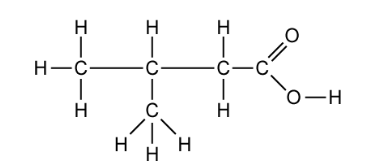
Displayed formula of a carboxylic acid, CH3CH(CH3)CH2COOH

Fig. 1.1

1c
3 marks

i) Construct a balanced symbol equation to show the dissociation of the acid from part (b).

[1]

ii) State where the position of the equilibrium lies and what this says about the strength of the acid.

[2]

1d
2 marks

Construct a balanced symbol equation, including state symbols, for the reaction of propanoic acid with sodium hydrogen carbonate powder.

1a
1 mark

A series of reactions based on propanoic acid is shown.

Flow chart of a series of reactions based on propanoic acid, showing reactions 1, 2, and 3 as arrows between structures

Construct an equation for reaction 1, using [H] to represent one atom of hydrogen from the reducing agent.

1b
3 marks

i) Name the type of reaction for reaction 2.

[1]

ii) State a suitable reagent and conditions for reaction 2.

[2]

1c
1 mark

Construct an equation for the reaction of propanoic acid with calcium carbonate, CaCO3.

1d
3 marks

i) State a suitable reagent and conditions for reaction 3.

[2]

ii) Identify the other product of reaction 3.

[1]

2a
2 marks

2-ethyl-3-methylbutanoic acid is present in fermented products such as rum.

i) Deduce the molecular formula of 2-ethyl-3-methylbutanoic acid.

[1]

ii) State the number of chiral carbon atoms in a molecule of 2-ethyl-3-methylbutanoic acid.

[1]

2b
6 marks

A sample of 2-ethyl-3-methylbutanoic acid may be prepared in a school or college laboratory by the oxidation of:

2-ethyl-3-methylbutan-1-ol (CH3)2CHCH(C2H5)CH2OH

i) State the reagent(s) that would be used for this oxidation.

reagent(s) .................................................................................................

colour change from .............................. to ..............................

[2]

ii) This reaction is carried out by heating the reacting chemicals together. What could be the main organic impurity present in the sample of the acid? Explain your answer.

[2]

iii) State whether a distillation apparatus or a reflux apparatus should be used.

Explain your answer.

[2]

2c
2 marks

A structural isomer of 2-ethyl-3-methylbutan-1-ol is 2-ethyl-3-methylbutan-2-ol, (CH3)2CHC(OH)(C2H5)CH3.

What colour change would be seen if this were heated with the reagents you have given in part (b)(i)?

Explain your answer.

2d
3 marks

An isomer of 2-ethyl-3-methylbutanoic acid which is an ethyl ester is a very strong smelling compound which is found in some wines. This ethyl ester contains a branched hydrocarbon chain and is chiral.

Draw the displayed formula of this ethyl ester.

Identify the chiral carbon atom with an asterisk (*).

3a
1 mark

Propan-1-ol can be oxidised to propanoic acid using acidified potassium dichromate(VI).

State the systematic name of the intermediate formed during this oxidation.

3b
3 marks

i) State the final colour of the reaction mixture after the potassium dichromate(VI) has reacted.

[1]

ii) State the conditions to ensure that propanoic acid is obtained in a high yield.

[2]

3c
2 marks

Describe a chemical test and observation which confirms the presence of a carboxyl functional group.

1a
1 mark

LiAlH4 is a reducing agent.

LiAlH4 cannot be used in aqueous solution because it reacts with water to produce LiOH(aq), H2(g) and a white precipitate which is soluble in excess sodium hydroxide. Identify the white precipitate.

1b
4 marks

Butane-1,2-diol is oxidised to form compound P in reaction 1. Compound P is then reduced using LiAlH4 in reaction 2 to give Q, and using NaBH4 in reaction 3 to give R, as shown in Fig. 1.1.

Reaction pathway diagram showing butane-1,2-diol oxidised to compound P, then P reduced by LiAlH4 to give Q and by NaBH4 to give R

Fig. 1.1

i) State the reagents and conditions required for reaction 1.

[2]

ii) Deduce whether Q or R is 2-hydroxybutanoic acid and explain the difference between reactions 2 and 3.

[2]

1c
4 marks

A third student prepares 2-hydroxybutanoic acid using propanal as the starting material as shown in Fig. 1.2. In step 1, propanal reacts with a mixture of NaCN and HCN.

Reaction pathway diagram showing propanal reacting with NaCN and HCN to form S in step 1, then S reacting with HCl under reflux in step 2 to give 2-hydroxybutanoic acid

Fig. 1.2

Draw the mechanism for the reaction of propanal with the mixture of NaCN and HCN to form S.

In your mechanism, include:

  • the identity of the ion that reacts with propanal

  • the structure of the intermediate

  • all charges, partial charges, lone pairs and curly arrows

1d
1 mark

Construct a balanced equation for step 2, in which S is heated under reflux with dilute hydrochloric acid.

2a
3 marks

Lactic acid, 2-hydroxypropanoic acid, CH3CH(OH)COOH, occurs naturally in sour milk.

Lactic acid is chiral and shows stereoisomerism.

Draw the three-dimensional structures of the two optical isomers of lactic acid.

Use an asterisk (*) to identify the chiral carbon atom in one of the structures.

2b
6 marks

Lactic acid may be synthesised from ethanol by the following route.

CH2CH2OH rightwards arrow with step space 1 on top CH3CHO rightwards arrow with step space 2 on top CH3CH(OH)CN rightwards arrow with step space 3 on top CH3CH(OH)COOH

State the reagent(s) and essential condition(s) for each step.

step 1

reagent(s) .......................................................................................

conditions .......................................................................................

step 2

reagent(s) .......................................................................................

condition(s) .......................................................................................

step 3

reagent(s) .......................................................................................

condition(s) .......................................................................................

2c
2 marks

Lactic acid, CH3CH(OH)COOH can be reduced by LiAlH4.

i) Construct an equation to show this reaction, using [H] to represent one atom of hydrogen from the reducing agent.

[1]

ii) State the systematic name of the organic product formed in this reaction.

[1]

3a
4 marks

Glycolic acid is commonly used in skin care products.

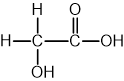
The structure is shown in Fig. 3.1.

Structural formula of glyolic acid, showing two carbon atoms with attached hydrogen, hydroxyl and carboxyl groups in a simple line diagram

Fig. 3.1

Glycolic acid is added separately to each of the three reagents below.

Complete the table to show what you would observe. If a reaction occurs, state the functional group of glycolic acid responsible for the reaction.

reagent

observation with glycolic acid

functional group

Na2CO3

2,4-DNPH

acidified K2Cr2O7 (aq) and heat

3b
7 marks

Two reaction sequences to produce glycolic acid are shown.

Sequence A:

HCHO rightwards arrow from reaction space 1 to HCN space and space NaCN of X rightwards arrow for reaction space 2 of CH2(OH)COOH

Sequence B:

CH3COOH rightwards arrow from reaction space 3 to Br subscript 2 of CH2BrCOOH rightwards arrow for reaction space 4 of CH2(OH)COOH

i) Draw the structure of X.

[1]

ii) Identify the reagent used for reaction 2.

[1]

iii) Name the mechanism for reaction 3.

[1]

iv) State the essential condition for reaction 3.

[1]

v) Reaction 4 occurs via an SN2 mechanism. Complete the diagram for the mechanism for reaction 4.

Incomplete SN2 mechanism diagram for reaction 4 showing the bromine-containing substrate with spaces for the nucleophile, curly arrows, and leaving group

In your mechanism, include all relevant charges, partial charges, curly arrows and lone pairs.

[3]

3c
2 marks

Glycolic acid can also be made by reacting glyoxylic acid with NaBH4.

i) State the role of NaBH4 in this reaction.

[1]

ii) Construct an equation for this reaction using molecular formulae. Use [H] to represent one atom of hydrogen from NaBH4.

[1]