Addition Polymerisation (Cambridge (CIE) AS Chemistry): Exam Questions

Exam code: 9701

2 hours28 questions
1a
1 mark

Polymer X can be formed from an alkene. The structure of polymer X is shown in Fig. 1.1.

Repeating unit of poly(propene) showing a two-carbon backbone with a CH₃ side chain

Fig. 1.1

State the type of polymerisation involved in the formation of polymer X.

1b
2 marks

i) Draw the fully displayed formula of the monomer used to form polymer X.

[1]

ii) State the name of polymer X.

[1]

1c
2 marks

State two reasons why the disposal of poly(alkenes) such as polymer X is difficult.

2a
6 marks

Butene, C4H8, can exist as three isomers.

Isomer A is a position isomer of isomers B and C and does not show geometric isomerism.

Isomers B and C are geometric isomers of each other.

Isomer B is the cis isomer.

Isomer C is the trans isomer.

i) Draw the displayed formulae of the three isomers, A, B and C, of butene, C4H8.

[3]

ii) State the names of all three isomers, A, B and C, of butene, C4H8.

[3]

2b
1 mark

Draw the displayed formula of the addition polymer formed by isomer A.

2c
1 mark

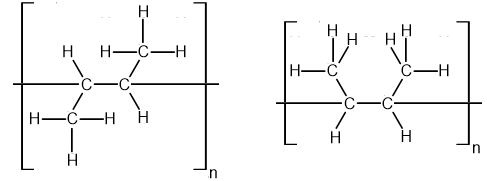
A student was asked to draw the displayed formula of the addition polymer of isomers B and C. They suggested that there were two structures as shown in Fig. 2.1.

Two displayed formulae of the addition polymer from but-2-ene isomers, showing apparently different arrangements of methyl groups along the backbone

Fig. 2.1

State why the student's two suggested structures are the same addition polymer.

3a
1 mark

A molecule of chloroethene is shown in Fig. 3.1.

Structural formula of chloroethene showing a C=C double bond with a chlorine atom and three hydrogen atoms

Fig. 3.1

Chloroethene can be polymerised to form poly(chloroethene).

State the alternative name for poly(chloroethene).

3b
2 marks

Draw a diagram of the structure of poly(chloroethene) including three repeat units.

3c
2 marks

State a problem caused by the combustion of poly(chloroethene) as a method of disposal and suggest how the effects of this problem can be reduced.

1a
2 marks

Addition polymers are made by the polymerisation of alkenes.

Explain what is meant by the term addition polymerisation.

1b
2 marks

Trans-hept-2-ene can be made into an addition polymer.

i) Draw the displayed formula of trans-hept-2-ene.

[1]

ii) Draw the structure of poly(hept-2-ene) showing two repeat units.

[1]

1c
2 marks

Suggest why the polymer made from trans-hept-2-ene is not called poly(trans-hept-2-ene).

1d
3 marks

Trans-hept-2-ene is a liquid at room temperature and pressure but poly(hept-2-ene) is a solid.

Explain why there is a difference in the states of trans-hept-2-ene and poly(hept-2-ene).

2a
1 mark

Polyvinyl chloride (PVC) is a polymer which is rigid enough for use as a drainpipe and flexible enough for plastic aprons.

State the IUPAC name of PVC.

2b
4 marks

Fig 2.1 below shows a section of the PVC polymer.

Fig 2.1

3-8-2b-m-pvc-chain-a

i) Draw the repeating unit of PVC.

[1]

ii) Draw the structure and state the name of the monomer of the PVC polymer.

[2]

iii) Write the equation to represent the formation of PVC from its monomer.

[1]

2c
6 marks

The polymer poly(propene) is formed from the monomer propene.

i) Draw the repeating unit of this polymer.

[1]

ii) The properties of two different polymers, poly(methylpropene) and poly(ethene) are compared to each other. Complete Table 2.1 by placing an X in the correct box. You may place more than one X for each physical property. 

[3]

Table 2.1

Physical property

Poly(methylpropene)

Poly(ethene)

Insoluble in water


Unreactive


High density


iii) Explain why the melting point of poly(methylpropene) is much higher than that of methylpropene. 

[2]

2d
3 marks

Polymers are unreactive compounds due to their long non-polar chain of saturated carbon-carbon and carbon-hydrogen bonds. Though this means that they are safe to use due it also means that they are non-biodegradable as they are not attacked by biological agents such as enzymes. 

Table 2.2 shows three different ways in which polymers can be disposed of.

Table 2.2

Method of disposal

Disadvantage

Recycling


Incineration


Landfill


State the disadvantage of each method of disposal to complete Table 2.2.

3a
1 mark

Poly(tetrafluoroethene), also known as PTFE, is an addition polymer used as a non-stick coating in pans as it is very unreactive.

Draw the displayed formula of the monomer used to form PTFE.

3b
1 mark

Draw two repeating units of poly(tetrafluoroethene).

3c
3 marks

The table shows the melting points of two polymers.

Polymer

Melting point / °C

Poly(ethene)

137

Poly(chloroethene) (PVC)

212

Explain the differences in melting point of these two polymers in terms of the intermolecular forces between the chains.

3d
2 marks

Poly(ethene) bags pollute the environment for a long time because they are non-biodegradable.

Describe two pollution problems that are caused by non-biodegradable polymers.

4a
2 marks

The structures of two different polymers, poly(ethene) and poly(propene) are shown in Fig. 4.1.

Structural formulae of poly(ethene) and poly(propene) showing their repeating units with backbone carbons and substituents

Fig. 4.1

Suggest two reasons why these polymers are unreactive.

4b
2 marks

State one advantage and one disadvantage of the unreactivity of addition polymers.

4c
1 mark

Another example of a polymer is polystyrene which is often used as packing material and electrical insulation.

Fig. 4.2 shows three repeating units of the polymer.

Three repeating units of polystyrene showing alternating backbone carbons, with a phenyl group attached to every other carbon

Fig. 4.2

Draw the structure of monomer X which is used to form the polymer shown in Fig. 4.2.

4d
2 marks

Two different monomers can also join together to form an addition polymer.

Monomer X can react with monomer Y to form a polymer. Two repeating units of this polymer are shown in Fig 4.3.

Two repeating units of the addition polymer from monomers X and Y, showing alternating phenyl and Cl substituents on the backbone

Fig. 4.3

i) Draw the structure of monomer Y which reacts with monomer X to form the polymer shown in Fig. 4.3.

[1]

ii) State the IUPAC name of monomer Y.

[1]

5a
1 mark

Poly(but-1-ene) is insoluble in water so is used in applications such as making water pipes.

Write an equation to show how poly(but-1-ene) is formed from the monomer but-1-ene.

5b
4 marks

Not all polymers are insoluble in water. One example is poly(vinylalcohol) known as PVA. PVA is used in applications such as in the casing of detergent-filled capsules.

A section of the polymer chain of PVA is shown in Fig. 5.1.

Section of the PVA polymer chain showing repeating units with OH groups on alternating backbone carbons

Fig. 5.1

i) Draw the structure and state the IUPAC name of the monomer of PVA.

[2]

ii) Suggest why PVA is soluble, but poly(but-1-ene) is not.

[2]

5c
2 marks

Combustion can be used to dispose of poly(alkenes), such as poly(but-1-ene).

State one advantage and one disadvantage to the environment of disposing of polymers by combustion.

5d
1 mark

Poly(chloroethene), PVC, can also be disposed of via combustion but it produces toxic waste gases including hydrogen chloride.

Suggest a reagent that can be used to remove this toxic gas from the waste gases.

1a
1 mark

Poly(methyl methacrylate) is used as a glass substitute in Perspex.

A section of the polymer chain is shown in Fig. 1.1.

Section of the poly(methyl methacrylate) polymer chain showing repeating units with ester and methyl substituents

Fig. 1.1

Draw the skeletal formula of the monomer.

1b
2 marks

Explain why poly(methyl methacrylate) is fairly unreactive.

1c
3 marks

Bioplastics, such as biodegradable plastics, offer a sustainable alternative to oil-based products.

Where the use of plant-based polymers is not possible, photodegradable polymers are being developed.

i) Explain how photodegradable polymers are broken down.

[1]

ii) Suggest two disadvantages of using photodegradable polymers.

[2]

2a
2 marks

Explain how p-orbitals are involved in the formation of the C=C bond in chloroalkenes.

You should include a sketch in your answer.

2b
5 marks

Compound Y has six possible structural isomers of C3H3Cl3.

Two of these isomers are shown in Fig. 2.1.

Two structural isomers of C~3~H~3~Cl~3~ labelled as isomer 1 and isomer 2

Fig. 2.1

i) State the IUPAC name of isomer 1.

[1]

ii) Draw three other structural isomers of C3H3Cl3 that are chloroalkenes.

[3]

iii) Show two repeat units for the polymer formed by isomer 2.

[1]

2c
4 marks

Polymers can be disposed of by incineration.

i) Write a balanced symbol equation for the incineration of poly(chloroethene). Carbon dioxide, water and HCl are formed.

[1]

ii) State the environmental impact of the carbon dioxide produced during this reaction.

[1]

iii) State the environmental impact of the hydrogen chloride produced during this reaction.

[1]

iv) Suggest how the environmental impact of the hydrogen chloride could be reduced.

[1]

3a
3 marks

But-2-ene, CH3CH=CHCH3, is an important compound which is obtained from the cracking of hydrocarbons present in crude oil.

Some reactions of but-2-ene are shown in Fig. 3.1.

Reaction scheme for but-2-ene showing three different reactions leading to organic compounds A, B, and C

Fig. 3.1

State the structural formulae of the organic compounds A to C.

3b
1 mark

But-2-ene can be polymerised to give poly(but-2-ene). Draw the structural formula of a portion of the polymer chain in poly(but-2-ene) showing two repeat units.

3c
2 marks

State two reasons why there is an increasing demand for polymers to be recycled rather than incinerated.