Covalent Bonding & Coordinate (Dative Covalent) Bonding (Cambridge (CIE) AS Chemistry): Exam Questions

Exam code: 9701

57 mins18 questions
1a
2 marks

The reaction between an ammonia molecule and a hydrogen ion forms an ammonium ion.

The structure of an ammonium ion is shown.

Structural formula of the ammonium ion: central nitrogen bonded to four hydrogens in a tetrahedral arrangement, enclosed in brackets with a positive charge.

i) State the type of bond represented in the diagram by N—H.

[1]

ii) State the type of bond represented in the diagram by N→H.

[1]

1b
1 mark

Explain how the N→H bond is formed.

1c
2 marks

Explain why the bond angles in the NH4+ ion are all 109.5°.

1a
2 marks

Alkenes contain a carbon to carbon double bond that consists of a σ bond and a π bond.

Complete the diagram to show, in terms of orbital overlap, how the σ bond and the π bond are formed in a C=C double bond. Label each bond.

Two bold black letter C shapes spaced widely apart on a plain white background.
1b
3 marks

Use the data in Table 5.1 to explain why ethene contains stronger covalent bonds between carbon atoms than ethane.

Table 5.1

Bond

Bond Length

C-C

150 pm

C=C

134 pm

1c
3 marks

Describe and explain the relative thermal stabilities of HCl, HBr and HI, using the data in Table 5.2.

Table 5.2

Bond energy / kJ mol-1

Bond length / pm

HCl

431

127

HBr

366

141

HI

299

161

1d
6 marks

The boiling points of the hydrogen halides are shown in Table 5.3.

Table 5.3

Hydrogen halide

Boiling point / K

HF

293

HCl

188

HBr

207

HI

238

i) Explain why hydrogen halides have relatively low boiling points despite having strong covalent bonds.

[2]

ii) Explain why HF has a higher boiling point than HCl.

[4]

2a
2 marks

The structure of a molecule is shown in Fig. 2.1.

Skeletal formula of an organic molecule containing multiple carbon-carbon single bonds, double bonds, and one triple bond.

Fig. 2.1

State the number of σ bonds and π bonds in one molecule of this compound.

2b
1 mark

Fig. 2.2 shows the structure of ethanol.

Displayed formula of ethanol with one carbon atom marked for hybridisation identification.

Fig. 2.2

State the hybridisation of the carbon atom marked in Fig. 2.2.

2c
3 marks

Sketch a labelled diagram to show, in terms of orbital overlap, how the bonds are formed in methanol, CH3OH. Your diagram should include any lone pairs of electrons.

3a
3 marks

Describe how the carbon-carbon triple bond forms in propyne, CH3C≡CH. Refer to orbital overlap and hybridisation in your answer.

3b
1 mark

Fig. 3.1 shows the structure of an organic molecule.

Skeletal formula of an organic molecule containing multiple carbon-carbon double bonds and carbon-carbon single bonds.

Fig. 3.1

State the number of carbon atoms that are sp2 hybridised in this molecule.

3c
3 marks

Table 3.1 shows three nitrogen-containing species. Complete Table 3.1 to state the hybridisation of the nitrogen atom in each species.

Table 3.1

NF4+

N2H2

N2H4

Hybridisation of nitrogen

1a
4 marks

Phosphorus reacts with chlorine to form PCl5.

i) State the shape of, and two different bond angles in, a molecule of PCl5.

shape of PCl5

bond angles in PCl5

[2]

ii) Draw a dot-and-cross diagram to show the bonding in a molecule of PCl5. Show the outer electrons only.

[2]

1b
2 marks

In the solid state, phosphorus(V) chloride exists as an ionic lattice containing [PCl4]+ and [PCl6] ions.

Draw three-dimensional diagrams to show the shapes of the [PCl4]+ and [PCl6] ions.

[PCl4]+

[PCl6]

1c
2 marks

A student suggests that the PCl5 molecule has sp3 hybridisation. Explain why the student is incorrect.

1d
2 marks

Antimony(V) chloride is another Group 15 chloride. Under standard conditions, it is a liquid made from SbCl5 molecules.

Use your answer to (b) to explain why phosphorus(V) chloride, in its solid form, has a higher melting point than antimony(V) chloride.

1e
1 mark

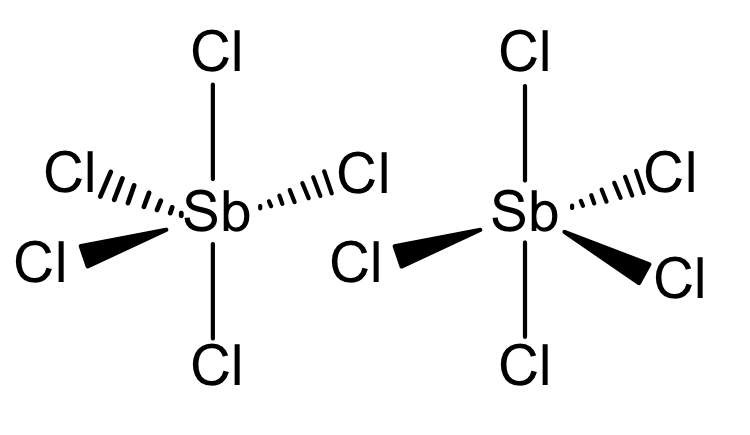
Under the right conditions, molecules of SbCl5 join together to form Sb2Cl10.

Complete Fig. 4.1 to show the bonding in Sb2Cl10. Include the coordinate (dative covalent) bonds.

Two diagrams of antimony pentachloride showing trigonal bipyramidal geometry with five Cl atoms around central Sb, illustrating different 3D bond orientations

Fig. 4.1

1f
1 mark

The other Group 15 elements also form pentachlorides with the exception of nitrogen.

Suggest a reason why nitrogen does not form NCl5.