Halogenoalkanes (Cambridge (CIE) AS Chemistry): Exam Questions

Exam code: 9701

3 hours42 questions
1a
2 marks

Compound X is a halogenoalkane. Its structure is shown in Fig. 1.1.

Structure of 2-bromopropane

Fig. 1.1

i) State the systematic name of compound X.

[1]

ii) State whether compound X is a primary, secondary or tertiary halogenoalkane.

[1]

1b
1 mark

Compound X is added to aqueous silver nitrate in ethanol.

State the colour of the precipitate formed.

1c
1 mark

Compound X is heated under reflux with KCN in ethanol.

Draw the structure of the organic product formed.

1d
2 marks

Fig. 1.2 shows the structure of 2-chloropropane.

Structure of 2-chloropropane

Fig. 1.2

Explain why compound X reacts with KCN in ethanol at a faster rate than 2-chloropropane.

2a
3 marks

Fig. 2.1 shows the reaction scheme for the production of propene.

Propane   rightwards arrow with space step space 1 space on top   1-chloropropane   rightwards arrow with space step space 2 space on top Propene

Fig. 2.1

i) State the reagent and conditions required for step 1.

[2]

ii) Name the mechanism for step 1.

[1]

2b
2 marks

The mechanism for step 1 involves initiation, propagation and termination steps.

Construct two equations to show the propagation steps in this mechanism.

2c
3 marks

i) Name the mechanism for step 2.

[1]

ii) State the reagent and conditions for step 2.

[2]

3a
2 marks

i) Explain what is meant by the term tertiary halogenoalkane.

[1]

ii) State the meaning of the numbers 1 and 2 in the terms SN1 and SN2.

[1]

3b
4 marks

2-bromo-2-methylpropane reacts with hydroxide ions via an SN1 mechanism.

i) The incomplete reaction mechanism for this reaction is shown in Fig. 3.1.

Complete the mechanism in Fig. 3.1. Include charges, dipoles, lone pairs of electrons and curly arrows, as appropriate.

Two-step SN1 reaction of tert-butyl bromide with hydroxide, showing carbocation intermediate, bromide ion by-product and formation of tert-butanol, awaiting curly arrows to complete the mechanism

Fig. 3.1

[3]

ii) State which step in this mechanism is the rate-determining step.

[1]

3c
2 marks

An ethanolic solution of excess ammonia (NH3 in ethanol) is heated under pressure with 2-bromo-2-methylpropane.

i) Draw the structure of the organic product formed.

[1]

ii) Name the functional group present in the organic product.

[1]

1a
1 mark

Propene and cyclopropane are structural isomers with the molecular formula C3H6. Their structures are shown in Fig. 1.1.

propene
cyclopropane

Fig. 1.1

State the H–C–H bond angle at the terminal =CH2 group in propene.

1b
4 marks

Under suitable conditions, propene and cyclopropane each react with chlorine.

i) Propene reacts with chlorine to form 1,2-dichloropropane, CH3CHClCH2Cl.

Name the mechanism for this reaction.

[1]

ii) When cyclopropane reacts with chlorine, three different compounds with the molecular formula C3H4Cl2 can be formed.

Draw the displayed formulae of these three compounds.

[3]

1c
2 marks

Ethane reacts with chlorine according to the following equation.

C2H6 + Cl2 → C2H5Cl + HCl

i) State the conditions needed for this reaction.

[1]

ii) Name the mechanism for this reaction.

[1]

1d
Sme Calculator
3 marks

i) One of the steps during the reaction in (c) is the following process.

Cl● + CH3CH3 → HCl + CH3CH2

Table 1.1

Bond

Bond enthalpy / kJ mol-1

C–H

410

H–Cl

431

H–I

299

Use the data in Table 1.1 to calculate the enthalpy change, ΔH, of this step.

[1]

ΔH = ................................ kJ mol-1

ii) Use the data in Table 1.1 to calculate the enthalpy change, ΔH, of the similar reaction:

I● + CH3CH3 → HI + CH3CH2

[1]

ΔH = ................................ kJ mol-1

iii) Use your answer to (d)(ii) to suggest why it is not possible to make iodoethane by reacting together iodine and ethane.

[1]

1e
3 marks

Complete the equations to show the steps in the mechanism for the formation of chloroethane.

Cl2 → ..............

Cl● + CH3CH3 → HCl + CH3CH2

CH3CH2● + .............. → ................ + ..............

.............. + .............. → CH3CH2Cl

2a
7 marks

1-chloropropane reacts to form organic products as shown in the reaction scheme in Fig. 2.1.

Flow diagram of organic reactions of 1‑chloropropane.
Reaction 1 forms propene.
Reaction 2 forms butanenitrile.
Reaction 3 with concentrated ammonia solution forms propylamine/propan‑1‑amine.

Fig. 2.1

i) State the reagent and conditions for Reaction 1.

[2]

ii) Identify a suitable reagent for Reaction 2. Explain why this reaction is useful in organic synthesis.

[2]

Reagent ..................................................

Explanation ..................................................

iii) State the conditions for Reaction 3.

[2]

iv) Draw the structural formula of the organic product formed when 1-chloropropane is heated under reflux with aqueous sodium hydroxide.

[1]

2b
Sme Calculator
3 marks

2‑chloro‑2‑methylpropane reacts with aqueous alkali to form 2-methylpropan-2-ol.

(CH3)3CCl + OH- → (CH3)3COH + Cl-

The graph in Fig. 2.2 shows how the concentration of 2‑chloro‑2‑methylpropane changes with time during an investigation of this reaction.

Graph of (CH₃)₃CCl concentration decreasing exponentially from about 0.065 to 0.003 mol dm⁻³ over 0–200 s, plotted as points with a smooth curve.

Fig. 2.2

Use the graph in Fig. 2.2 to calculate the rate of reaction at t = 50 s. Show your working on the graph.

Rate of reaction = ............................ units ............................

2c
1 mark

Name the mechanism for the reaction of 2‑chloro‑2‑methylpropane with aqueous sodium hydroxide.

2d
3 marks

X is 1‑bromobutane, Y is 1‑iodobutane and Z is 1-chlorobutane.

Equal volumes of X, Y and Z are added to separate test-tubes containing aqueous silver nitrate in ethanol at 50 °C.

i) State what is observed in the test-tube containing X. Give the formula of the compound responsible for this observation.

[2]

ii) Deduce the order of the rate of reaction of X, Y and Z, starting with the fastest.

fastest ........................ > ........................ > ........................ slowest

[1]

2e
4 marks

2-bromo-2-methylpropane can be prepared from the addition of hydrogen bromide, HBr, to 2-methylpropene.

Complete the diagram to show the mechanism for this reaction.

Include charges, dipoles, lone pairs of electrons and curly arrows, as appropriate.

3a
2 marks

One method of preparing 1-bromobutane in the laboratory is described below.

35 g of solid potassium bromide, 30 cm3 of water, and 25 cm3 of butan-1-ol are placed in a 250 cm3 two-necked flask fitted with a tap funnel and reflux condenser. Concentrated sulfuric acid (25 cm3) is then added drop by drop from the tap funnel, keeping the contents well shaken and cooled in an ice-water bath.

The overall reaction takes place in two stages. In the first stage, the inorganic reagents react to form HBr. In the second stage, the organic reagent reacts with the HBr formed in the first stage.

Construct an equation for each of these stages.

stage 1 ......................................................................

stage 2 ......................................................................

3b
2 marks

Identify two different reagents and conditions that can be used to prepare 1-bromobutane. Include the reagents and conditions for each method.

3c
5 marks

i) Complete the reaction scheme in Fig. 3.1, which starts with 1-bromobutane.

In each empty box, draw the structural formula of the organic compound that would be formed.

[4]

Flow diagram of reactions of CH₃CH₂CH₂CH₂Br with aqueous NaOH or NaOH in ethanol, under reflux, forming intermediates W and X, then oxidised to Y and Z

Fig. 3.1

ii) Name the type of reaction that occurs when compound X is produced from 1-bromobutane.

[1]

3d
2 marks

Compound W can also be formed by heating 1-bromobutane under reflux with aqueous silver nitrate.

Suggest why the rate of formation of compound W is slower in this reaction than when 1-bromobutane is heated under reflux with aqueous sodium hydroxide.

4a
5 marks

Describe an experiment that would allow the relative rates of hydrolysis of 1-chlorobutane, 1-bromobutane and 1-iodobutane to be compared.

4b
2 marks

Explain the trend in the rates of hydrolysis of 1-chlorobutane, 1-bromobutane and 1-iodobutane.

4c
3 marks

The hydrolysis of 2-bromobutane produces butan-2-ol.

i) Explain what is meant by the term chiral centre.

[1]

ii) Draw the three-dimensional structures of the two optical isomers of butan-2-ol.

[2]

4d
6 marks

Primary halogenoalkanes, such as RCH2X, and tertiary halogenoalkanes, such as R3CX, undergo hydrolysis with aqueous sodium hydroxide via different mechanisms.

i) Name the mechanism for the hydrolysis of a primary halogenoalkane.

Draw the structure of the transition state formed in this reaction.

[2]

ii) Name the mechanism for the hydrolysis of a tertiary halogenoalkane.

Draw the structure of the intermediate formed in this reaction.

[2]

iii) State one difference between these two mechanisms in terms of the species involved in the rate-determining step.

[2]

5a
4 marks

There are four structural isomers with the molecular formula C4H9Br.

Complete Table 1.1 to draw the skeletal formula of each isomer and state whether each is a primary, secondary or tertiary halogenoalkane.

Table 1.1

skeletal formula

primary, secondary or tertiary

5b
3 marks

One of the isomers of C4H9Br contains a chiral centre.

i) State the systematic name of this isomer.

[1]

ii) Draw the three-dimensional structures of the two optical isomers of this compound.

[2]

5c
2 marks

Aqueous silver nitrate in ethanol was added to separate test-tubes containing chloroethane, bromoethane and iodoethane. The test-tubes were placed in a hot water bath.

A yellow precipitate appeared first in the tube containing iodoethane, followed by a cream precipitate in the tube containing bromoethane and finally a white precipitate appeared in the tube containing chloroethane.

Explain these observations.

5d
3 marks

Bromoethane reacts with aqueous sodium hydroxide.

i) Name the mechanism for this reaction.

[1]

ii) Complete the diagram below to show the mechanism for this reaction.

Include charges, dipoles, lone pairs of electrons and curly arrows, as appropriate.

[2]

Hydroxide ion reacting with bromoethane, substituting bromine to form ethanol and bromide ion in a nucleophilic substitution reaction diagram, awaiting curly arrows to complete the mechanism
5e
4 marks

Primary and tertiary halogenoalkanes have different reaction mechanisms when they react with aqueous sodium hydroxide.

i) State the name of the mechanism when aqueous sodium hydroxide reacts with each of the following types of halogenoalkane.

primary halogenoalkane ....................................................................................

tertiary halogenoalkane ....................................................................................

[2]

ii) Explain why a tertiary carbocation is more stable than a primary carbocation.

[2]

1a
4 marks

A student investigates the rate of reaction of six halogenoalkanes using the following method.

  1. Mix ethanol with six drops of halogenoalkane.

  2. Warm the mixture in a water bath at 50 °C.

  3. Add silver nitrate solution.

  4. Record the time taken for the precipitate to form.

Table 1.1 shows the student's results.

Table 1.1

Halogenoalkane

Time taken for the precipitate to form (s) at 50 °C

CH3CH2CH2CH2CH2Cl

265

CH3CH2CH2CH2CH2Br

152

CH3CH2CH2CH2CH2I

65

CH3CH2CH2CHBrCH3

88

(CH3)2CHCHClCH3

190

CH3CH2C(CH3)2Cl

88

i) Suggest three modifications to the experimental procedure to improve the reliability of the results.

[3]

ii) Name the type of reaction occurring in this method, other than precipitation.

[1]

1b
4 marks

Using Table 1.1, describe and explain two factors that influence the rate of this type of reaction in halogenoalkanes.

1c
4 marks

1-bromopentane reacts with an aqueous solution of sodium hydroxide.

i) Name the mechanism for this reaction.

[1]

ii) State the systematic name of the inorganic product formed.

[1]

iii) State the reagents and conditions required to favour an elimination reaction rather than nucleophilic substitution.

[2]

1d
4 marks

1-chloropentane and two other products can be prepared in the laboratory by the reaction of pentan-1-ol with thionyl chloride, SOCl2.

i) Construct an equation for this reaction. Include state symbols.

[2]

ii) Identify one safety precaution necessary for carrying out this reaction. Explain why it is required.

[2]

2a
2 marks

2-bromo-2-methylpropane is refluxed with ethanolic potassium hydroxide, KOH.

Complete Table 2.1 to state the systematic name of each organic product and identify the mechanism involved.

Table 2.1

organic product

name

mechanism involved

alkene

alcohol

2b
2 marks

Explain why a mixture of an alkene and an alcohol is produced in the reaction outlined in part (a).

2c
1 mark

Butan-2-ol reacts with phosphorus(III) iodide, PI3, to produce an iodoalkane and phosphorous acid, H3PO3.

Construct an equation for this reaction.

2d
1 mark

Explain why concentrated sulfuric acid cannot be used to prepare iodoalkanes from potassium iodide.

3a
2 marks

Compound G is a chloroalkane that can undergo two different reactions as outlined in Fig. 3.1.

Flow chart: compound G undergoes reaction A to give compound H, or reaction B to give a four‑carbon chain with a carbon-2 bonded to CN and H.

Fig. 3.1

Compound H is an alkene which does not show geometrical (cis/trans) isomerism.

Draw the skeletal structures of compounds G and H.

3b
2 marks

State the reagents and conditions for reaction A in Fig. 3.1.

3c
4 marks

Name and draw the mechanism for reaction B in Fig 3.1. Include all charges, partial charges, lone pairs and curly arrows.

4a
1 mark

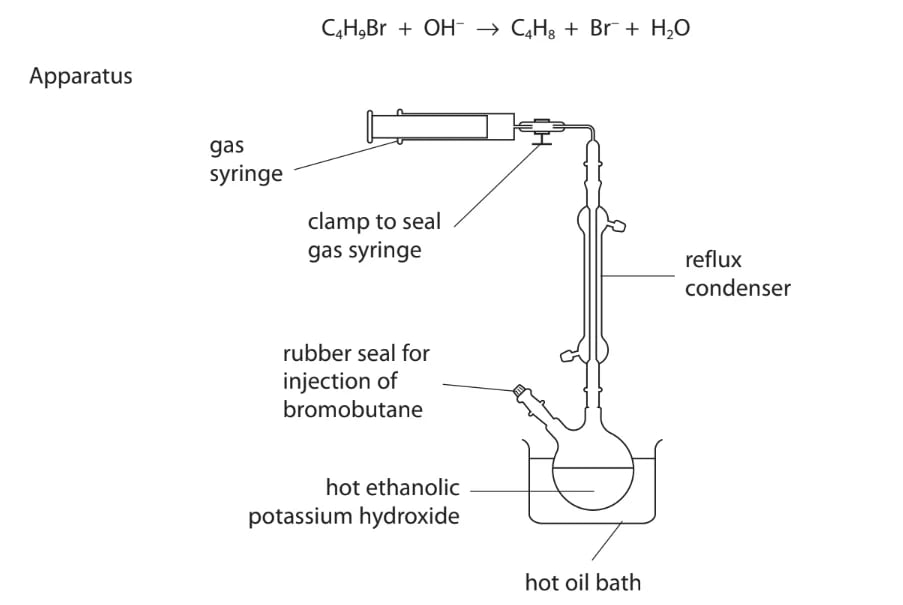
Bromobutanes react with hot ethanolic potassium hydroxide solution to produce gaseous butenes.

Diagram of reflux apparatus in hot oil bath with ethanolic potassium hydroxide, bromobutane injection seal and gas syringe to collect gaseous product

0.0080 mol of liquid 1-bromobutane was injected into a round bottom flask containing hot ethanolic potassium hydroxide. After the reaction, the syringe was sealed using a clamp and removed from the apparatus. It was then allowed to cool to 25 °C.

The final volume of but-1-ene collected was 22.0 cm3.

State the purpose of the condenser.

4b
2 marks

Describe a chemical test and expected observation to confirm the presence of the carbon-carbon double bond in the gas in the syringe.

4c
Sme Calculator
2 marks

Calculate the percentage of 1-bromobutane which was converted to but-1-ene. Show your working.

4d
Sme Calculator
2 marks

Before cooling, the volume of but-1-ene in the gas syringe was 24.0 cm3.

Assuming constant pressure and that no but-1-ene is lost from the gas syringe during cooling, calculate the temperature of the gas in the syringe before cooling. Show your working.

Temperature = ...................... K

4e
6 marks

i) Another compound formed from 1-bromobutane under these conditions is butan-1-ol.

Name the type of reaction taking place to form butan-1-ol.

[1]

ii) Draw the mechanism for the reaction of 1-bromobutane with hydroxide ions to form butan-1-ol. Include charges, dipoles, lone pairs of electrons and curly arrows, as appropriate.

[3]

iii) Describe a chemical test and expected observation to confirm the presence of the hydroxyl group in butan-1-ol.

[2]

4f
3 marks

The elimination reaction of 2-bromobutane produces a mixture of three isomeric alkenes.

Draw the displayed formulae of the three alkene isomers formed.