Shapes of Organic Molecules; σ & π Bonds (Cambridge (CIE) AS Chemistry): Exam Questions

Exam code: 9701

1 hour16 questions
1a
1 mark

The carbon chain of an aliphatic organic molecule can be described as straight-chained.

State two other terms used to describe the arrangement of carbon atoms in an aliphatic organic molecule.

1b
3 marks

Complete Table 1.1 to state the number of σ and π bonds in each type of hybridised bond.

Table 1.1

hybridisation

number of σ bonds

number of π bonds

sp3

sp2

sp

1c
4 marks

Four compounds are shown in Fig. 1.1.

Four molecules including CO2, water, boron trifluoride and cis-platin

Fig. 1.1

Complete Table 1.2 to state the shape and bond angle of each molecule.

Table 1.2

molecule

shape

bond angle / °

carbon dioxide

linear

water

104.5

boron trifluoride

120

cis-platin

square planar

1a
3 marks

By reference to the hybridisation of the carbon atoms and orbital overlap, describe how the σ and π bonds are formed in the triple bond of propyne.

1b
1 mark

The structure of an organic molecule is shown in Fig. 1.1.

Organic molecule containing sigma and pi bonds

Fig. 1.1

State the number of carbon atoms that are sp2 hybridised in this molecule.

1c
3 marks

Complete Table 1.1 to state the hybridisation of the nitrogen atom in each species.

Table 1.1

 NF4+

N2H2

N2H4

hybridisation

2a
2 marks

Gasoline is a mixture of hydrocarbons. Compound X is a component of gasoline. The displayed formula of compound X is shown in Fig. 2.1.

Displayed formula of 2,2-dimethylpentane, a branched alkane component of gasoline

Fig. 2.1

i) State the systematic name of compound X.

[1]

ii) State the general formula for the homologous series to which compound X belongs.

[1]

2b
6 marks

Compound X shown in Fig. 2.1 can react with chlorine in the presence of UV light to form various chlorinated products.

i) Name the mechanism for this reaction.

[1]

ii) Draw the skeletal formulae of the four monochlorinated isomers formed when compound X reacts with chlorine.

[4]

iii) State the type of structural isomerism shown by the isomers in (ii).

[1]

2c
4 marks

Fig. 2.2 shows the mechanism for the reaction of aqueous sodium hydroxide with 1-bromopropane.

SN2 mechanism showing hydroxide ion attacking 1-bromopropane to form compound X with bromide leaving

Fig. 2.2

i) State the role of the aqueous hydroxide ion in this reaction.

[1]

ii) State the systematic name of compound X.

[1]

iii) Under different reaction conditions, 1-bromopropane reacts with hydroxide ions to form propene.

State the conditions required for this reaction and name the mechanism.

[2]

2d
4 marks

Pentanal reacts with HCN in the presence of NaCN to form 2-hydroxyhexanenitrile as shown in Fig. 2.3.

Reaction scheme showing pentanal reacting with HCN and NaCN to form 2-hydroxyhexanenitrile, with the carbonyl carbon highlighted

Fig. 2.3

i) By reference to hybridisation and orbital overlap, explain why the carbonyl carbon in pentanal is trigonal planar.

[3]

ii) State the shape and bond angle around carbon-2 in 2-hydroxyhexanenitrile.

[1]

3a
2 marks

Explain why the ring of carbon atoms in cyclohexane, C6H12, is non-planar. In your answer, refer to the hybridisation of the carbon atoms and the C–C–C bond angles.

3b
4 marks

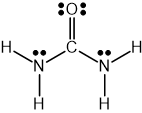
The structure of urea, CO(NH2)2, is shown in Fig. 3.1.

Lewis structure of urea showing the central carbonyl carbon double-bonded to oxygen and single-bonded to two NH2 groups

Fig. 3.1

Complete Table 3.1 to state the hybridisation and approximate bond angle around the carbon atom and each nitrogen atom in urea.

Table 3.1

atom

hybridisation

approximate bond angle / °

carbon

nitrogen

3c
4 marks

State the hybridisation of the carbon atom in methane, CH4. Name the shape of the molecule and explain why it has this shape.

hybridisation:

shape:

explanation:

3d
1 mark

A molecule of ethanol is shown in Fig. 3.2.

Displayed formula of ethanol with one carbon atom labelled

Fig. 3.2

State the hybridisation of the carbon atom marked in Fig. 3.2.

1a
2 marks

The structure of ibuprofen is shown in Fig. 1.1.

Skeletal structure of ibuprofen showing benzene ring, carboxylic acid, and isobutyl chain

Fig. 1.1

State the number of pi (π) bonds and the number of chiral centres in a molecule of ibuprofen.

number of π bonds ..............................

number of chiral centres ..............................

1b
2 marks

State the number of sp2 and sp3 hybridised carbon atoms in a molecule of ibuprofen.

sp2 hybridised carbon atoms ..............................

sp3 hybridised carbon atoms ..............................

1c
3 marks

Describe and explain the shape of the benzene ring in ibuprofen.

In your answer, include:

  • the bond angle between carbon atoms

  • the hybridisation of the carbon atoms

  • how orbital overlap forms σ and π bonds between the carbon atoms