Enthalpy Change, ΔH (Cambridge (CIE) AS Chemistry): Exam Questions

Exam code: 9701

2 hours29 questions
1a
3 marks

Standard enthalpy changes include enthalpy of formation, enthalpy of combustion and enthalpy of neutralisation.

i) Define the term standard enthalpy change of formation.

[2]

ii) Construct an equation that represents the standard enthalpy change of formation of ammonia, NH3. Include state symbols.

[1]

1b
1 mark

State what is meant by standard conditions in enthalpy measurements.

1c
2 marks

The equation for the reaction between dilute sulfuric acid and aqueous sodium hydroxide is shown.

H2SO4 (aq) + 2NaOH (aq) → Na2SO4 (aq) + 2H2O (l)

Explain why the enthalpy change for this reaction does not represent the standard enthalpy change of neutralisation.

2a
Sme Calculator
2 marks

Freon 21 is a hydrochlorofluorocarbon that was used as a propellant and refrigerant but later withdrawn from use because of its effect on ozone depletion. The formula is CHCl2F.

Freon 21 is produced by reacting hydrogen fluoride with trichloromethane in the following reaction:

CHCl3 (g) + HF (g) → CHCl2F (g) + HCl (g)

Use the data in Table 2.1 to calculate the standard enthalpy change of reaction, ΔH°r, for this reaction. Show your working.

Compound

Standard enthalpy change of formation, ΔH°f / kJ mol–1

CHCl3 (g)

–103.2

CHCl2F (g)

–284.1

HF (g)

–273.3

HCl (g)

–92.3

Table 2.1

2b
2 marks

On Fig. 2.1, sketch a reaction pathway diagram for this reaction. Label the diagram to show the enthalpy change of reaction, ΔH°r, and the activation energy, Ea.

Blank reaction pathway diagram with energy on the y-axis and reaction coordinate on the x-axis

Fig. 2.1

2c
1 mark

Define the term activation energy.

3a
2 marks

Define the term bond energy.

3b
1 mark

Suggest why the value of ΔHr calculated using bond energies may differ from the value obtained by experiment.

3c
3 marks

Use the data given in Table 3.1 to calculate the enthalpy change for the hydration of ethene to form ethanol. Show your working.

CH2=CH2 (g) + H2O (g) → CH3CH2OH (l)

Table 3.1

Bond

Bond energy / kJ mol-1

C–C

346

C=C

614

C–H

414

C–O

358

O–H

463

3d
Sme Calculator
4 marks

Ethane reacts with bromine to form 1,2-dibromoethane and hydrogen bromide.

Construct an equation for this reaction. Hence, use the data in Table 3.2 to calculate the enthalpy change for this reaction. Show your working.

Bond

Bond enthalpy / kJ mol-1

C–C

346

C–H

414

C–Br

285

H–Br

366

Br–Br

193

Table 3.2

1a
Sme Calculator
4 marks

Propane reacts with chlorine to form chloropropane.

C3H8 (g) + Cl2 (g) → C3H7Cl (g) + HCl (g)

i) Use bond energies from Table 1.1 to calculate the enthalpy change for this reaction.

Show your working.

Table 1.1

Bond

Bond Energy / kJ mol-1

C-H

410

C-Cl

340

Cl-Cl

242

H-Cl

431

Include a sign in your answer.

enthalpy change = ................................. kJ mol–1

[3]

ii) State the conditions needed for this reaction to occur.

[1]

1b
3 marks

Using Fig. 1.1, sketch a labelled reaction pathway diagram for the reaction in part (a) including the activation energy.

Blank enthalpy profile graph with vertical axis labelled “Enthalpy” and horizontal axis labelled “Progress of reaction”, both indicated by arrows

Fig. 1.1

1c
2 marks

Ethane and chlorine will also react together under the same conditions.

State and explain the difference in enthalpy change for the two reactions

1d
2 marks

Propane will react with bromine in a similar reaction to part (a).

Suggest, with a reason, whether the sum of the bonds broken would be larger or smaller compared to the reaction between propane and chlorine.

2a
4 marks

The apparatus shown in Fig. 2.1 can be used to determine the enthalpy of combustion of butan-1-ol, C4H9OH (Mr = 74.12 g mol-1).

Diagram of a calorimeter: water bath with stirrer, thermometer and copper spiral coil, heated butan‑1‑ol sample below, oxygen gas supply and suction pump attached

Fig. 2.1

i) Construct an equation to represent the standard enthalpy change of combustion of butan-1-ol.

Include state symbols.

[2]

ii) Suggest the purpose of the copper spiral and small electric heater in the apparatus.

[2]

2b
Sme Calculator
2 marks

An experiment was carried out and the following measurements were recorded in Table 2.1

Table 2.1

Mass of butan-1-ol / g

2.20

Volume of water / cm3

875

Initial temperature of water / °C

22.5

Final temperature of water / °C

25.0

(Specific heat capacity of water = 4.18 J g-1 K-1)

Use the data to calculate the energy change, q, for the reaction.

Show your working.

Give your answer to two significant figures.

q = ........................................... kJ

2c
Sme Calculator
3 marks

Determine the enthalpy of combustion of butan-1-ol using Table 2.1 and your answer to part (b).

Show your working.

Give your answer to three significant figures.

ΔH = ..................... kJ mol-1

3a
Sme Calculator
1 mark

Two common oxides of nitrogen are nitrogen monoxide, NO, and nitrogen dioxide, NO2.

i) Complete Table 3.1 to show the oxidation number of nitrogen in each compound.

Table 3.1

Compound

NO

NO2

oxidation number of N

[1]

ii) Construct equations for the formation of NO2 by:

  • The reaction of N2 with O2

  • The reaction of NO with O2

[2]

3b
Sme Calculator
3 marks

Molecules of NO2 can be formed by the reaction between N2 and O2. The bond between the N and O atoms in NO2 is a double covalent bond.

The enthalpy change of reaction for this reaction is +497 kJ mol–1. Calculate the bond energy, in kJ mol–1, of the N=O bond.

Show your working.

Use relevant data from Table 3.2.

Table 3.2

Bond

Bond energy / kJ mol-1

N≡N

941

O=O

495

Bond energy of the N=O bond = ............................. kJ mol–1

3c
2 marks

The boiling points of carbon dioxide and nitrogen dioxide are -78.5 oC and 21 oC respectively.

Suggest a reason for the difference.

3d
1 mark

Construct an equation that represents the standard enthalpy change of formation of nitrogen monoxide, NO.

Include state symbols.

4a
Sme Calculator
3 marks

Propane gas is used widely as a fuel which can be used in camping gas stoves. The enthalpy of combustion for propane is −2219.2 kJ mol-1.

Calculate the minimum mass of fuel needed to bring 150 cm3 of water from 25.0°C to its boiling point of 100.0°C.

Show your working.

................... g

4b
1 mark

Suggest why more propane may be required than calculated in part (a).

4c
3 marks

Using Fig. 5.1, Sketch a labelled reaction pathway diagram for the reaction in part (a) including the activation energy.

Blank reaction profile graph with horizontal axis labelled “Progress of reaction” and vertical axis labelled “Enthalpy”, both with arrows showing positive direction.

Fig. 5.1

1a
Sme Calculator
2 marks

The enthalpy change of solution for ammonium chloride can be measured using calorimetry. 12.04 g of ammonium chloride is dissolved in 125.0 cm3 of water at 19.5 °C.

The standard enthalpy change of solution of ammonium chloride is +15.1 kJ mol-1. Calculate the energy change, q, in J, when 12.04 g of ammonium chloride is dissolved in 125.0 cm3 of water.

Show your working.

q = ................................. J

1b
Sme Calculator
1 mark

Use your answer to part (a) to calculate the final temperature, in °C, of the solution.

The specific heat capacity of the solution is 4.18 J g-1 K-1.

Show your working.

Final temperature = ................................. °C

2a
Sme Calculator
3 marks

Use the data in Table 2.1 to calculate the enthalpy change of reaction for the hydrogenation of propene.

Show your working.

Table 2.1

Bond

Bond energy / kJ mol-1

H–H

435

C–H

413

C–C

347

C=C

619

Enthalpy of hydrogenation, ΔHr = ................................. kJ mol–1

2b
Sme Calculator
2 marks

Use the data in Table 2.1 to suggest, with a reason, whether the polymerisation of propene is exothermic or endothermic

2c
Sme Calculator
2 marks

Carbon, hydrogen and ethene each undergo complete combustion in oxygen.

Equation

ΔHθc / kJ mol–1

C (s) + O2 (g) → CO2 (g)

−393.7

H2 (g) + ½O2 (g) → H2O (l)

−285.9

C2H4 (g) + 3O2 (g) → 2CO2 (g) + 2H2O (l)

−1411.0

Use the data to calculate the standard enthalpy change of formation, ΔHθf, in kJ mol–1, of ethene at 298 K.

Show your working.

ΔHθf = ................................. kJ mol–1

3a
3 marks

Compound A is a liquid containing carbon, hydrogen and oxygen. Quantitative analysis shows that A has the empirical formula CH2O.

A sample of A with a mass of 0.240 g is vaporised. At 80.0 °C and 101 kPa, the vapour occupies a volume of 116 cm3.

Calculate the relative molecular mass, Mr, of A.

Show your working.

Mr = .............

3b
5 marks

Methyl methanoate, HCOOCH3, is a liquid ester.

i) Define the term standard enthalpy change of formation.

[2]

ii) The standard enthalpy changes of combustion, ΔHθc, in Table 2.1 are for complete combustion to CO2 (g) and H2O (l) under standard conditions.

Table 2.1

Substance

Standard enthalpy change of combustion, ΔHθc / kJ mol-1

C (s)

–394

H2 (g)

–286

HCOOCH3 (l)

–975

The enthalpy of formation of methyl methanoate refers to the reaction:

2C (s) + 2H2 (g) + O2 (g) → HCOOCH3 (l)

Use the data in Table 2.1 to calculate the standard enthalpy change of formation, ΔHθf, of liquid methyl methanoate.

Show your working.

ΔHθf = ........................ kJ mol-1

[3]

3c
2 marks

The equation for the formation of gaseous methyl methanoate from gaseous atoms is shown.

2C (g) + 4H (g) + 2O (g) → HCOOCH3 (g)

Use bond energy data from the Data Booklet to calculate the enthalpy change for this reaction.

Show your working.

3d
4 marks

A student investigates the rate of reaction of methyl methanoate with dilute hydrochloric acid.

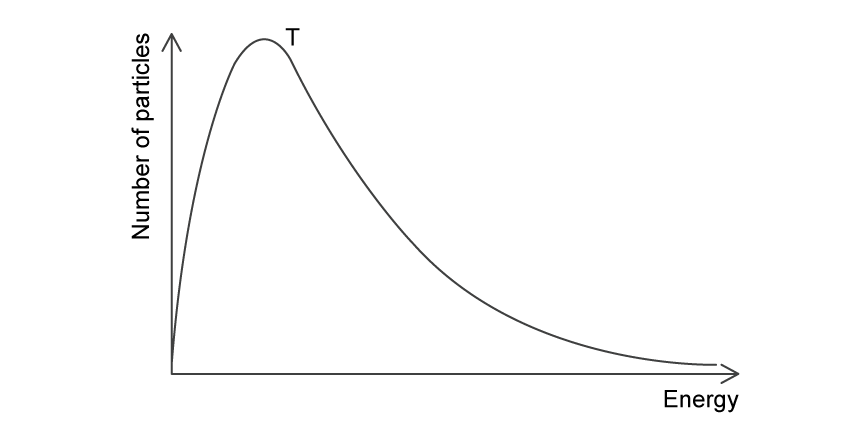
i) A Boltzmann distribution curve for the reactant molecules at temperature T is shown.

Maxwell Boltzmann distribution curve for temperature T, to have a higher temperature added.

On the same axes, sketch the Boltzmann distribution curve for the reactant molecules at a higher temperature, Thigh.

Label the curve Thigh and mark the activation energy, Ea, on the x-axis.

[2]

ii) Use your Boltzmann distribution curves to explain why the rate of reaction is greater at Thigh.

[2]