Motion (Edexcel AS Physics): Exam Questions

Exam code: 8PH0

1 hour13 questions
1a
12 marks

Scientists have been studying a type of spider that can jump up to six times its body length.

The scientists photographed a spider at 0.02s intervals, during a jump. The picture is taken from the photograph and is shown at its actual size.

q16a-nov-2020-9ph0-01-edexcel-as-a-level-phy

i) Deduce whether the images show that the motion in the x-direction is independent of the motion in the y-direction. You should take measurements with a ruler using the cross markings at the centre of gravity of the spider.

(4)

ii) Show that the initial velocity of the spider at the start of the jump is about 1 m s−1. You should take measurements using the cross marking the centre of gravity of the spider.

(5)

iii) The spider achieves this jump by extending its two back legs by 3.0 mm.

Calculate the average force the spider exerts in each leg to achieve the jump.

mass of spider = 150 mg

Average force = ......................................................(3)

1b
2 marks

Just as the spider starts the jump, it fixes a silk thread to the platform. It is thought that the thread acts as a safety line in case the spider falls.

q16b-nov-2020-9ph0-01-edexcel-as-a-level-phy

A student makes the comment:

ʻIf the silk thread can withstand a tension equal to the weight of the spider then this safety system should work.ʼ

Deduce whether this statement is correct.

2a
2 marks

A physics class made a toy rocket. A drinks bottle was partially filled with water and inverted over a valve. An air pump delivered air to the bottle until the pressure forced the bottle from the valve and the water was ejected from the bottle at high speed.

q14-june-2018-9ph0-01-edexcel-as-a-level-phy

A velocity-time graph for the bottle for the first 4 s after take-off is shown.

q14-1-june-2018-9ph0-01-edexcel-as-a-level-phy

Determine the height to which the rocket travelled.

Height = ....................................

2b
5 marks

Sketch the corresponding acceleration-time graph on the axes below.

q14b-june-2018-9ph0-01-edexcel-as-a-level-phy
3a
2 marks

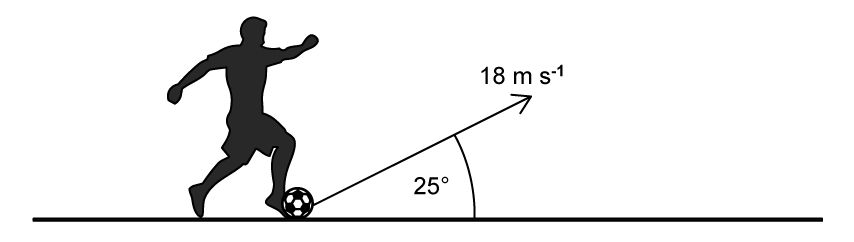
A footballer takes a free kick. The ball leaves the ground with a velocity of 18 m s−1 at an angle of 25° above the horizontal, as shown. The effects of air resistance can be ignored.

A footballer kicking a ball. An arrow from the ball points up and to the right, labelled 18 m s to the power of minus 1. The angle between the arrow and a dashed horizontal line from the ball is marked as 25 degrees.

Calculate the horizontal and vertical components of the ball’s initial velocity as it leaves the ground.

3b
1 mark

Give a reason why the horizontal component of the velocity of the ball remains constant while the ball is in flight.

3c
4 marks

Defending players stand in a wall at a horizontal distance of 9.1 m from the ball. The ball is kicked towards the wall. The top of the wall is at a height of 2.2 m.

Determine whether the ball passes over the wall of players.

1a
1 mark

In the game of golf a stationary ball is hit by a club. One of the aims of the game is to land the ball on a patch of ground called the green.

The graph shows how the force F exerted by the club on the ball varies with time t as the ball is hit.

q12-nov-2021-9ph0-01-edexcel-as-a-level-phy

State why the area under the graph represents impulse.

1b
8 marks

i) Show that the velocity of the ball is about 30 ms−1 immediately after it is hit by the club.

mass of ball = 0.046 kg

(3)

ii) The ball has a time of flight of 3.5 s before landing. The green is a vertical distance of 7.5 m above the point at which the ball was hit, as shown. The green is about seventy metres away from where the ball is hit.

q12bii-nov-2021-9ph0-01-edexcel-as-a-level-phy

Deduce whether, if air resistance is ignored, the ball could land on the green after a flight time of 3.5 s.

(5)

2a
2 marks

A track for toy cars can be built with a circular loop as shown. 

q11-june-2019-9ph0-01-edexcel-as-a-level-phy

A toy car is placed on the track at various heights. It travels around the loop before leaving the track horizontally at X.

The loop has radius r and the mass of the toy car is m. It is possible for a toy car to complete the loop without losing contact with the inside of the track.

For this to occur the minimum speed of the toy car at the top of the loop vtop is given by

vtop =gr

Explain why. 

2b
3 marks

The toy car just completes the loop without losing contact with the track.

Show that the speed of the toy car at the bottom of the loop is about 3 ms-1.

r = 0.15 m

2c
4 marks

The toy car leaves the track at X with a horizontal velocity of 3.0 ms-1.

X is 0.65 m above the floor.

Calculate the horizontal displacement of the car from X when it hits the floor.

Horizontal displacement = ..........................................

3
3 marks

During a test run, a train accelerates uniformly from rest to a maximum speed of 505 km h−1 and maintains this speed for 130 s. The train decelerates uniformly at the same rate and completes the test in a total time of 480 s.

Calculate the average speed of the train during the test run.

4a
2 marks

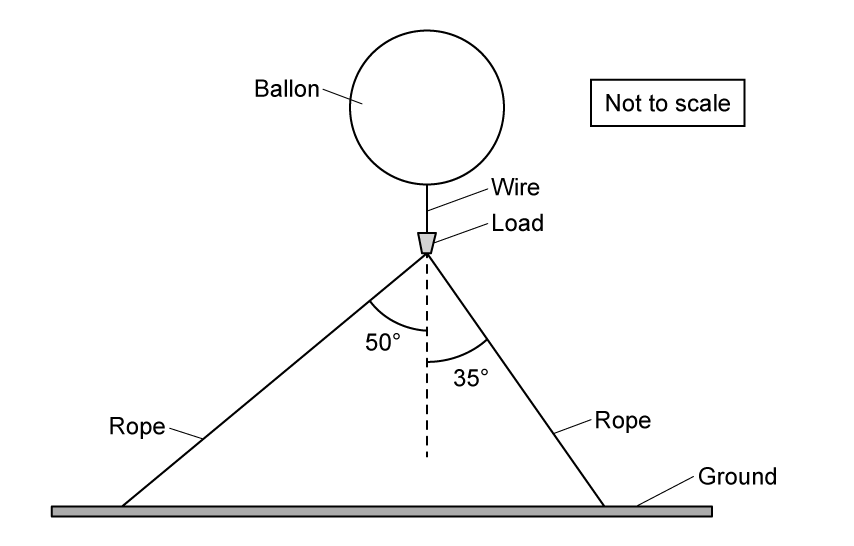
A weather balloon consists of a load hanging from a wire attached to a balloon filled with helium. Two ropes tether the load to the ground before take-off.

One rope makes an angle of 35° with the vertical, and the other rope makes an angle of 50° with the vertical, as shown.

A balloon connected to a load vertically below it by a wire, floating above horizontal ground. Two ropes hold the load to the ground, one anchored on each side. The rope on the right makes an angle of 35 degrees with a dashed vertical line and the rope on the left makes an angle of 50 degrees with the vertical.

In the arrangement shown, the balloon is stationary.

Complete the free-body force diagram to show the other two forces acting on the balloon.

An incomplete free-body diagram: a small circle representing the balloon, with a single arrow labelled weight pointing vertically downwards from the circle.
4b
4 marks

The tension in the rope at 35° to the vertical is 28 N. The tension in the rope at 50° to the vertical is 21 N.

The upthrust acting on the balloon is 120 N.

Determine the magnitude of the total weight of the balloon and the load by using a scaled vector diagram.

A blank grid of small squares for drawing a scaled vector diagram.
4c
2 marks

The ropes are then released and the balloon takes off.

On a second flight, the load is replaced with a load of greater mass. The upthrust on the balloon does not change, and the balloon still accelerates upwards when the ropes are released.

Explain the effect of this change on the initial acceleration at take-off.