Legal & Political Challenges (DP IB History: SL): Revision Note

Summary
Feminists in the 1960s and 1970s challenged authority by working within legal and political systems to overturn discriminatory laws and expand women's constitutional rights
Campaigns for the Equal Rights Amendment (ERA) aimed to amend the Constitution. They represented a direct challenge to federal and state authority and led to national political lobbying
There were strategic court cases on employment discrimination that used the Civil Rights Act (1964) and the Fourteenth Amendment to challenge workplace inequality and expand legal protections
Ruth Bader Ginsburg and the ACLU Women's Rights Project used carefully selected cases to persuade the Supreme Court to reinterpret the Constitution and establish legal precedents for gender equality
These legal and political challenges forced governments, employers, and educational institutions to address gender discrimination and contributed to significant changes in law and policy
Lobbying for the Equal Rights Amendment (ERA)
Background and origins
The Equal Rights Amendment (ERA) was originally proposed in 1923 by Alice Paul of the National Woman's Party
It gained renewed support during the Second-Wave Feminist Movement of the 1960s
Activists were seeking constitutional protection against gender discrimination
Feminists argued that existing legislation, such as the Civil Rights Act (1964), was not sufficient to protect women's rights because laws could be interpreted differently
A constitutional amendment would provide permanent legal equality
The ERA proposed that equality of rights under the law should not be denied on the basis of sex
It would require the federal and state governments to remove discriminatory legislation
Political campaign strategies
Feminist organisations lobbied members of Congress directly
They presented evidence of discrimination in:
Employment
Education
Law
They aimed to persuade lawmakers to support constitutional reform
To demonstrate public support and influence political decision-makers, activists organised:
Nationwide letter-writing campaigns
Petitions
Feminists testified before congressional committees
They used legal arguments to highlight inequality and justify constitutional reform
Campaigns were also conducted at the state level
Ratification required approval from three-quarters of the state legislatures
Key developments
In 1972, Congress passed the ERA and sent it to the states for ratification
It required approval from 38 states
Between 1972 and 1977, 35 states ratified the amendment
This demonstrated significant political support
Congress set a deadline of 1979, later extended to 1982, for ratification
Opposition and limitations
Opposition was led by Phyllis Schlafly, who founded the STOP ERA campaign in 1972
She argued that the amendment would undermine traditional gender roles
Critics claimed the ERA would:
Require women to serve in the military
Weaken family structures
Remove legal protections for women
Despite strong feminist campaigning, the ERA fell three states short of ratification and ultimately failed in 1982
How the ERA challenged authority
The ERA campaign represented a direct attempt to amend the Constitution, challenging federal and state authority over gender equality
Feminists used political lobbying to pressure lawmakers and influence public policy at both the national and state levels
Historiography
Jane Mansbridge
Why We Lost the ERA (1986)
Mansbridge argued that feminist lobbying was effective in gaining political support but ultimately failed to overcome institutional resistance and conservative backlash.
Examiner Tips and Tricks
For Paper, Question 3, you must use all of the sources to explain how different viewpoints can be used to answer the inquiry question. This means identifying what each source believes, why that perspective exists, and how the views agree or disagree.
Do not simply summarise each source one by one. Instead, compare perspectives and link them directly to the inquiry question.
The Equal Rights Amendment is especially useful because it created clear opposing perspectives in the 1970s.
Title IX campaigns
Background and legislation
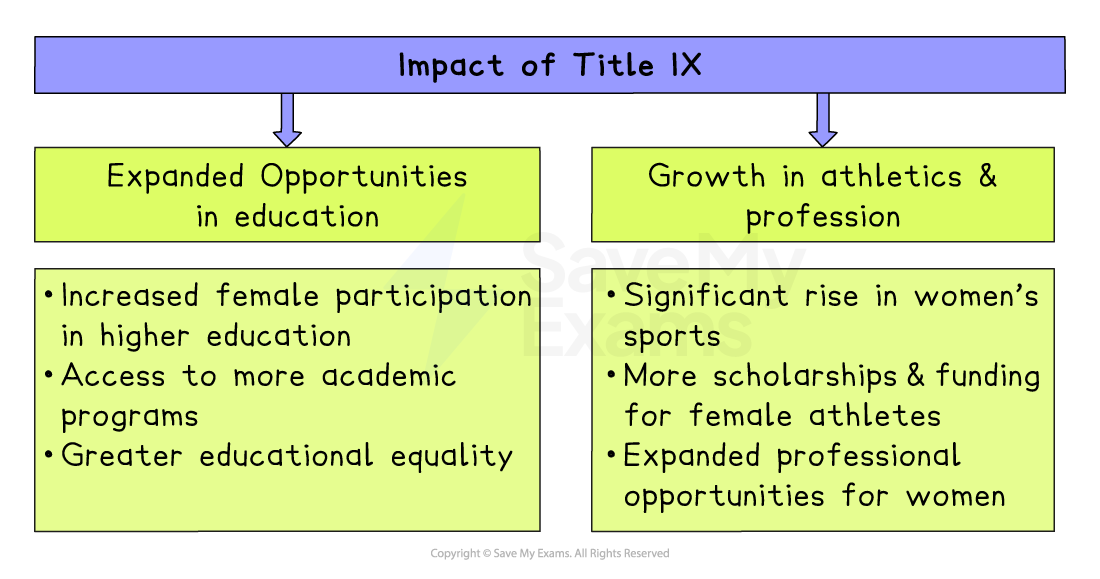
Title IX was passed as part of the Education Amendments of 1972 and prohibited sex discrimination in federally funded educational institutions
The legislation was introduced by Senator Birch Bayh and supported by Representative Patsy Mink, who played a key role in promoting gender equality in education
Feminist campaigns and pressure
Feminist organisations lobbied Congress to support Title IX and emphasised the issues of educational inequality
Activists monitored compliance
They threatened legal action against institutions that failed to implement the legislation
Groups such as the National Organization for Women (NOW) and the Women's Equity Action League (WEAL) played key roles in ensuring enforcement
Court cases on employment discrimination
Legal foundations
Feminists used Title VII of the Civil Rights Act (1964)
This prohibited employment discrimination based on sex
The Equal Protection Clause of the Fourteenth Amendment was also used to challenge gender discrimination
Feminists pressured the Equal Employment Opportunity Commission (EEOC) to enforce anti-discrimination laws
Key Supreme Court Cases
Reed v. Reed (1971)
The case challenged an Idaho law that automatically preferred men over women as estate administrators
The Supreme Court ruled that this discrimination violated the Equal Protection Clause
This was the first time the Court ruled against gender discrimination
Frontiero v. Richardson (1973)
The case involved a female Air Force officer who was denied spousal benefits available to male officers
The Supreme Court ruled the policy unconstitutional, expanding legal equality
Weinberger v. Wiesenfeld (1975)
A widower challenged Social Security rules that denied benefits t
o men
The Court ruled that the policy discriminated based on gender
Examiner Tips and Tricks
In Paper 1 or 3 analysis, the sequence of Reed v. Reed (1971), Frontiero v. Richardson (1973), and Weinberger v. Wiesenfeld (1975) can be used together to show how Supreme Court rulings gradually built legal precedent against gender discrimination.
Historiography
Cynthia HarrisonOn Account of Sex (1988)
Harrison argued that government institutions, federal agencies, and courts became crucial battlegrounds for women’s rights.
Ruth Bader Ginsburg and the ACLU Women's Rights Project
Background
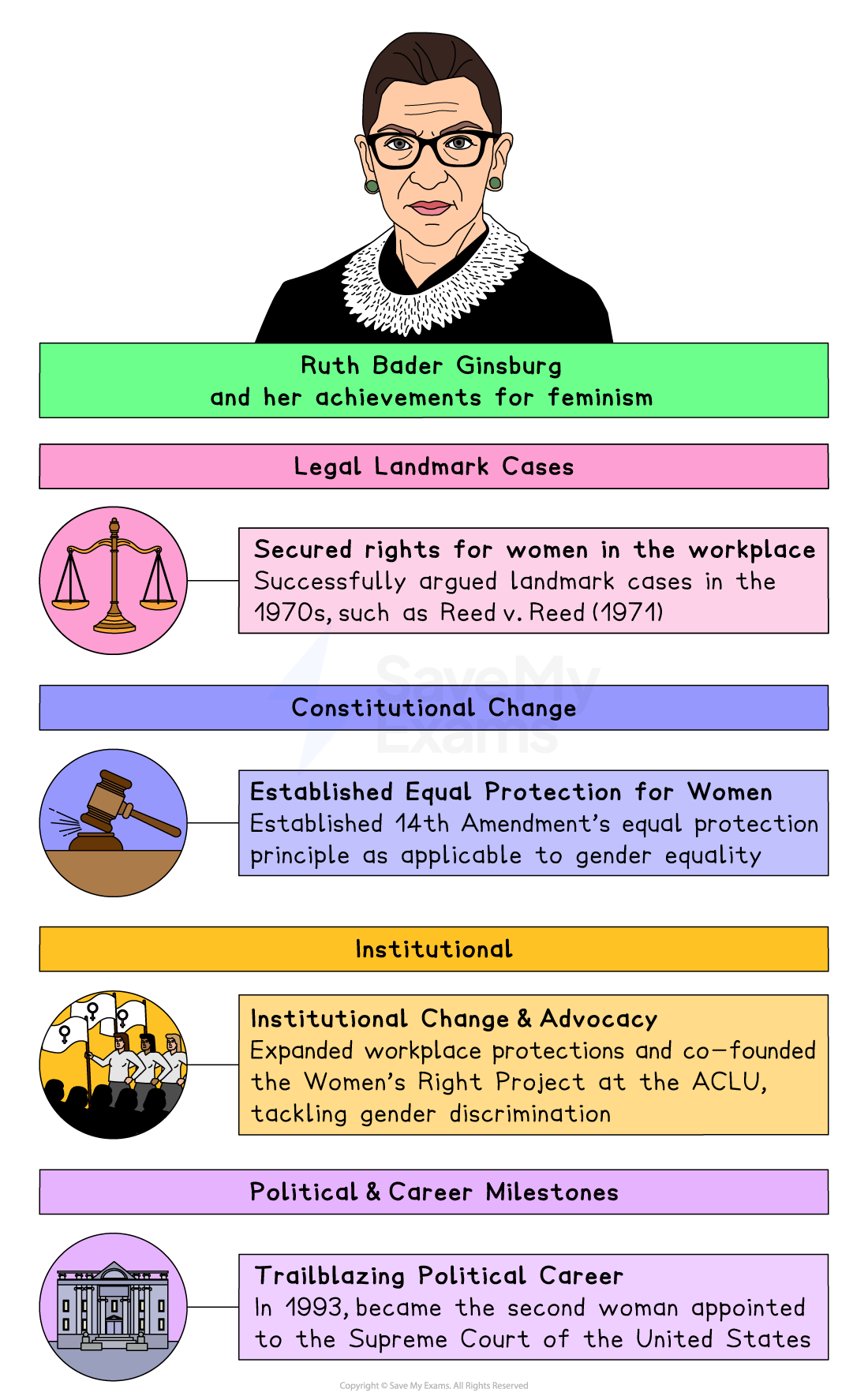
Ruth Bader Ginsburg was a law professor and feminist legal advocate who
She was a leading figure in legal challenges to gender discrimination
In 1972, she founded the ACLU Women's Rights Project to coordinate legal challenges
Strategic litigation
Ginsburg selected cases carefully to build legal precedent gradually
She sometimes used male plaintiffs to demonstrate that gender discrimination affected both sexes
Historiography
Jane Sherron De Hart
Ruth Bader Ginsburg: A Life (2018)
De Hart argues that Ginsburg transformed women’s rights by using the courts as a political arena, making constitutional equality achievable through litigation rather than protest alone.
She notes that Ginsburg deliberately chose cases involving both male and female plaintiffs to show that gender stereotypes harmed everyone.
Impact
Ginsburg argued multiple Supreme Court cases during the 1970s
These cases expanded Equal Protection rights and strengthened legal equality

Unlock more, it's free!
Join the 100,000+ Students that ❤️ Save My Exams
the (exam) results speak for themselves:

Was this revision note helpful?