Limitations & Critiques of the Feminist Movement (DP IB History: SL): Revision Note

Summary
Despite achieving major legal and political reforms, the feminist movement of the 1960s–70s faced significant limitations
The movement was often dominated by white, middle-class women, meaning that the experiences of working-class women and African American Women were not fully represented
Divisions between liberal feminists and radical feminists weakened unity and reduced the effectiveness of campaigns
Economic inequality persisted despite legal reforms, demonstrating that changes in law did not immediately translate into real-life equality
Opposition movements, particularly against the Equal Rights Amendment, limited the success of feminist political goals
Political limitations
Failure of the Equal Rights Amendment (ERA)
The Equal Rights Amendment was one of the most important goals of the feminist movement but ultimately failed to be ratified
It was passed by Congress in 1972, but did not gain the required 38 state ratifications
This failure demonstrated the limits of feminist influence within the political system
Historiography
Jane Mansbridge
Why We Lost the ERA (1986)
Mansbridge argued that the failure of the Equal Rights Amendment reflected both conservative mobilisation and feminist strategic weaknesses.
Conservative opposition
Opposition to feminist reforms was led by figures such as Phyllis Schlafly
She argued that feminism threatened traditional family structures
Campaigns such as STOP ERA led to support against feminist goals and slowed political progress
This resistance highlighted the persistence of traditional gender attitudes in American society
Limited political representation
Although women’s representation in politics increased, it remained relatively low throughout the 1970s
Political institutions continued to be dominated by men
This limited the extent of feminist influence
Economic inequalities
Persistence of the gender wage gap
Despite the Equal Pay Act of 1963, women continued to earn significantly less than men throughout the 1970s
On average, women earned around 60% of male wages in the early 1970s
This indicated that legal reforms had limited immediate impact
Occupational segregation
Women remained concentrated in lower-paid, lower-status jobs, such as:
Clerical work
Retail
Service industries
Access to higher-paying professions improved but remained limited, particularly for minority and working-class women
This highlighted the gap between legal equality and economic reality
Limited impact for working-class women
Many working-class women were already part of the workforce before the feminist movement gained momentum
Their main concerns were not always prioritised by mainstream feminist organisations, including:
Low wages
Job security
Childcare
As a result, economic improvements were uneven across different social groups
Unequal representation
Dominance of white middle-class women
The leadership of many major feminist organisations, such as the National Organization for Women (NOW), was largely composed of white, middle-class women
Their priorities often reflected their own social and economic positions
As a result, issues such as professional advancement, workplace discrimination, and legal equality were prioritised over concerns affecting poorer or minority women
This led to criticism that mainstream feminism did not fully represent the diversity of women’s experiences
Experiences of Black women
Black women often faced both racial and gender discrimination, which were not always addressed by mainstream feminist campaigns
Some Black women criticised the movement for focusing primarily on gender inequality without considering racism and economic inequality
The National Black Feminist Organization (1973) was formed to address these concerns and highlight the specific experiences of Black women
Historiography
Angela Davis
Women, Race and Class (1981)
Davis argued that many feminist campaigns failed to address the interconnected nature of race, class, and gender oppression.
Intersectional critiques
The Combahee River Collective (founded 1974) argued that systems of oppression such as racism, sexism, class inequality, and homophobia were interconnected
In its 1977 statement, the Collective criticised both feminist and civil rights movements for failing to fully address the needs of Black women
These critiques demonstrated that feminism was not a unified movement
The internal divisions limited its effectiveness
“Black women are systematically left out of both the feminist movement, which has been primarily white, and the Black liberation movement, which has been primarily male… the major systems of oppression are interlocking.”
Extract from The Combahee River Collective Statement (1977)
Divisions within the movement
Liberal vs radical feminism
Liberal feminists focused on legal and political reform
They worked within existing systems to achieve equality
Radical feminists argued that deeper structural change was needed
They criticised institutions such as the family, marriage, and capitalism
These differing approaches created divisions that weakened the overall movement
Fragmentation of the movement
The emergence of multiple feminist groups with different priorities led to a lack of unity
Disagreements over strategy, goals, and ideology made it more difficult to present a unified challenge to authority
Historiography
Alice Echols
Daring to Be Bad: Radical Feminism in America 1967–1975 (1989)
She argues that internal divisions between liberal and radical feminists weakened the movement
Cultural resistance
Persistence of traditional gender roles
Despite feminist activism, traditional ideas about women’s roles in the family and workplace remained influential
Many Americans continued to support conventional gender norms, limiting the impact of feminist reforms
Negative media portrayals
Mass media sometimes portrayed feminists as extreme, aggressive, or anti-family
These portrayals reduced public support and reinforced stereotypes about the movement
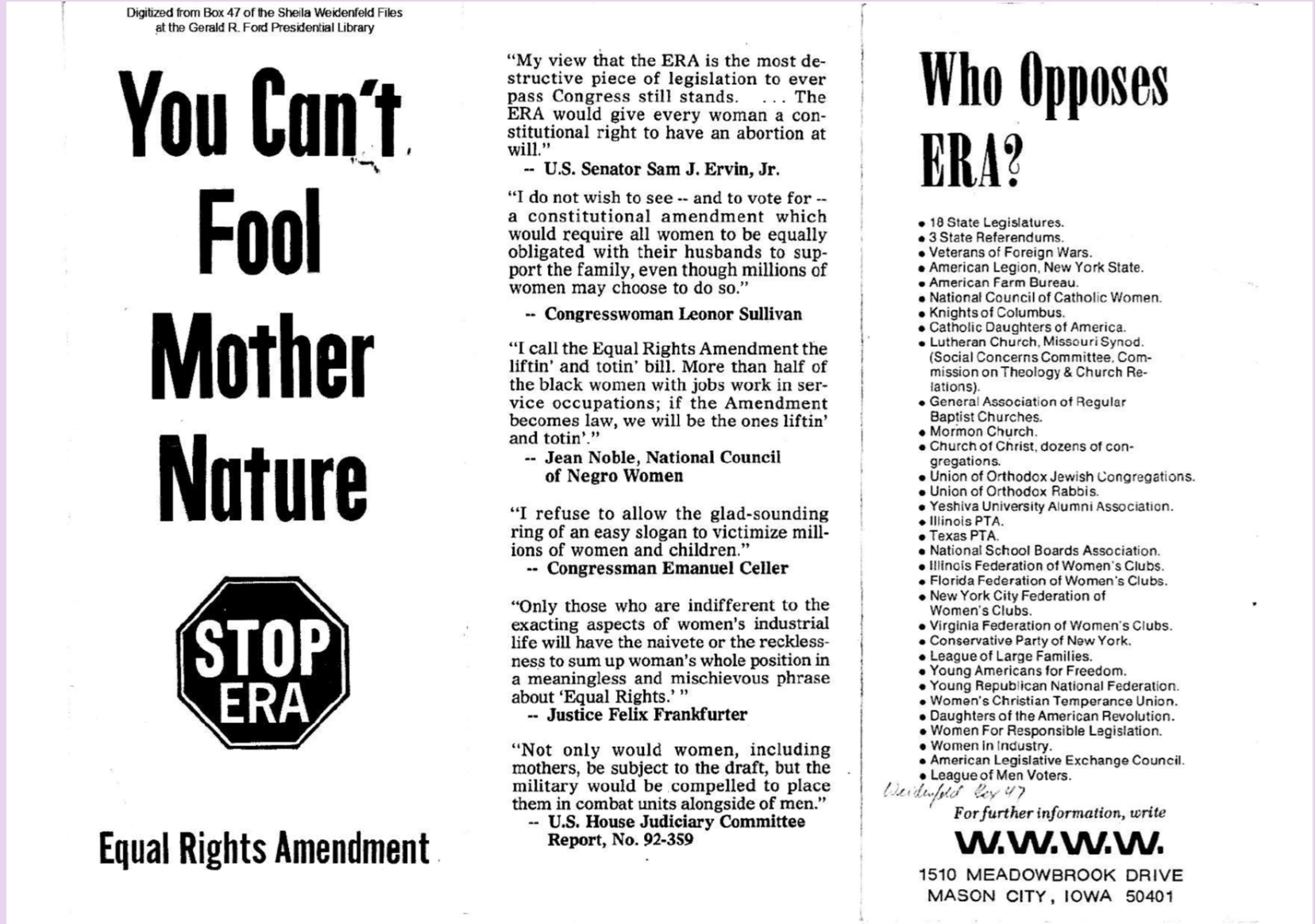
Anti-ERA Campaign Pamphlet, circa 1970s, by Women Who Want to Be Women (W.W.W.W.)
Overall impact
The feminist movement achieved significant legal and political reforms
Important legislation such as the Civil Rights Act of 1964 (Title VII), and Supreme Court rulings such as Roe v. Wade (1973) expanded women's rights
These reforms demonstrated the movement’s success in challenging institutional authority
Feminists were able to influence Congress, the Supreme Court, and federal agencies, leading to long-term changes in American law and policy
The impact of these reforms was uneven and often limited in practice
Legal equality did not automatically result in social or economic equality, particularly in areas such as wages, job opportunities, and workplace conditions
Examiner Tips and Tricks
In essay questions, you are required to analyse different 'perspectives' on a topic to gain higher marks.
In this case, it means giving a balanced argument and analysing both the achievements and limitations of the feminist movement.

Unlock more, it's free!
Join the 100,000+ Students that ❤️ Save My Exams
the (exam) results speak for themselves:

Was this revision note helpful?
