The Changing Role of Women: Increased Employment (DP IB History: SL): Revision Note

Summary
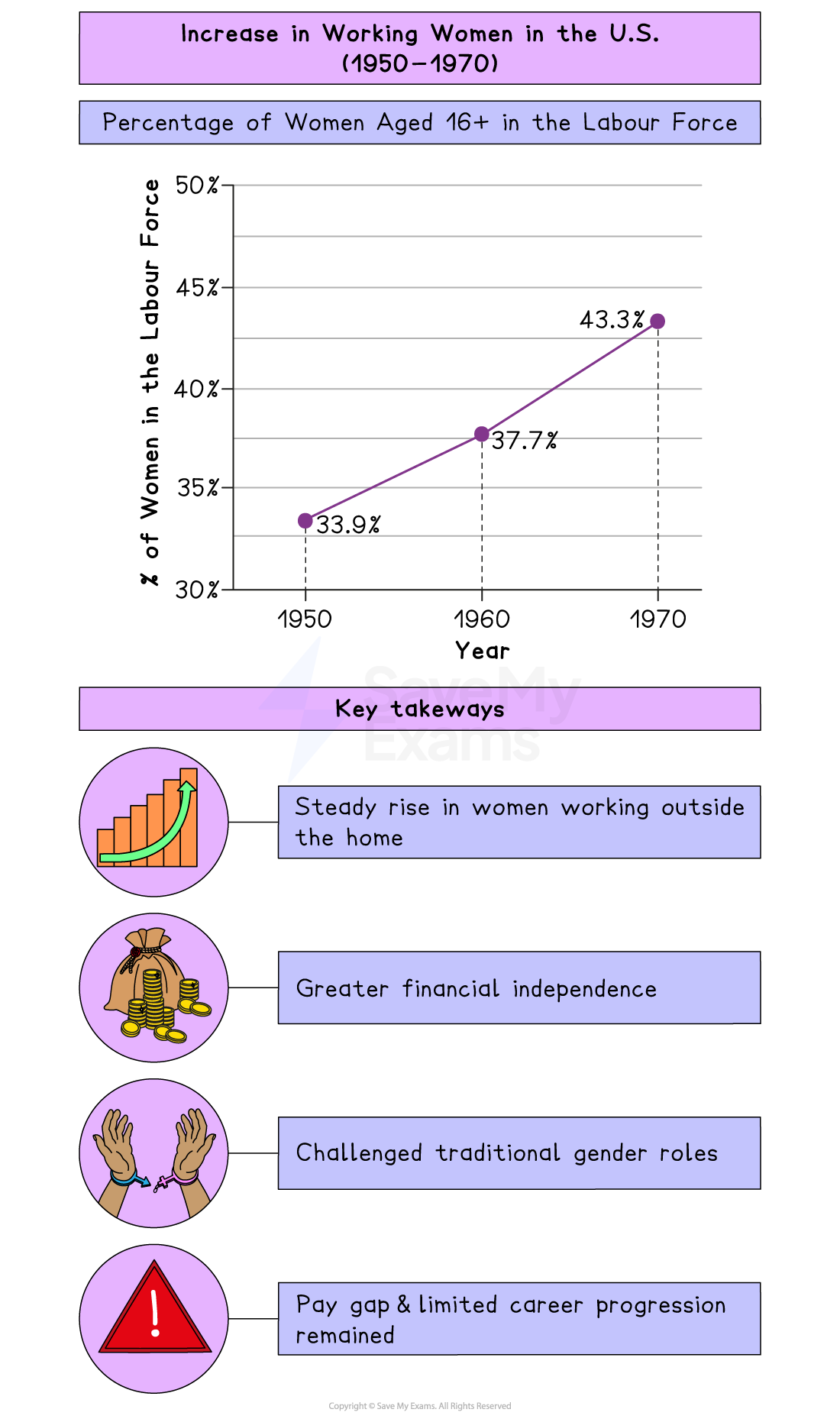
The 1960s and 1970s saw a significant rise in female employment in the United States, which became a key factor in the emergence of second-wave feminism
By 1970, approximately 43% of women were in the workforce, compared to about 30% in 1950, demonstrating a clear long-term shift in women’s roles
This increase was especially among married and middle-class women, reflecting changing social and economic conditions such as rising living costs and expanded access to education
As more women worked outside the home, traditional expectations that women should remain full-time homemakers were increasingly challenged
Greater participation in the workforce
Clerical work
A large proportion of employed women worked in clerical roles such as secretaries, typists, and receptionists
These were considered suitable “female” jobs
By 1970, over 70% of clerical workers were women
This shows strong gender concentration in this sector
A woman working as a secretary in a corporate office would often manage schedules and correspondence for male executives but would have little authority or opportunity for promotion
Teaching
Teaching, particularly at elementary and secondary levels, was another major profession for women
It was in line with the traditional ideas of women as caregivers
Although women dominated classroom teaching, men were far more likely to hold senior positions such as principals or administrators
Nursing
Nursing was a common career for women
Like teaching, it was viewed as an extension of domestic caregiving roles
Women made up the majority of nurses in hospitals
Higher-status and better-paid roles, such as doctors and surgeons, remained male-dominated
For example, a woman could work as a registered nurse but would face significant barriers if she attempted to enter medical school or become a senior consultant
Examiner Tips and Tricks
In both your Paper 1 and Paper 3, you need to link increased employment to a greater awareness of inequality and motivation for activism.
Use specific examples, such as clerical workers facing wage discrimination or teachers blocked from promotion.
Include both opportunities (independence) and limitations (barriers) to reach top-level analysis.
How increased employment affected independence
Economic independence
Paid employment allowed women to earn their own income
This reduced their financial dependence on husbands or fathers
This increased independence enabled women to participate more actively in financial decision-making within the household
Changing family roles
Employment contributed to shifts in family patterns, including later marriage and smaller family sizes
Women increasingly viewed themselves as individuals with personal ambitions, rather than being defined solely by their roles as wives and mothers
Increased awareness of inequality
Workplace experiences exposed women to discrimination, making inequalities more visible and harder to ignore
Women became aware that they were often paid less than men and had fewer opportunities for advancement
Historiography
Susan WareAmerican Women Since 1945 (1986)
Ware argued that by the 1970s, women’s employment had become normalised in American life, although discrimination in pay and promotion remained widespread.
She emphasised that feminist activism helped turn workforce participation into a political issue.
How did this independence lead to the feminist movement?
Increased employment played a crucial role in the development of feminist activism by highlighting systemic inequalities in the workplace
Women’s shared experiences of discrimination helped to create a collective identity and a sense of injustice
Many women became involved in activist organisations such as the National Organization for Women
This organisation campaigned for equal opportunities and an end to workplace discrimination
Feminists pushed for legal reforms, including equal pay and anti-discrimination laws, using protests, lobbying, and court cases
What barriers remained?
Wage gap
Women in the 1960s typically earned around 60% of men’s wages
This demonstrated a significant and persistent pay gap
Even full-time working women remained financially disadvantaged compared to men
Limited career progression (glass ceiling)
Although women entered the workforce in greater numbers, they faced significant barriers to promotion into senior roles
This “glass ceiling” prevented women from advancing beyond lower- and mid-level positions
For example, women dominated teaching roles but were rarely promoted to become principals, while men advanced more easily
Lack of women in positions of power
Women were significantly underrepresented in leadership roles in business, government, and education
Decision-making positions remained overwhelmingly male-dominated, limiting women’s influence over policy and workplace practices
Occupational segregation
Employment remained strongly divided along gender lines, with women concentrated in lower-paid, lower-status jobs
Professions such as law, engineering, and senior medical roles were dominated by men, while women were concentrated in teaching, nursing, and clerical work
This reinforced traditional gender stereotypes and limited women’s opportunities for advancement

Unlock more, it's free!
Join the 100,000+ Students that ❤️ Save My Exams
the (exam) results speak for themselves:

Was this revision note helpful?
