Polynomial Functions (DP IB Analysis & Approaches (AA): HL): Exam Questions

4 hours31 questions
1a
4 marks

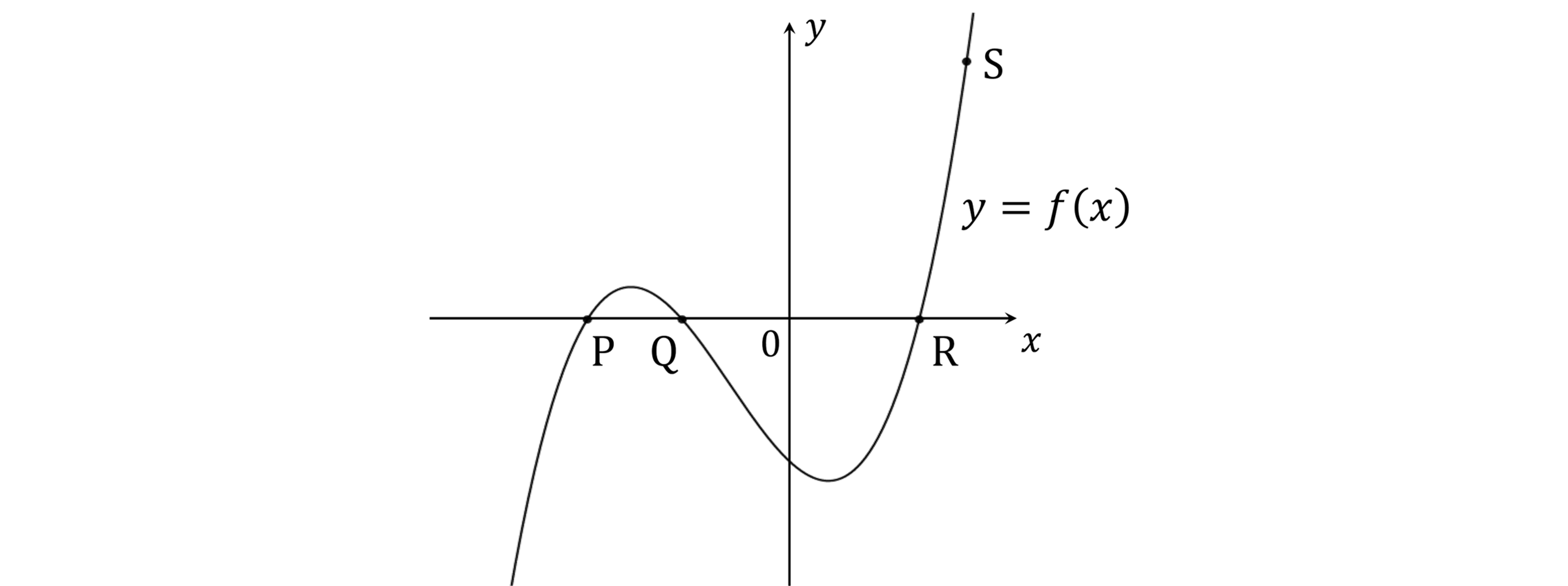
Below is the graph of a function f(x)=ax3+bx2+cx+d,  passing through the points P(−3,0), Q(−2,0), R(12, 0) and S(2, 60).

Polynomial functions Medium Q1

Find the values of a, b, c and d.

1b
2 marks

The function is translated vertically by the vector (0k) so that it passes through the point (3,190).  

Find the value of k.

2
6 marks

Let a function f be defined by f(x)=2x3+7x2−3x−18. 

(i) Show that (x+3) is a factor of f(x).

(ii) Hence factorise f(x) fully.

(iii) Write down all the solutions to 2x3+7x2−3x−18=0.

3a
4 marks

Factorise fully 6x3+x2−12x+5.

3b
6 marks

f(x)=ax3+(5a−2)x2+(4a+2)x−2a 

(i) Given that (x+3) is a factor of f(x), find a. 

(ii) Hence factorise f(x) fully.

4a
2 marks

Consider the polynomial g(x)=3x5−25x4+72x3−72x2−16x+48.

Show that 2 is a root of g(x).

4b
5 marks

Given that 2 is a root of g(x) with multiplicity 3, factorise g(x) fully and hence state the other two roots.

5
4 marks

Consider the function f(x)=4x3+6x2−7x+2.

(i) Find the quotient and remainder when 4x3+6x2−7x+2 is divided by (x−2). 

(ii) Hence write  4x3+6x2−7x+2 in the form (x−2)(ax2+bx+c)+d, where a, b, c and d are constants to be determined.

6a
4 marks

The function f(x)=2x3−5x2+ax+b  has (2x+3) as a factor, and when f(x) is divided by (x−2) the remainder is 7. 

Show that a and b must satisfy the simultaneous equations:  

2a+b=11

3a−2b=−36

6b
2 marks

Hence find a and b.

7
5 marks

Given that 3+2i is one of the roots of the equation x3−3x2−5x+39=0, find the other two roots.

8a
4 marks

For each of the following polynomials, find the sum of the roots and the product of the roots. 

(i)  f(x)=9x4+7x3−3x+2  

(ii) g(x)=7x5−x4+2x3+x2−5x+14 

(iii) h(x)=2x3−5x2−3x 

(iv)  j(x)=−3x4+2x2+5x−3

8b
5 marks

Consider the equation 6x3−4ax2−(a+2)x=0.

Given that the sum of the roots is 83, find the three roots of the equation.

9
4 marks

For the function  f(x)=ax4+bx3−x2−24x−(5b+1),  the sum of the roots is −72 and the product of the roots is −18.  
Find the values of a and b.

10a
2 marks

The function f(x)=(x−3)(x2+3x−4)(ax2+bx+c) has three real roots and two non-real roots.

Find the three real roots.

10b
5 marks

It is given for f(x) that the sum of the roots is −32 and the product of the roots is −60.

Find the two non-real roots, giving your answers in exact form.

10c
4 marks

Given that f(2)=−144, find the values of a, b and c.

11a
2 marks

α and β are non-real roots of the equation x2+3kx+2k+1=0, where k>0 is a constant.

Find α+β and αβ, in terms of k.

11b
2 marks

Given that α2+β2=3, show that (α+β)2=4k+5.

11c
3 marks

Hence find the value of k.

12a
2 marks

Consider the function f(x)=kx3+3x2+11x+3k,  where k is a constant.

It is given that (2x−1) is a factor of f(x). 

Find the value of k.

12b
3 marks

Fully factorise f(x).

12c
3 marks

Hence sketch the graph of y=f(x) .
Clearly label the coordinates of any points where the graph intersects the coordinate axes.

13a
4 marks

Consider the function f(x)=3x3+px2+22x+q,  where p and q are constants.  It is given that (x2−x+6) is a factor of f(x).

Find the values of p and q.

13b
3 marks

Find the roots of f(x).

14
6 marks

Given that (x+4) is a factor of the function f(x)=px3+(5p+1)x2+5qx−2q−2 and that the remainder when f(x)  is divided by (x+1) is −12,  find the values of the constants p and q.

15
4 marks

Express 3x3+16x2−22x in the form (3x+1)(ax2+bx+c)+d, where a, b, c and d are constants to be found.

16
7 marks

Consider the function g defined by g(x)=ax3+4bx2+(4a−3)x−3b,  where a, b∈ℝ are constants.

Given that (x−3) is a factor of g(x), and that the sum of the roots of the equation g(x)=0 is 5, 

(i) find the values of a and b, and

(ii) hence factorise g(x) fully.

1a
5 marks

34 is a zero of the function f(x)=4x3−19x2+kx−12, where k is a constant.

Find the value of k and hence find all the solutions to the equation f(x)=0.

1b
3 marks

Sketch the graph of y=f(x), clearly indicating the coordinates of any points where the graph meets the coordinate axes.

1c
2 marks

The point (76,125108)  is a turning point on the graph y=f(x).

Given that f(x)=p  has three distinct real solutions, where p is a real constant, find the set of possible values of p.

2a
3 marks

The graph of y=f(x) is shown below, where f(x) is a polynomial function. The graph passes through the points A(−3, 0), B(12, 0) and C(1, −12).

q3a_2-7_polynomial-functions_hard_ib_aa_hl_maths-dig

Given that the degree of f is as small as possible, find an expression for f(x).

2b
3 marks

The graph is translated by the vector (k0)  to form the graph y=g(x), where k is a constant and g(x) is a polynomial.

Given that x is a factor of g(x), find the possible values of k.

3
6 marks

For the function f(x)=(3x−1)(x2+x−1)(ax2+bx+c), the sum of the roots is 13 and the product of the roots is −3136. 
Find all five roots of f(x).

4
6 marks

α and β are non-real solutions of the equation 2x2−(2k−3)x+2k=0. 
Given that  α2+β2=94 and k≠0,  find the value of k.

5
6 marks

The function f(x)=x2−mx+3m−4 has two integer solutions, one of which is double the other one. 

Find the value of m.

6a
2 marks

Consider the function f(x)=px6+qx4+rx2+1, where p, q and r are real constants.

Show that if α is a zero of f(x) then −α is also a zero.

6b
4 marks

Given that 5 and −7−6i are roots of the equation f(x)=0, find the value of p.

7a
6 marks

Let f be a polynomial defined by f(x)=8x3−24x2−72x+385.

Show that:

(i) (2x+7) is a factor of f(x),

(ii) f(x)=0 has exactly one real root.

7b
4 marks

Consider the function g defined by g(x)=f(x)+k, where k is a real constant.

Given that the equation g(x)=0 has three distinct real roots, find the set of possible values of k.

8a
5 marks

Consider the function f(x)=2x6−5x5+px4+qx3−2x2+20x−8, where p and q are constants.  It is given that (x2−x−2) is a factor of f(x).

Show that p=8  and find the value of q.

8b
6 marks

Given that −2i is a root of f, find all of the roots of the equation f(x)=0.

9a
2 marks

Consider the function

f(x)=∑r=0narxr

where ar∈ℝ for r=0, 1, …, n.

The graph of y=f(x), shown below, passes through A(0, 18). The roots of f(x) are 32, −1, i and −i.

q2a_2-7_polynomial-functions_very_hard_ib_aa_hl_maths-diagram

Explain why n must be even.

9b
4 marks

Given that n is as small as possible, find an expression for f(x).

10
7 marks

Consider the function f defined by f(x)=(2x3+9x2+4x−15)(mx2+nx+p), where m, n and p are real constants.

It is given that the sum of the roots of the equation f(x)=0 is −416, and that the product of the roots is 252.

Find one possible set of integer values of m, n and p.

11a
6 marks

The equation x2+(k−1)x−2k=0, k∈ℝ has non-real roots α and β where  α3+β3=5. 

Find the value of k.

11b
2 marks

The equation x2+px+q=0  has roots α3 and β3.

Find the values of p and q.

1a
4 marks

A polynomial function f is defined by f(x)=k(m−x)3(n−x)2, where k, m and n are positive constants with n>m.

Sketch the graph of y=f(x). Label the coordinates of any points where the graph meets the coordinate axes.

1b
1 mark

Determine the maximum number of distinct real solutions to the equation f(x)=p, where p is a real constant.

1c
3 marks

Consider the function g(x)=f(ax+b), where a and b are positive constants. The points (0,0) and (1,0) lie on the graph y=g(x).

Find a and b in terms of m and n.

2a
2 marks

Consider the polynomial function defined by

f(x)=∑r=05arxr, 

where the ar are real constants. The function has the property that f(−x)=−f(x) for all values of x.

Show that a0=a2=a4=0.

2b
6 marks

Given that −2+3i is a root of the equation f(x)=0,

(i) show that 2−3i is also a root of f(x)=0, and

(ii) hence find the values of a1 and a3 in terms of a5.

3a
7 marks

Consider the polynomial function f(x)=x4+ax3+bx2+cx+d, where a, b, c, d∈ℝ.

Two distinct roots of f(x)=0 are given by k+k2i and k2+ki, where k is a real constant.

The remainder when f(x) is divided by x is 8100.

(i) Find the two possible values of k.

(ii) Hence find the values of p and q such that x2+px+q is a factor of f(x) for both values of k.

3b
4 marks

Given that a=−12 , find the values of b and c.

4a
4 marks

The polynomial function f is defined by

f(x)=2ax3+(4+2a−a2)x2−(6+2a+a2)x+3a 

where a≠0 is a real constant. 

The graph of y=f(x) only intersects the x-axis at the point (a2, 0).

By considering the sum of the roots, use proof by contradiction to show that f(x)=0 has two non-real roots.

4b
5 marks

Find the set of possible values of a.