Modulus Functions (DP IB Analysis & Approaches (AA): HL): Revision Note

Dan Finlay

Written by: Dan Finlay

Reviewed by: Mark Curtis

Updated on

Modulus functions & graphs

What is the modulus function?

  • The modulus function (or absolute value function) is defined by f(x)=|x|

    • which gives the positive distance (or size) of a real number x from zero

    • e.g.

      • |3|=3

      • |2|=2

      • |0|=0

  • It can also be defined as

    • |x|={xx0xx<0

    • or |x|=x2

  • Its largest domain is the set of all real values

    • and its range is the set of all real non-negative values

Examiner Tips and Tricks

It is common quick way of saying y=|x| is "y equals mod x".

How do I sketch the modulus function?

  • The graph of y=|x| is the line y=x for x0

    • and y=x for x<0

      • giving it a V-shape

      • with its vertex at the origin

  • The function is continuous

    • but not differentiable at x=0

      • as no gradient exists there

2-4-2-ib-aa-hl-modulus-function

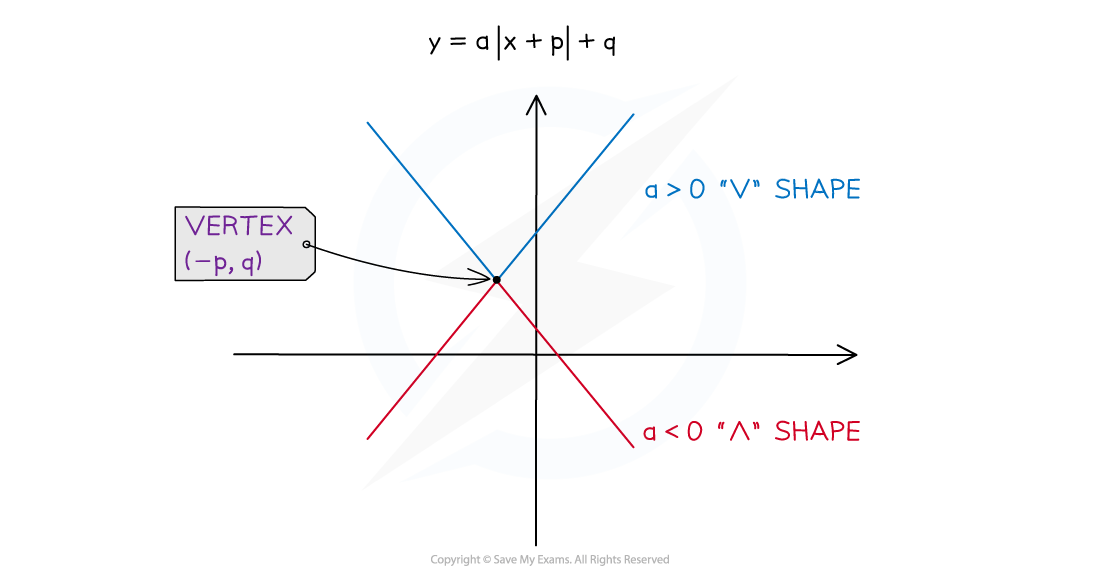
How do I sketch y = a|x + p| + q?

  • The graph of y=a|x+p|+q is a transformation of the graph y=|x| as follows:

    • First, apply a vertical stretch of scale factor a to y=|x|

      • y=a|x|

    • Secondly, apply a translation of (pq)

      • y=a|x+p|+q

  • This transforms the vertex (0, 0) on y=|x| to

    • the new vertex at (p, q) on y=a|x+p|+q

Examiner Tips and Tricks

A lot of students get the sign of p wrong when finding the vertex coordinates (p, q) from y=a|x+p|+q.

  • Note that

    • a>0 means a shape

      • the bigger a the steeper the

    • a<0 means a shape

      • the more negative the a the steeper the

Graph of transformed modulus function y = a|x + p| + q showing vertex at (-p, q), with 'V' shape for a>0 and '∧' shape for a<0. Axes included.

How do I rearrange a graph into the form y = a|x + p| + q?

  • Two useful modulus relations for rearranging are

    • |ab|=|a||b|

    • |ab|=|ba|

  • e.g. y=|62x|+1 can be rearranged as follows:

    • y=|2x6|+1

      • using |ab|=|ba|

    • y=|2(x3)|+1

      • by factorisation

    • y=|2||(x3)|+1

      • using |ab|=|a||b|

    • |2|=2 and |(x3)|=|x3| giving

      • y=2|x3|+1

Unlock more, it's free!

Join the 100,000+ Students that ❤️ Save My Exams

the (exam) results speak for themselves:

Build on this topic

Dan Finlay

Author: Dan Finlay

Expertise: Portfolio Lead

Dan graduated from the University of Oxford with a First class degree in mathematics. As well as teaching maths for over 8 years, Dan has marked a range of exams for Edexcel, tutored students and taught A Level Accounting. Dan has a keen interest in statistics and probability and their real-life applications.

Mark Curtis

Reviewer: Mark Curtis

Expertise: Maths Content Creator

Mark graduated twice from the University of Oxford: once in 2009 with a First in Mathematics, then again in 2013 with a PhD (DPhil) in Mathematics. He has had nine successful years as a secondary school teacher, specialising in A-Level Further Maths and running extension classes for Oxbridge Maths applicants. Alongside his teaching, he has written five internal textbooks, introduced new spiralling school curriculums and trained other Maths teachers through outreach programmes.