Angle Between Two Lines (DP IB Analysis & Approaches (AA): HL): Revision Note

Amber

Written by: Amber

Reviewed by: Dan Finlay

Updated on

Angle between two lines

How do we find the angles between two lines?

  • The angles between two lines are equal to the angles between their direction vectors

    • They can be found using the scalar product of their direction vectors

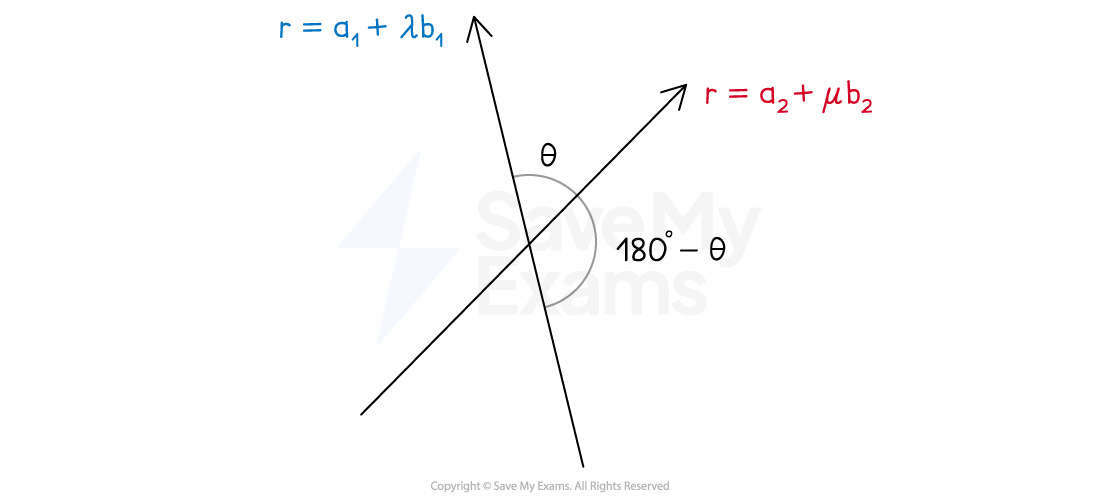
  • The intersection of two lines will always create two pairs of equal angles

    • one pair are acute

    • the other are obtuse

Intersecting lines with angles theta and 180 minus theta, labelled as r equals a1 plus lambda b1 and r equals a2 plus mu b2 in blue and red text.
Angles between two lines
  • You can find one angle between r=a1+λb1 and r=a2+λb2 using θ=cos1(b1 · b2|b1|| b2|)

  • You can find the other angle by subtracting this from 180°

    • Or from π if you are working in radians

  • The sign of the scalar product determines whether θ is acute or obtuse

    • It is acute if the scalar product is positive

    • It is obtuse if the scalar product is negative

  • You can always find the acute angle first by taking the absolute value of the scalar product

    •  cos1(|b1 · b2||b1|| b2|)

Worked Example

Find the acute angle, in radians between the two lines defined by the equations:

l1:  r=(20 3 )+λ(14 3 ) and  l2:  r=(143)+μ( 3 25)

Answer:

R_UZJlZ8_3-10-3-ib-aa-hl-angle-between-we-solution-2a

Unlock more, it's free!

Join the 100,000+ Students that ❤️ Save My Exams

the (exam) results speak for themselves:

Build on this topic

Amber

Author: Amber

Expertise: Maths Content Creator

Amber gained a first class degree in Mathematics & Meteorology from the University of Reading before training to become a teacher. She is passionate about teaching, having spent 8 years teaching GCSE and A Level Mathematics both in the UK and internationally. Amber loves creating bright and informative resources to help students reach their potential.

Dan Finlay

Reviewer: Dan Finlay

Expertise: Portfolio Lead

Dan graduated from the University of Oxford with a First class degree in mathematics. As well as teaching maths for over 8 years, Dan has marked a range of exams for Edexcel, tutored students and taught A Level Accounting. Dan has a keen interest in statistics and probability and their real-life applications.