Inverse Functions (DP IB Analysis & Approaches (AA): HL): Revision Note

Inverse functions
What is an inverse function?
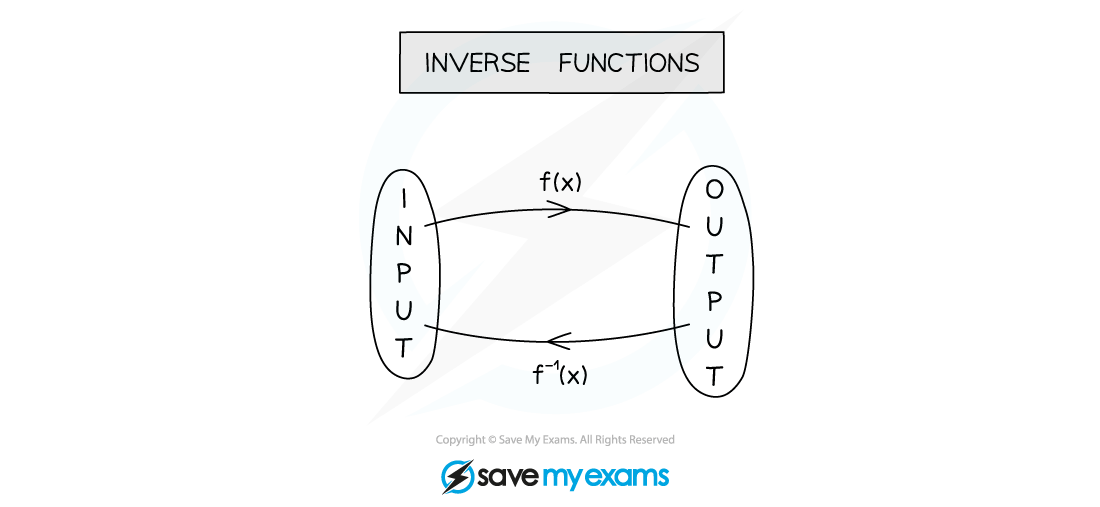
An inverse function, , reverses (or undoes) the effect of
for example
if then
if then
Inverse functions can be used to solve equations
e.g. the solution of is
Examiner Tips and Tricks
Note that the inverse function is not the same as the reciprocal of the function .
What is the identity function?
The identity function maps each value to itself
e.g.
Applying a function to an input
then applying the inverse,
gives back the original input
This also works if you swap the order of and
i.e. the composite function
has the same effect as the identity function
How do I sketch an inverse function?
The graph of is a reflection of the graph in the line
e.g. if and
then and
which reflect in
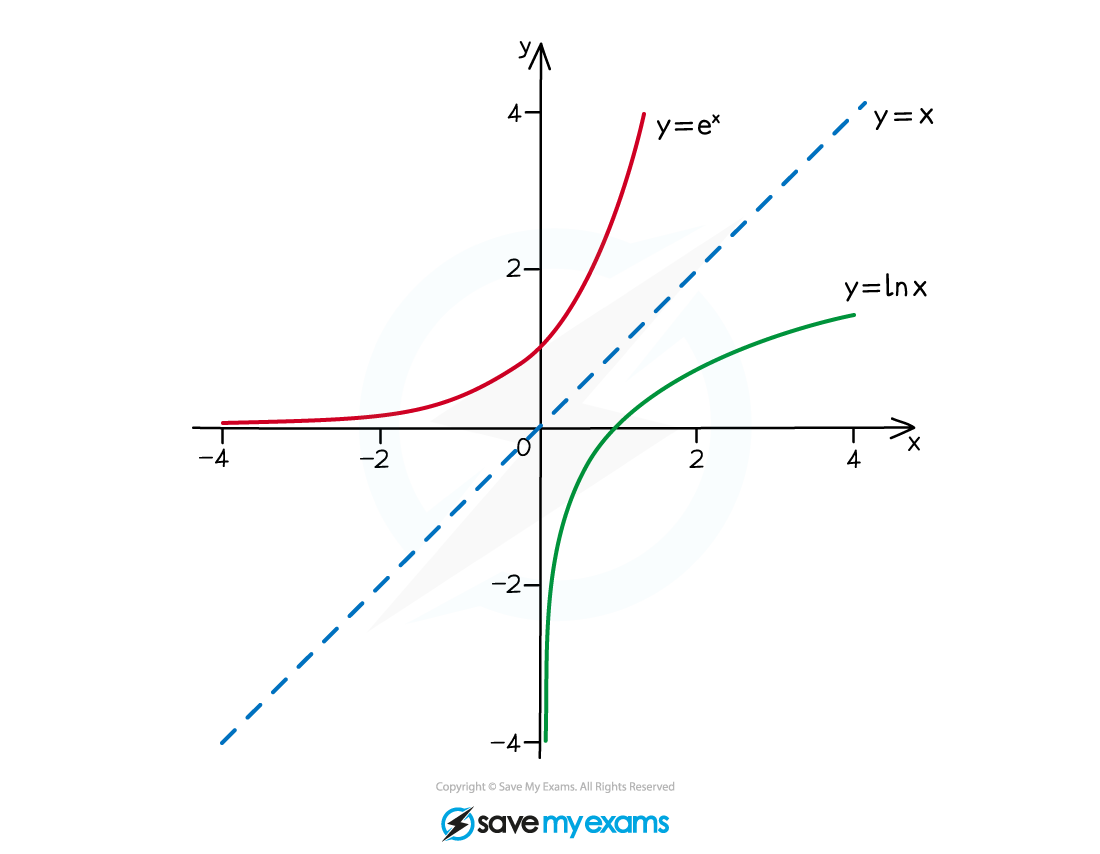
If intersects then also intersects at the same point
i.e. solutions to either or
are solutions to
There may be other solutions to that don't lie on the line
How do I find the inverse of a function?
To find the inverse function using algebra, following these steps:
STEP 1
Swap the and inSTEP 2
Rearrange to make the subjectThe result is
How do I find the domain and range of an inverse function?
The domain of a function becomes the range of its inverse
e.g. if has domain
then the range of is
The range of a function becomes the domain of its inverse
e.g. if has range
then the domain of is
What condition is needed for an inverse function to exist?
For an inverse function to exist
the original function must be one-to-one
This ensures never gives out two or more outputs
which functions are not allowed to do
How do I restrict many-to-one functions to be one-to-one?
To restrict the domain of a many-to-one function
choose a subset of the domain on which the function is one-to-one
e.g. restrict for the function to
or or or ... etc
To find the biggest possible one-to-one domain:
For quadratics
use the vertex as the upper or lower bound for the restricted domain
e.g.
or
e.g.
or
For trigonometric functions
use part of a cycle
e.g.
e.g.
e.g. restrict the domain to one cycle between two asymptotes
How do I find the inverse function of a restricted function?
This is best shown through an example
e.g. to find the inverse of the function that has been restricted to the domain
use algebra initially
gives
so
then choose a sign depending on the range of the inverse
Use the rule that "the range of the inverse, is equals the domain of the function"
The domain of is
so is the range of
means the inverse function always gives positive outputs
so choose the positive square root out of
The answer is
If the restricted domain is changed to
the inverse function changes to
Worked Example
The function has an inverse.
(a) Write down the largest possible value of .
Answer:

(b) Find the inverse of .
Answer:

(c) Find the domain of .
Answer:

(d) Find the value of such that .
Answer:


Unlock more, it's free!
Join the 100,000+ Students that ❤️ Save My Exams
the (exam) results speak for themselves:

Was this revision note helpful?
Build on this topic