Functions Toolkit (DP IB Analysis & Approaches (AA): HL): Exam Questions

5 hours40 questions
1a
3 marks

Consider the function g(x)=4−x.

On the following grid, sketch the graph of y=g(x), labelling any axis intercepts.

q4-2-2-easy-ib-ai-sl-maths
1b
2 marks

Find

(i) g(−5)

(ii) the value of x such that g(x)=12.

1c
2 marks

(i) Write down the largest possible domain of g.

(ii) Write down the corresponding range of g.

2a
2 marks

The functions f and g are defined such that f(x)=4x−10 and g(x)=x+82.

Show that (g∘f)(x)=2x−1.

2b
2 marks

Given that (g∘f)(a)=27, find the value of a.

2c
2 marks

Show that (f∘g)(x)=2x+6.

2d
2 marks

Given that (f∘g)(b)=44, find the value of b.

3a
3 marks

The graph of y=f(x) is shown below.

2-8-m-q5-edexcel-al-maths-pure

(i) Use the graph to write down the domain and range of f(x).

(ii) Given that the point (1, 1) lies on the dotted line, write down the equation of the line.

3b
2 marks

On the diagram above, sketch the graph of y=f−1(x).

4a
1 mark

The values of two functions, f and g, for certain values of x are given in the following table:

x

-2

0

3

f(x)

-12

-4

8

g(x)

0

-12

30

Find the value of f−1(8).

4b
2 marks

Find the value of (f∘g)(−2).

4c
2 marks

Given that f is a linear function, find f(x).

5
6 marks

Determine, for each of the following functions, whether they are even, odd or neither:

(i) f(x)=1x2+2

(ii) g(x)=x3−3x

(iii) h(x)=x2+2x−5.

1a
1 mark

The functions f and g are defined for x∈ℝ by f(x)=x2 and g(x)=4x−3.

Write down the range of f.

1b
4 marks

Find

(i) (f∘g)(x)

(ii) (g∘f)(x).

1c
2 marks

Solve the equation f(x)=g(x).

2a
1 mark

The function f is defined as

f(x)=x2+1x2, x∈ℝ, x≠0

Show that f(x) can be written in the form

f(x)=1+1x2

2b
2 marks

Explain why the inverse of f(x) does not exist and suggest an adaption to its domain so that the inverse does exist.

2c
5 marks

The domain of f(x) is changed to x>0. Find an expression for f−1(x) and state its domain and range.

3a
4 marks

The functions f and g are defined for x∈ℝ by f(x)=12(4x−3) and g(x)=0.5x+0.75.

Find

(i) (f∘g)(x)

(ii) (g∘f)(x).

3b
3 marks

Hence write down f−1(x), and state its domain and range.

4a
1 mark

The function f is defined by f(x)=54x−13, for −2<x<20.

Find f(52).

4b
2 marks

Find the range of f.

4c
2 marks

Find the value of f−1(122).

4d
1 mark

Write down the range of f−1.

5a
2 marks

Consider the function f(x)=−6x−3, for −5≤x≤3.

Find

(i) f(2)

(ii) the value of x such that f(x)=15.

5b
2 marks

Find the range of f.

5c
1 mark

Write down the domain of f−1.

6a
2 marks

Let f(x)=2x−5x+8, where x≠a, x∈ℝ.

Write down

(i) the value of a

(ii) the range of f.

6b
2 marks

For the graph of f, write down the equation of

(i) the vertical asymptote

(ii) the horizontal asymptote.

6c
3 marks

Find f−1(x).

6d
2 marks

For the graph of f−1, find the equation of

(i) the horizontal asymptote

(ii) the vertical asymptote.

7
2 marks

Prove that the sum of two odd functions is also an odd function.

8a
2 marks

Let f(x)=π2x, where x≠0, x∈ℝ.

Show that f(x) is a self-inverse function.

8b
1 mark

Let g(x)=−x−25x+1, where x≠p, x∈ℝ.

Write down the value of p.

8c
3 marks

Show that g(x) is a self-inverse function.

9a
3 marks

Consider the function f defined by f(x)=2x3+3x2−36x+7, x∈ℝ.

Sketch the graph of f. Clearly label the points where the graph intersects the axes, along with any points that are local maxima or minima.

9b
3 marks

Let the function g be defined by g(x)=2x3+3x2−36x+7, x≤p.

Given that g has an inverse:

(i) Write down the largest possible value of p

(ii) Find the domain of g−1 for the value of p found in part (b)(i)

(iii) Find the value of g−1(0).

9c
3 marks

Let the function h be defined by h(x)=2x3+3x2−36x+7, x≥q.

Given that h has an inverse:

(i) Write down the smallest possible value of q

(ii) Find the domain of h−1 for the value of q found in part (c)(i)

(iii) Find the value of h−1(0).

10a
1 mark

Let f(x)=5−x23 and g(x)=4−3x, where each function has its largest possible domain.

Write down the range of f.

10b
2 marks

Write down the domain and range of g.

10c
4 marks

Find

(i) (f∘g)(x)

(ii) (g∘f)(x).

10d
2 marks

Solve the equation (f∘g)(x)=(g∘f)(x).

11a
3 marks

The functions f and g are defined such that f(x)=2x2−4x and g(x)=5x+122.

Find (g∘f)(x), giving your answer in the form (g∘f)(x)=m(x−h)2+k, where m, h and k are constants to be found.

11b
1 mark

Hence, or otherwise, find the coordinates of the vertex of the graph of  y=(g ∘ f)(x).

11c
3 marks

Find (f∘g)(x), giving your answer in the form (f∘g)(x)=ax2+bx+c where a,b and c are constants to be found.

11d
1 mark

Hence, or otherwise, find the coordinates of the y-intercept of the graph of y=(f∘g)(x).

12a
2 marks

The function f is defined by f(x)=4(1−x)3, for −1≤x≤17.

Find the range of f.

12b
2 marks

Find f−1(x).

12c
2 marks

Write down the domain and range of f−1.

13a
4 marks

The following diagram shows the graph of y=f(x), for −3≤x≤3. The graph passes through A(−3, 2.5), B(3, −2.5) and (2, 0).

D7QW-XUD_q6a-2-2--quadratic-functions-graphs-very-hard-ib-aa-sl-maths

The function f is made up of two linear pieces, the first for −3≤x≤2.

Find f(x) as a piecewise function.

13b
3 marks

On the grid above, sketch the graph of y=f−1(x).

14a
2 marks

A rectangle has length 4x and width x.

Find an expression, in terms of x, for

(i) the perimeter P of the rectangle

(ii) the area A of the rectangle.

14b
2 marks

Show that P(A)=5A.

14c
3 marks

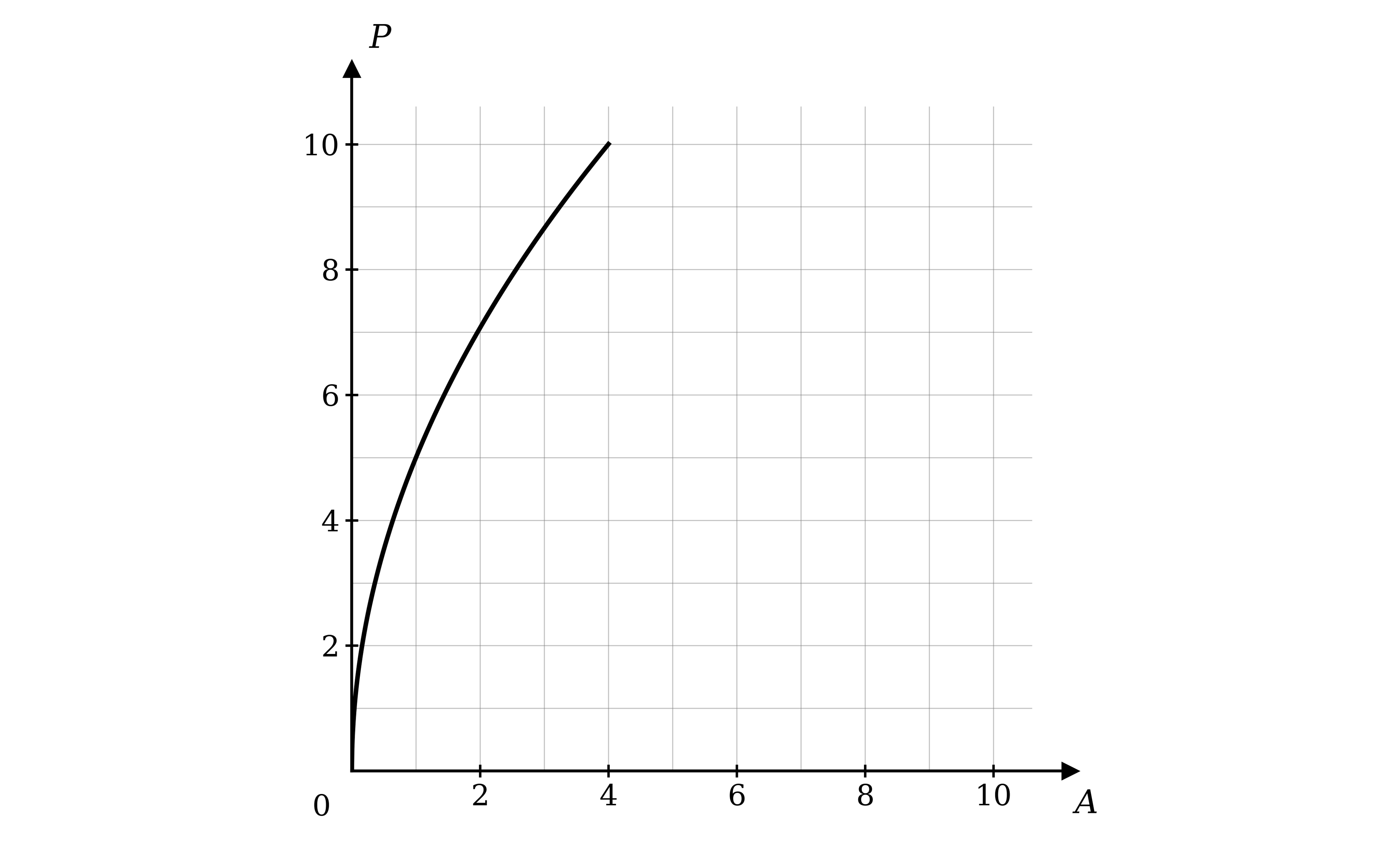
The graph of P, for 0≤A≤4, is shown on the following grid.

Grid from 0 to 10 on both axes, with A on the horizontal axis and P on the vertical axis, showing the graph of P, a curve rising from the origin to the point (4, 10)

On the same grid, sketch the graph of P−1.

15
4 marks

Show that the function f, defined by f(x)=ln(ex+1ex−1), is a self-inverse function.

1a
4 marks

The perimeter, P, and the area, A, of a square with sides of length x are given by P=4x and A=x2.

Find an expression for

(i) P in terms of A

(ii) A in terms of P.

1b
2 marks

Given that P−1(40)=A(k), find the value of k.

2a
2 marks

Let f(x)=x−14, for x≥14.

Find f−1(2).

2b
3 marks

Let g be a function such that g−1 exists for all real numbers.

Given that g(14)=3, find (f∘g−1)(3).

3a
4 marks

Let f(x)=2x2−16x+41, where f has its largest possible domain.

Find the domain and range of f.

3b
3 marks

(i) Find the values of x for which f(x)=11.

(ii) Hence explain why f does not have an inverse function.

4a
2 marks

Let f(x)=x2−9 and g(x)=x2−1, for x≥0.

Find

(i) f−1(x)

(ii) g−1(x).

4b
2 marks

Find (f∘g)(x), giving your answer in the form ax4+bx2+c.

4c
3 marks

Solve the equation (f∘g)(x)=0.

5a
2 marks

Express x2+12x+24 in the form (x+h)2+k, where h, k∈ℤ.

5b
3 marks

Let g(x)=x+6.

Given that (f∘g)(x)=x2+12x+24, find f(x).

6a
2 marks

Write 2x2+8x−3 in the form a(x+h)2+k.

6b
1 mark

Explain why the function f  defined by f(x)=2x2+8x−3, x∈ℝ,  does not have an inverse.

6c
7 marks

The function g defined by   g(x)=2x2+8x−3, x≥p  has an inverse.

  (i)      Write down the smallest possible value of p.

Given that p takes its smallest possible value:

   (ii)     Find the domain and range of g−1.

   (iii)    Find the inverse function g−1 .

6d
3 marks

Solve (g∘f)(x)=21.

7a
4 marks

Let f(x) be an even function and let g(x) be an odd function. Both functions are defined for all real values of x.

Prove the following statements:

(i) p(x)=f(x)g(x) is an odd function.

(ii) q(x)=(f∘g)(x) is an even function.

7b
3 marks

Determine whether or not it is possible for the function r defined by

r(x)=f(x)+g(x)

to be even or odd, being sure to state clearly any conditions that apply.

8
5 marks

The function f is defined by f(x)=ax+bcx+d, where a, b, c and d are real constants with c≠0.

Given that f is a self-inverse function, find the value of a+d.

9a
2 marks

The functions f and g are defined for x∈ℝ by f(x)=3x2+10x+7 and g(x)=x+d, where d∈ℝ.

Find the range of f.

9b
4 marks

Given that (g∘f)(x)>0 for all x∈ℝ, determine the set of possible values of d.

10a
2 marks

The function h is defined by h(x)=−4x2+24x+8, for x∈ℝ.

Express h(x) in the form a(x−p)2+q, where a, p, q∈ℤ.

10b
3 marks

Let f(x)=(x−3)2.

Given that (g∘f)(x)=h(x), find g(x).

11a
3 marks

The functions f and g are defined for x∈ℝ by f(x)=9x−3x2−3 and g(x)=−66+2x3.

Find (g∘f)(x), giving your answer in the form a(x−p)(x−q).

11b
1 mark

Hence write down the x-intercepts of the graph of y=(g∘f)(x).

11c
5 marks

Let h(x)=1−2x, for x∈ℝ.

The graph of y=(f∘h)(x) meets the y-axis at A. The graph of y=(g∘f)(x) meets the positive x-axis at B.

Find the exact value of AB.

12a
4 marks

The functions f and g are defined for x∈ℝ by f(x)=3−2x5 and g(x)=4x−7.

Find, in the form mx+c,

(i) (g∘f)(x)

(ii) (f∘g)(x).

12b
2 marks

Describe a single transformation that maps the graph of y=(g∘f)(x) onto the graph of y=(f∘g)(x).

12c
3 marks

Given that (g∘f)−1(p)=2,  find the value of p.

13a
1 mark

Let f(x)=−3x2+8x+16, where f has its largest possible domain.

Write down the coordinates of the y-intercept of the graph of y=f(x).

13b
6 marks

Find the domain and range of f.

14a
4 marks

Let the function f be such that f(x)=5x2−11x+6.05.

Find the largest domain of the form x≥a for which f−1 exists, and write down the corresponding range of f.

14b
2 marks

For the domain found in part (a), find f−1(22.05).

15a
2 marks

Let the function f be defined by f(x)=(2x2−5x−12)−12−k, where k is a constant and f has the largest possible domain.

Find the domain of f.

15b
1 mark

Given that limx→∞f(x)=−7, find the value of k.

15c
3 marks

Write down the equations of any vertical and/or horizontal asymptotes on the graph of y=f(x).

16a
5 marks

Consider the function f defined by f(x)=x2−6x+10, x≤p, where p is the largest value such that f has an inverse.

(i) Write down the value of p.

(ii) On the same set of axes, sketch the graphs of f and f−1.

(iii) Write down the domain and range of f−1.

16b
4 marks

Find the inverse function f−1 .

16c
5 marks

Let the function g be defined by g(x)=x2−6x+10, x∈ℝ.

(i) Solve (g∘f)(x)=2.

(ii) Solve (f∘g)(x)=2.

17a
1 mark

A part of the graph of the function f(x)=2x3−3x2−12x+8, x∈ℝ is shown below.  

ib13a-ai-sl-2-3-ib-maths-veryhard

Explain why f  does not have an inverse.

17b
6 marks

The domain of f is now restricted to   a≤x≤b  where   a<0  and  b>0. a and b are chosen so that f has an inverse and the interval [a,b] is as large as possible. 

Find the domain and range of f−1

1a
2 marks

Let f(x)=94x2−1 and g(x)=x2−2, for x≥0.

Find

(i) f−1(x)

(ii) g−1(x).

1b
2 marks

Find (f∘g)(x), giving your answer in the form ax4+bx2+c.

1c
3 marks

Solve the equation (f∘g)(x)=0.

2a
4 marks

Consider the function  f(x)=ax4+bx3+cx2+dx+e where  a,b,c,d,e∈ℝ .

Show that:

(i) if f  is even then b=d=0.

(ii) if f  is odd then a=c=e=0.

2b
5 marks

Consider the function g  defined by   g(x)=(3x+p)(x−2)(qx+1)(2x+3)  where p  and q  are real constants.

Find the possible values of p  and q in the case where g is an even function.

2c
4 marks

Use proof by contradiction to show that g  can never be an odd function.

3a
4 marks

Consider the function f defined by f(x)=2x−53x+k, x∈ℝ, x≠−k3.

In the case where f is self-inverse, find the value of k.

3b
5 marks

In the case when the graphs of f and f−1 intersect at exactly one point, find the possible values of k.