Higher Order Derivatives (DP IB Analysis & Approaches (AA): HL): Revision Note

Second order derivatives
What is a second order derivative?
If you differentiate the derivative of a function (i.e. differentiate the function a second time) you get the second order derivative of the function
There are two forms of notation for the second order derivative
(First order derivative)
(Second order derivative)
Note the position of the superscript 2’s
differentiating twice (so) with respect to twice (so)
The second order derivative can be referred to simply as the second derivative
Similarly, the first order derivative can be called just the first derivative
A first order derivative is the rate of change of a function
a second order derivative is the rate of change of the rate of change of a function
i.e. the rate of change of the function’s gradient
Second order derivatives can be used to
test for local minimum and maximum points
help determine the nature of stationary points
determine the concavity of a function
help graph the derivative of a function
How do I find a second order derivative of a function?
By differentiating twice!
This may involve
rewriting fractions, roots, etc. as negative and/or fractional powers
differentiating trigonometric functions, exponentials and logarithms
using the chain rule
using the product or quotient rules
Examiner Tips and Tricks
It is easy to make mistakes with negative and/or fractional powers when finding second derivatives, so work carefully through each term.
Worked Example
Given that
a) Find and .
Answer:
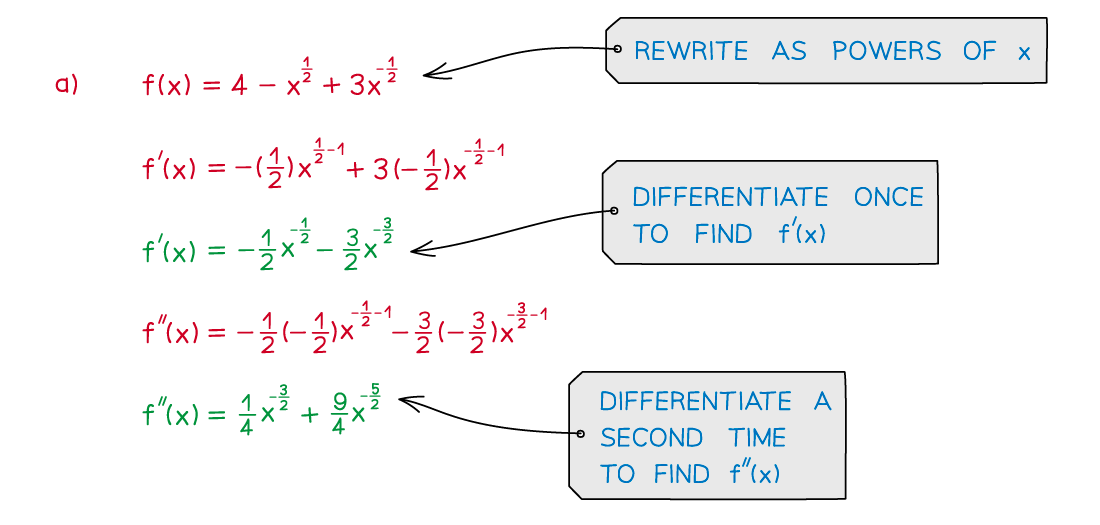
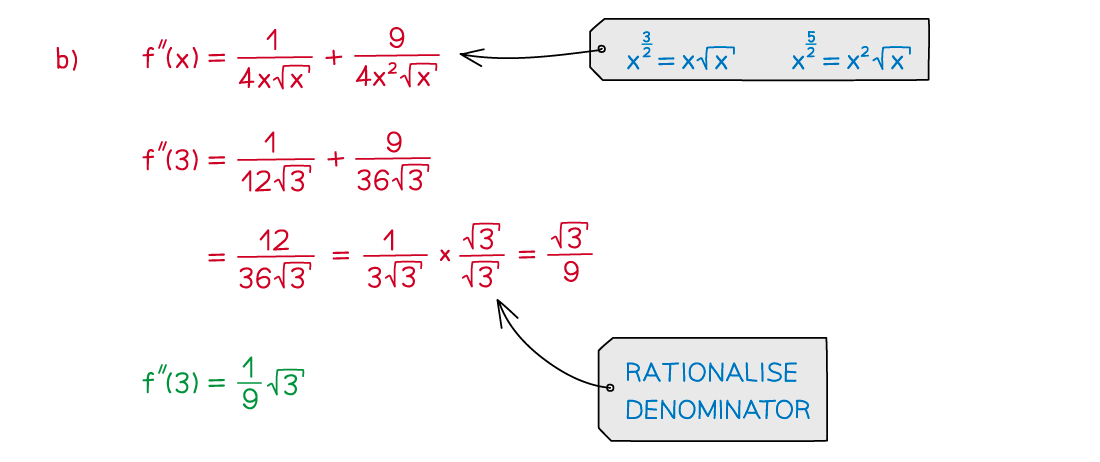
b) Evaluate .
Give your answer in the form , where is an integer and is a rational number.
Answer:
Higher order derivatives
What is meant by higher order derivatives of a function?
Many functions can be differentiated numerous times
The third, fourth, fifth, etc derivatives of a function are generally called higher order derivatives
It may not be possible, or practical to (algebraically) differentiate complicated functions more than once or twice
Polynomials will, eventually, have higher order derivatives of zero
Since powers of x reduce by 1 each time
What is the notation for higher order derivatives?
The notation for higher order derivatives follows the logic from the first and second derivatives
or for the th derivative
So the fifth derivative would be or
The ‘dash’ notation is replaced with numbers after a point, as it would become cumbersome after the first few
So you could use , and for the first three derivatives
but after that , , etc. should be used for the 4th, 5th, etc., derivatives
for the third derivative is also common
How do I find a higher order derivative of a function?
By differentiating as many times as required!
This may involve
rewriting fractions, roots, etc. as negative and/or fractional powers
differentiating trigonometric functions, exponentials and logarithms
using the chain rule
using the product or quotient rules
Examiner Tips and Tricks
If you are required to evaluate a higher order derivative at a specific point your GDC can help.
Typically a GDC will only work out the values of the first and second derivatives directly from the original function. But if you wanted, say, the fourth derivative, you only need to differentiate twice algebraically, then call this the ‘original’ function on your GDC.
Worked Example
It is given that .
a) Show that .
Answer:

b) Without further working, write down an expression for .
Answer:


Unlock more, it's free!
Join the 100,000+ Students that ❤️ Save My Exams
the (exam) results speak for themselves:

Was this revision note helpful?
Build on this topic
