Inverse Trigonometric Functions (DP IB Analysis & Approaches (AA): HL): Revision Note

Amber

Written by: Amber

Reviewed by: Dan Finlay

Updated on

Inverse trig functions

What are the inverse trig functions?

  • The inverse trig functions are

    • arcsinx=sin1x

    • arccosx=cos1x

    • arctanx=tan1x

  • They are inverses when the domains are restricted

    • arcsinx is the inverse of sinx when its domain is π2xπ2

      • e.g. sin(π2)=1arcsin(1)=π2

    • arccosx is the inverse of cosx when its domain is 0xπ

      • e.g. cos(π3)=12arccos(12)=π3

    • arctanx is the inverse of tanx when its domain is π2<x<π2

      • e.g. tan(π4)=1arctan(1)=π4

Examiner Tips and Tricks

Be careful when you are working outside these domains. For example, sin(2π)=1 but arcsin(1)2π.

What do the graphs of the inverse trig functions look like?

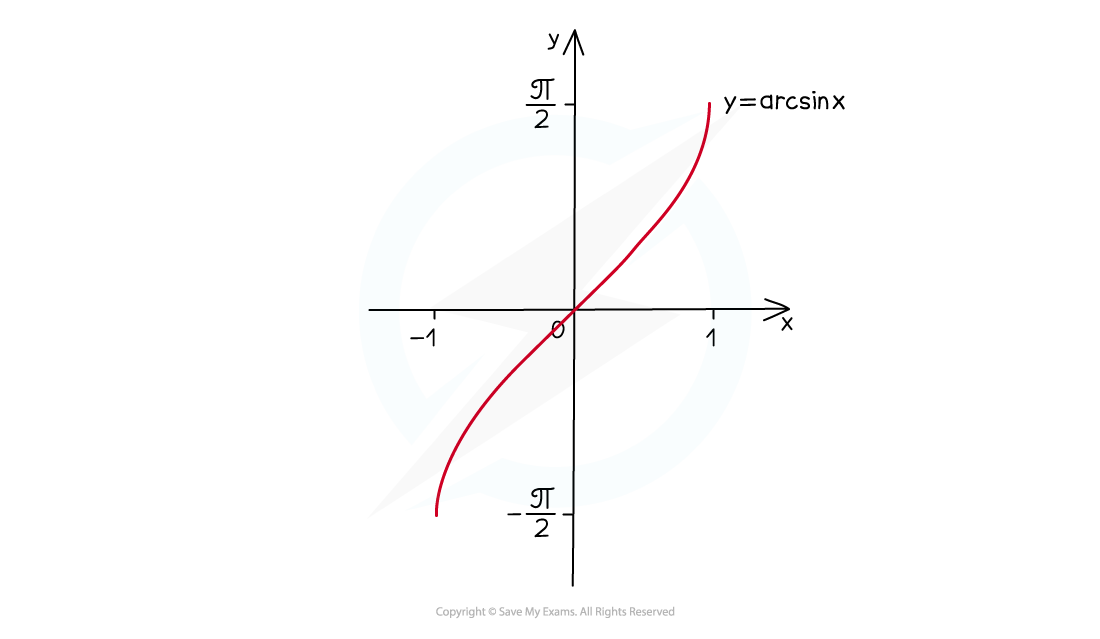
y=arcsinx

  • y=arcsinx is a reflection of y=sinx in the line y=x when its domain is π2xπ2

  • The domain is 1  x  1

  • The range is π2 y π2

Graph of the arcsine function, y = arcsin(x), with a curved red line. X-axis from -1 to 1, y-axis from -π/2 to π/2, passing through origin.
The graph of y=arcsinx

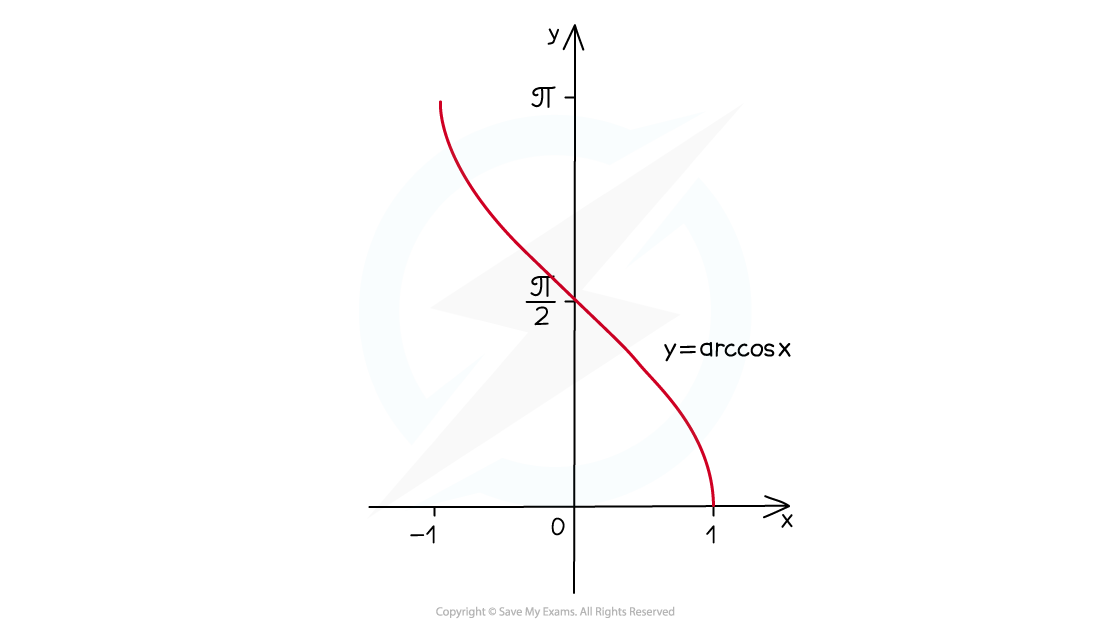
y=arccosx

  • y=arccosx is a reflection of y=cosx in the line y=x when its domain is 0xπ

  • The domain is 1  x  1

  • The range is 0 y π

Graph of y = arccos(x) in red, spanning x-axis from -1 to 1 and y-axis from 0 to π, with marked π/2 point.
The graph of y=arccosx

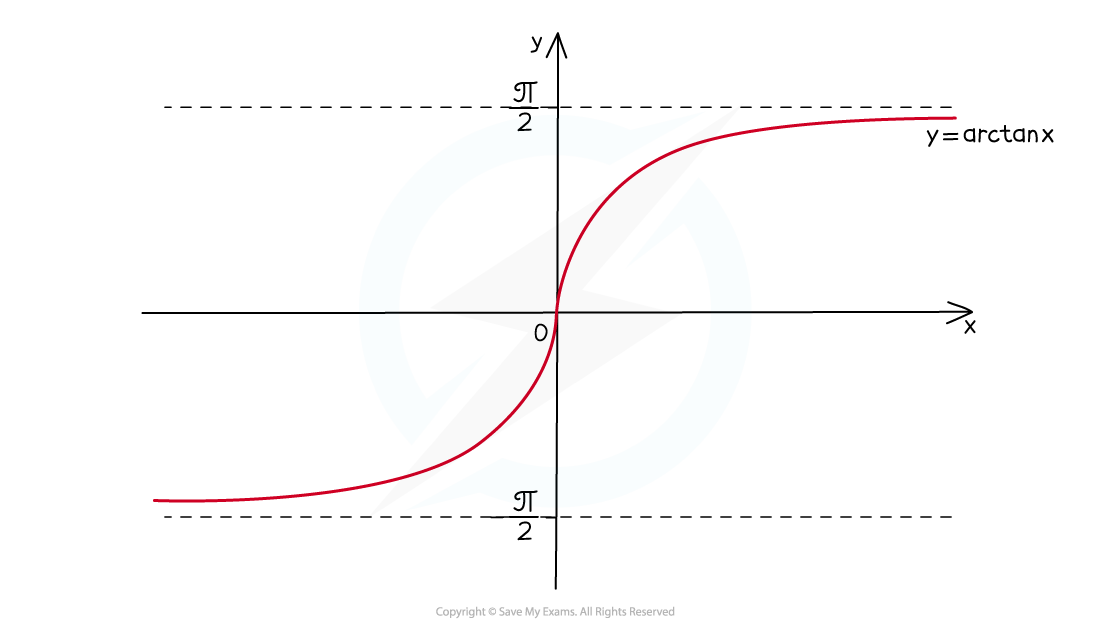
y=arctanx

  • y=arctanx is a reflection of y=tanx in the line y=x when its domain is π2<x<π2

  • The domain is x

  • The range is π2< y <π2

  • There are horizontal asymptotes at y=±π2

Graph of y = arctan(x) with a red curve. Asymptotes at y = π/2 and y = -π/2. The curve crosses the origin, approaching horizontal lines.
The graph of y=arctanx

How can I use inverse trig functions?

  • You can use the inverse trig functions to help you to solve trig equations

    • e.g. if sinx=13 then one solution is x=arcsin(13)

    • You need to use the symmetries of the trig functions to find the other solutions

  • You can solve equations involving inverse trig equations

    • arcsinx=kx=sink

    • The converse is not always true

    • You need to use the symmetries to make the value in the trig function be within its restricted domain

      • e.g. sin(7π8)=sin(π8)

      • Therefore sin(7π8)=xarcsinx=π8

Worked Example

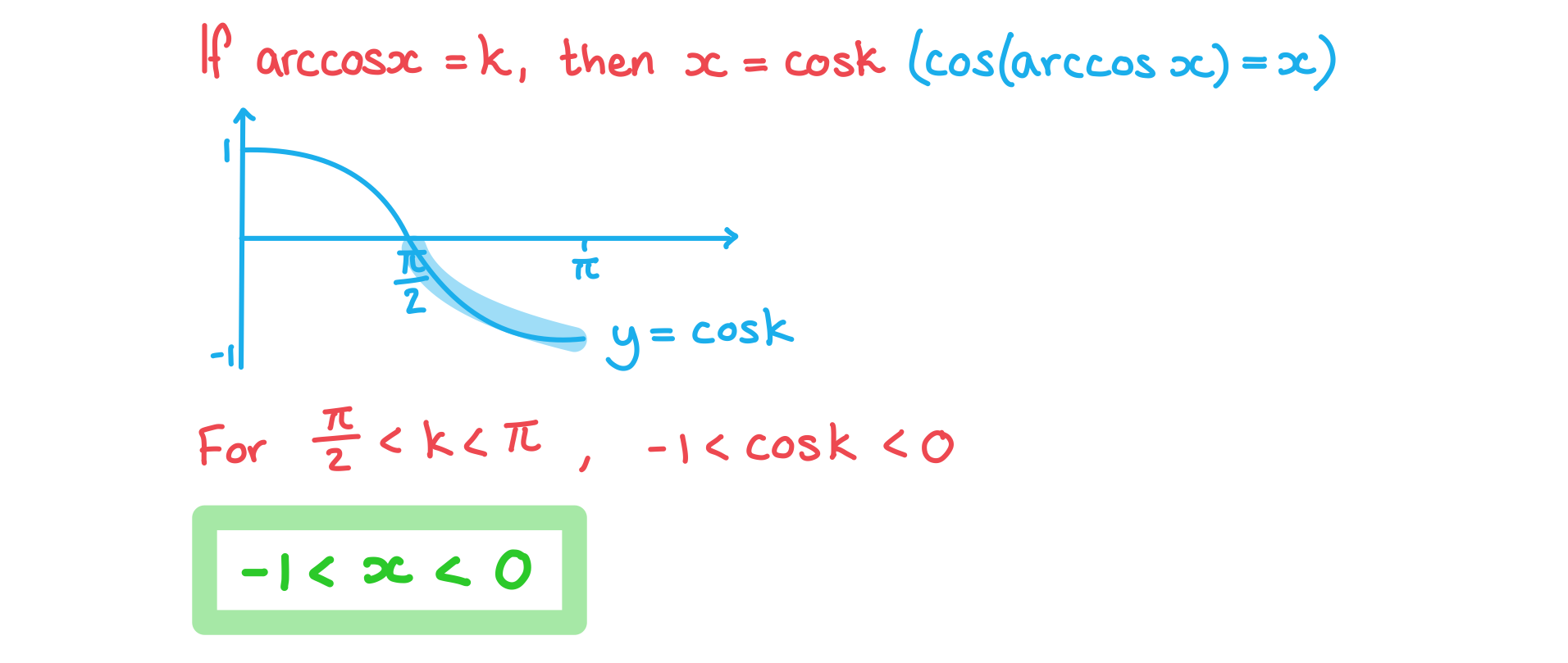
Given that xsatisfies the equation arccos x = k where  π2<k<π,  state the range of possible values of x.

Answer:

BpKJi_8r_3-7-2-ib-aa-hl-we-solution-inverse-functions

Unlock more, it's free!

Join the 100,000+ Students that ❤️ Save My Exams

the (exam) results speak for themselves:

Build on this topic

Amber

Author: Amber

Expertise: Maths Content Creator

Amber gained a first class degree in Mathematics & Meteorology from the University of Reading before training to become a teacher. She is passionate about teaching, having spent 8 years teaching GCSE and A Level Mathematics both in the UK and internationally. Amber loves creating bright and informative resources to help students reach their potential.

Dan Finlay

Reviewer: Dan Finlay

Expertise: Portfolio Lead

Dan graduated from the University of Oxford with a First class degree in mathematics. As well as teaching maths for over 8 years, Dan has marked a range of exams for Edexcel, tutored students and taught A Level Accounting. Dan has a keen interest in statistics and probability and their real-life applications.