Continuity & Differentiability (DP IB Analysis & Approaches (AA): HL): Revision Note

Continuity & differentiability
What does it mean for a function to be continuous at a point?
If a function is continuous at a point then the graph of the function does not have any ‘holes’ or any sudden ‘leaps’ or ‘jumps’ at that point
Imagine sketching the graph
If you can sketch the graph without lifting your pencil from the paper, then the function is continuous at all the points that your sketch goes through
But if you would have to lift your pencil off the paper at some point and continue drawing the graph from another point, then the function is not continuous at any such points where the function ‘jumps’
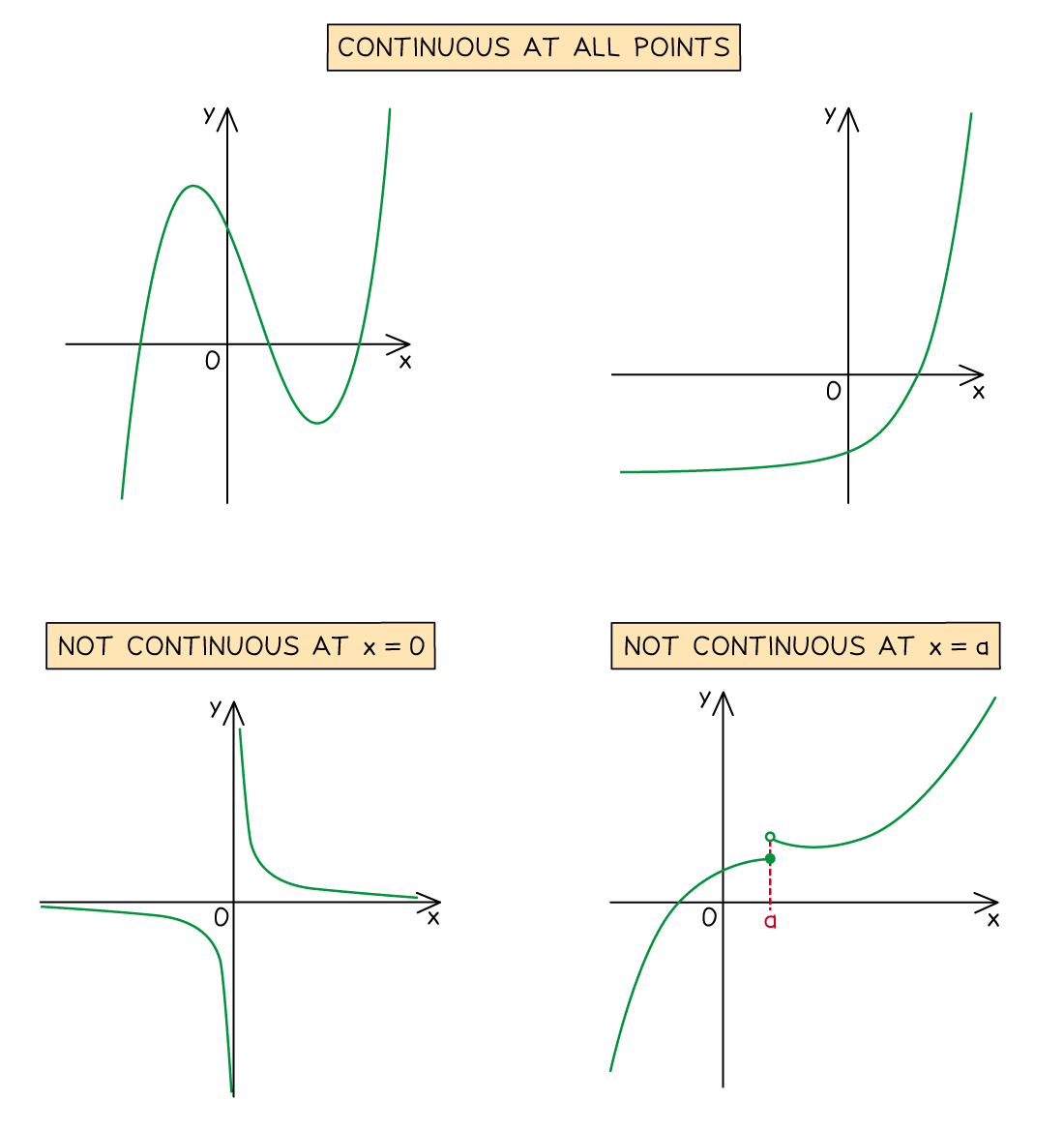
There are two main ways a function can fail to be continuous at a point:
If the function is not defined for a particular value of x then it is not continuous at that value of x
For example, is not continuous at x = 0
If the function is defined for a particular value of x, but then the value of the function ‘jumps’ as x moves away from that x value (in the positive or negative direction), then the function is not continuous at that value of x
This type of discontinuity can occur in a piecewise function, for example, where the different pieces of the function’s graph don’t ‘join up’
You can use limits to show that a function is continuous at a point
Let f(x) be a function defined at x = a, such that f(a) = b
If and , then f(x) is continuous at x = a
If either of those limits is not equal to b, then f(x) is not continuous at x = a
This is a slightly more formal way of expressing the ‘you don’t have to lift your pencil from the paper’ idea!
What does it mean for a function to be differentiable at a point?
We say that a function f(x) is differentiable at a point with x-coordinate x0, if the derivative f’(x) exists and has a well-defined value f’(x0) at that point
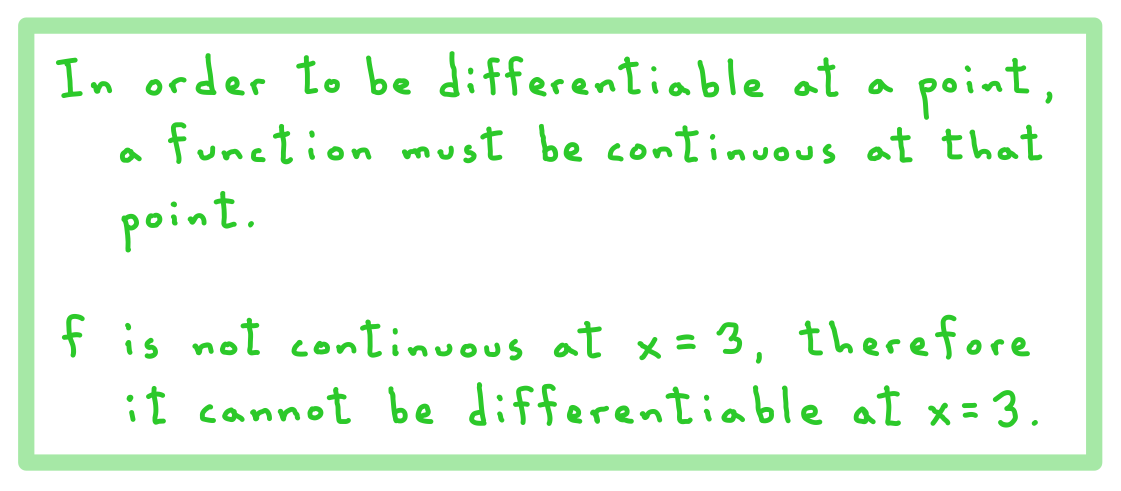
To be differentiable at a point a function has to be continuous at that point
So if a function is not continuous at a point, then it is also not differentiable at that point
But continuity by itself does not guarantee differentiability
Differentiability is a stronger condition than continuity
If a function is differentiable at a point, then the function is also continuous at that point
But a function may be continuous at a point without being differentiable at that point
So a function may be continuous everywhere but not differentiable everywhere
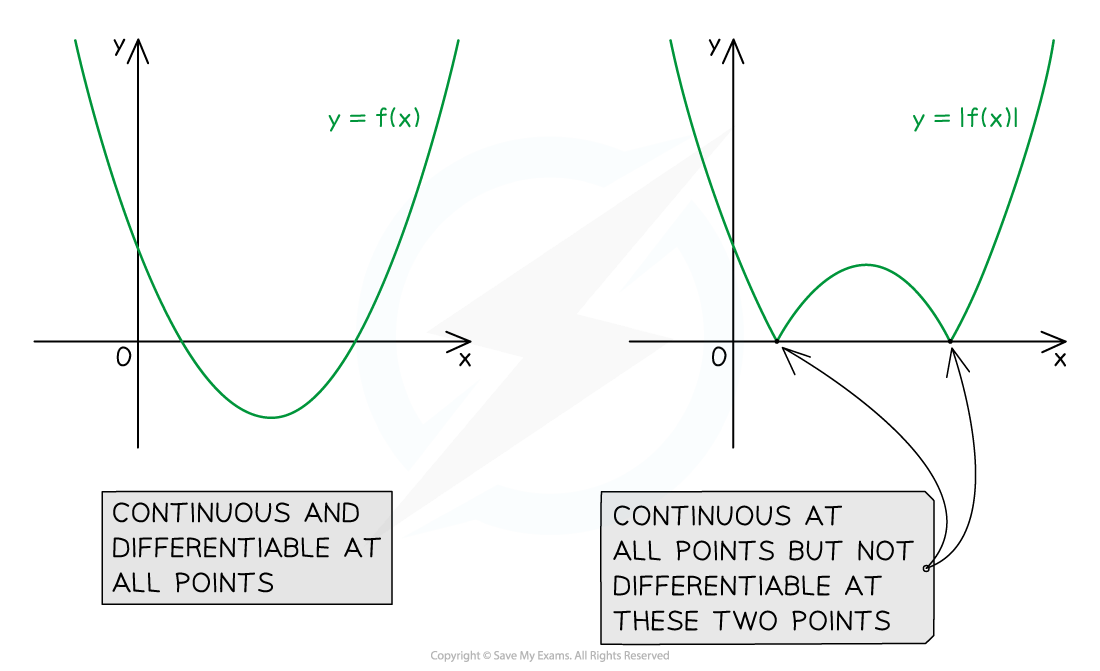
In addition to being continuous a point, differentiability also requires that the function be smooth at that point
‘Smooth’ means that the graph of the function does not have any ‘corners’ or sudden changes of direction at the point
An obvious example of a function that is not smooth at certain points is a modulus function |f(x)| at any values of x where f(x) changes sign from positive to negative
At any such point a modulus function will not be differentiable
Examiner Tips and Tricks
On the exam you will not usually be asked to test a function for continuity at a point, though you should be familiar with the basic ideas about continuity outlined above.
You will not be asked to test a function for differentiability at a point. You should however be familiar with the basic ideas about differentiability, and its relationship with continuity, as outlined above. In particular:
But those do not automatically work the other way round:
Worked Example
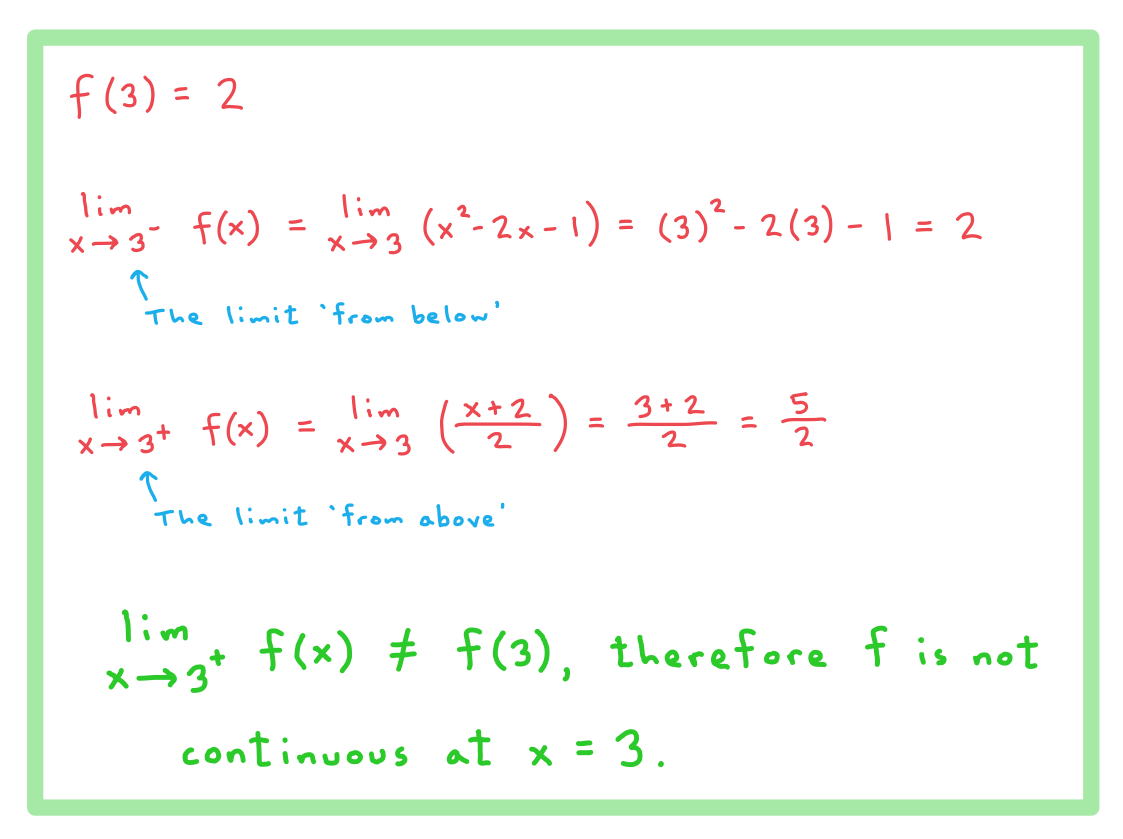
Consider the function defined by
a) use limits to show that is not continuous at .
Answer:
b) Hence explain why cannot be differentiable at .
Answer:

Unlock more, it's free!
Join the 100,000+ Students that ❤️ Save My Exams
the (exam) results speak for themselves:

Was this revision note helpful?
Build on this topic
