Roots of Complex Numbers (DP IB Analysis & Approaches (AA): HL): Revision Note

Amber

Written by: Amber

Reviewed by: Mark Curtis

Updated on

Roots of complex numbers

How do I find the square roots of a complex number?

  • A complex number z has two square roots, w and w, that are also complex

    • To find them, let w=a+bi where a, b

    • and form simultaneous equations from the relationship w2=z

      • by expanding w2

      • and equating the real and imaginary parts with z

  • E.g. find the square roots of 3+4i

    • Let a+bi be one of the square roots of 3+4i

    • This means (a+bi)2=3+4i

    • Expand the left-hand side

      • (a+bi)(a+bi)=a2+abi+bai+b2i2=a2+2abib2

      • so a2+2abib2=3+4i

    • Equate the real parts on both sides

      • a2b2=3

    • Equate the imaginary parts on both sides

      • 2ab=4

    • Solve these two equations simultaneously

      • e.g. make b the subject of 2ab=4 to get b=2a

      • Substitute b=2a into a2b2=3 to get a2(2a)2=3

      • Rearrange to a43a24=0 which gives a2=4 or a2=1 (but a)

      • so a=±2 which gives b=±1

    • The two square roots are 2+i and  2i

How do I use de Moivre’s theorem to find the nth roots of a complex number?

  • De Moivre's theorem to find the nth roots of a complex number, z=r(cosθ+isinθ), is

    • zn=z1n=r1n(cos(θ+2kπn)+i sin(θ+2kπn))

      • Letting k=0, 1, 2, ..., n1 gives each nth root

  • In exponential (Euler's) form, this is

    • zn=z1n=r1neθ+2kπn

      • where k=0, 1, 2, ..., n1

Examiner Tips and Tricks

This formula is not given in the formula booklet so it must be learnt.

  • e.g. find the fourth roots of 16(cosπ2+i sinπ2)

    • z4=z14=1614(cos(π2+2kπ4)+i sin(π2+2kπ4))

      • k=0 gives 2(cosπ8+i sinπ8)

      • k=1 gives 2(cos5π8+i sin5π8)

      • k=2 gives 2(cos9π8+i sin9π8)

      • k=3 gives 2(cos13π8+i sin13π8)

Examiner Tips and Tricks

Your GDC can find roots of complex numbers.

  • If you plot the n complex roots of of a complex number on an Argand diagram

    • they form a regular n-sided polygon

  • e.g. in the example above

    • 2(cosπ8+i sinπ8), 2(cos5π8+i sin5π8), 2(cos9π8+i sin9π8) and 2(cos13π8+i sin13π8)

      • form a square

      • whose vertices lies on a circle of radius r=2

Worked Example

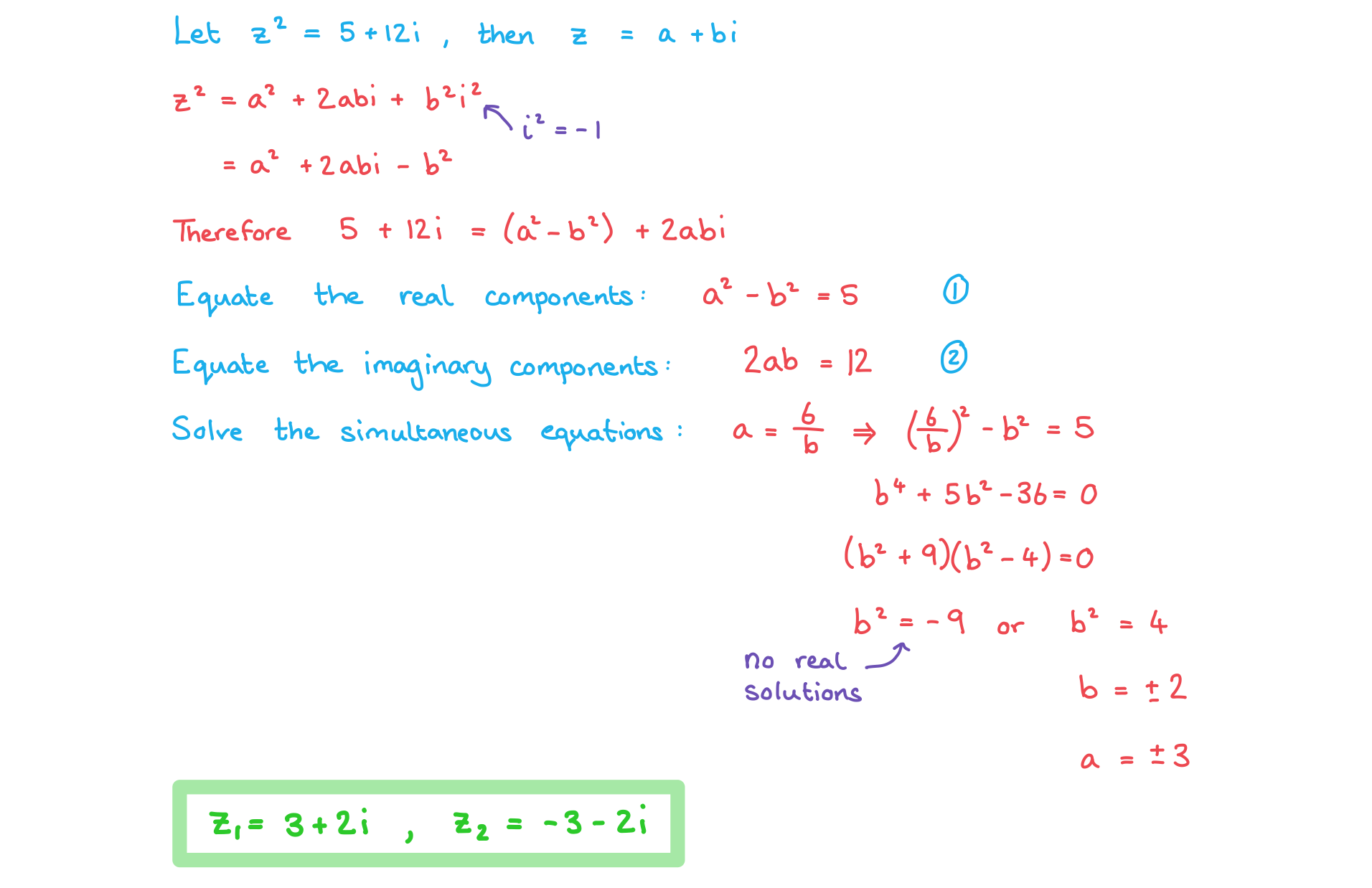
(a) Find both square roots of 5+12i, giving your answers in the form a+bi.

Answer:

k-4_ksf4_1-9-3-ib-aa-hl-de-moivres-theorem-we-solution-2

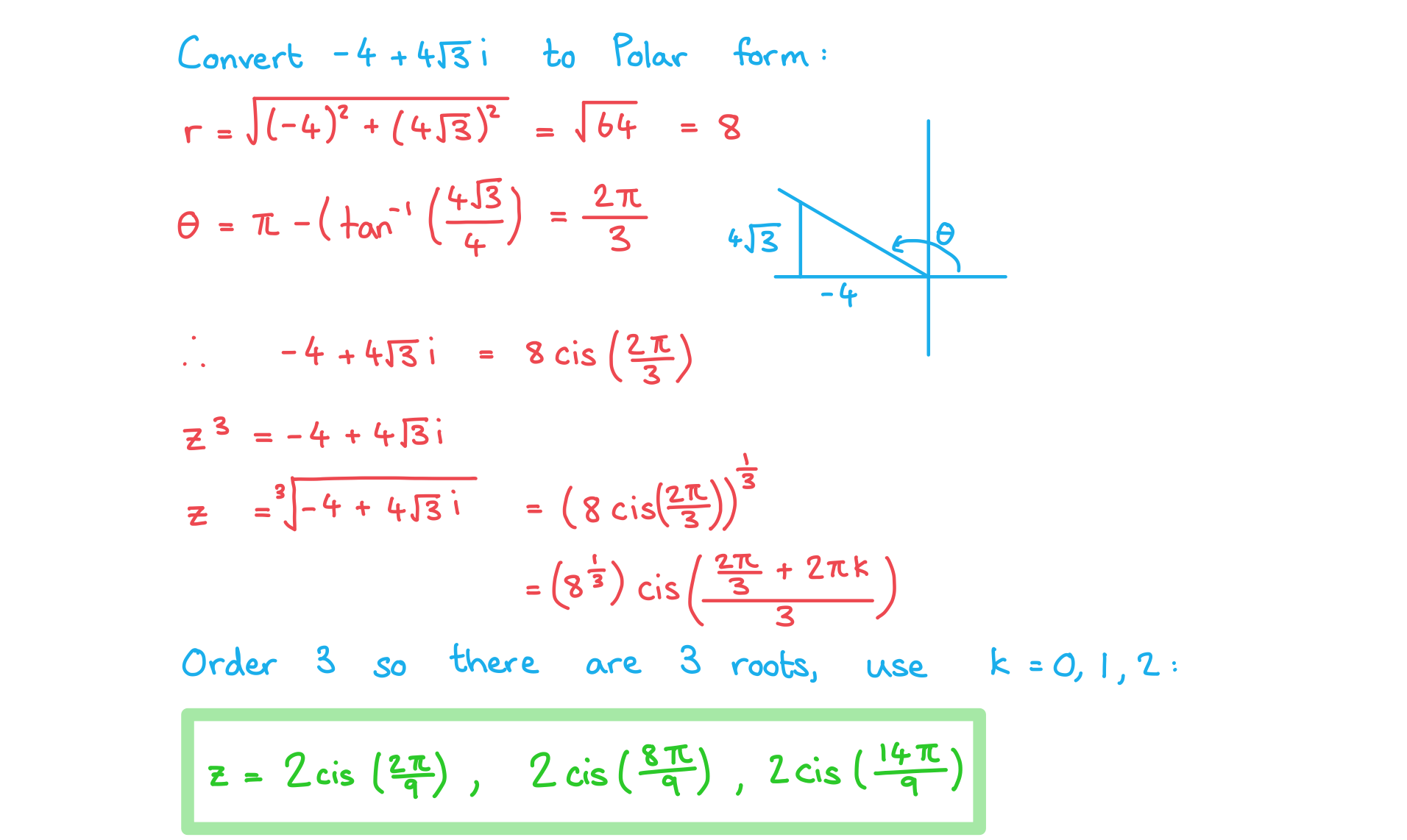
(b) Solve the equation z3=4+43i, giving your solutions in the form r cis θ.

Answer:

1-9-3-ib-aa-hl-roots-of-cn-we-solution

Unlock more, it's free!

Join the 100,000+ Students that ❤️ Save My Exams

the (exam) results speak for themselves:

Build on this topic

Amber

Author: Amber

Expertise: Maths Content Creator

Amber gained a first class degree in Mathematics & Meteorology from the University of Reading before training to become a teacher. She is passionate about teaching, having spent 8 years teaching GCSE and A Level Mathematics both in the UK and internationally. Amber loves creating bright and informative resources to help students reach their potential.

Mark Curtis

Reviewer: Mark Curtis

Expertise: Maths Content Creator

Mark graduated twice from the University of Oxford: once in 2009 with a First in Mathematics, then again in 2013 with a PhD (DPhil) in Mathematics. He has had nine successful years as a secondary school teacher, specialising in A-Level Further Maths and running extension classes for Oxbridge Maths applicants. Alongside his teaching, he has written five internal textbooks, introduced new spiralling school curriculums and trained other Maths teachers through outreach programmes.