Calculus for Kinematics (DP IB Analysis & Approaches (AA): HL): Revision Note

Differentiation for kinematics
How is differentiation used in kinematics?
Displacement, velocity and acceleration are related by calculus
In terms of differentiation and derivatives
velocity is the rate of change of displacement
or
acceleration is the rate of change of velocity
or
so acceleration is also the second derivative of displacement
or
If a graph is not given you can use your GDC to draw one
You can then use your GDC’s graphing features to find gradients
Velocity is the gradient on a displacement (-time) graph
Acceleration is the gradient on a velocity (-time) graph
Worked Example
The displacement,, of a particle at seconds, is modelled by .
i. Find and.
ii. Find the times at which the particle is at rest.
Answer:

Integration for kinematics
How is integration used in kinematics?
Since velocity is the derivative of displacement () it follows that
Similarly, velocity will be an antiderivative of acceleration
How would I find the constant of integration in kinematics problems?
A boundary or initial condition would need to be known
Phrases involving the word “initial”, or “initially” are referring to time being zero, i.e.
You might also be given information about the object at some other time (this is called a boundary condition)
Substituting the values in from the initial or boundary condition allows the constant of integration to be found
How are definite integrals used in kinematics?
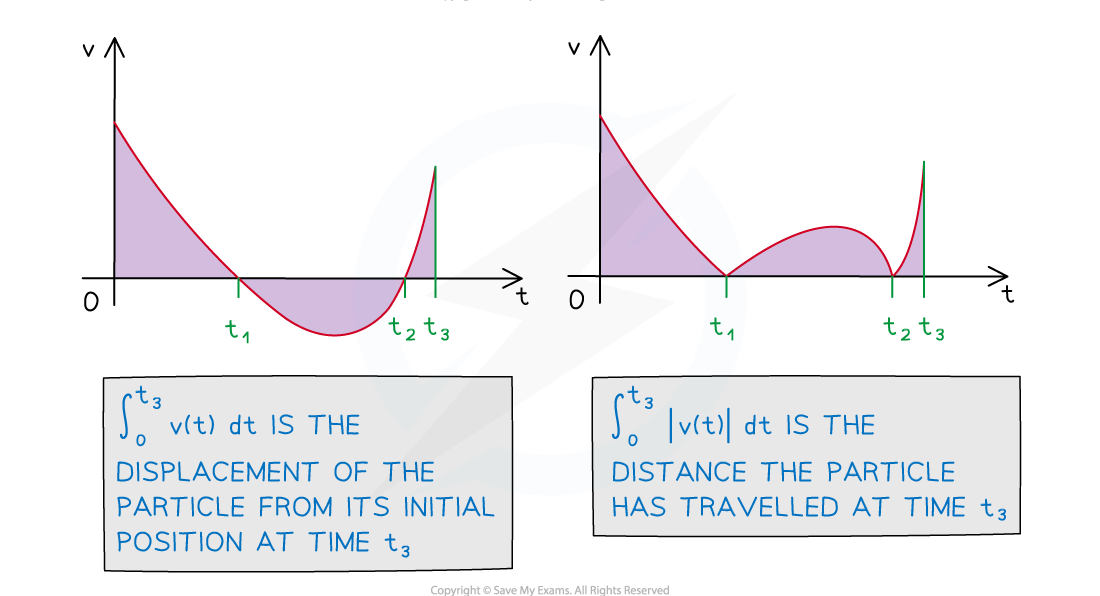
Definite integrals can be used to find the displacement of a particle between two points in time
would give the displacement of the particle between the times and
This can be found using a velocity-time graph by subtracting the total area below the horizontal axis from the total area above
gives the distance a particle has travelled between the times and
This can be found using a velocity velocity-time graph by adding the total area below the horizontal axis to the total area above
You can use a GDC to plot the modulus graph
Examiner Tips and Tricks
Sketching the velocity-time graph can help you visualise the distances travelled using areas between the graph and the horizontal axis.
Worked Example
A particle moving in a straight horizontal line has velocity () at time seconds modelled by.
i. Given that the initial position of the particle is at the origin, find an expression for its displacement from the origin at time seconds.
ii. Find the displacement of the particle from the origin in the first five seconds of its motion.
iii. Find the distance travelled by the particle in the first five seconds of its motion.
Answer:


Unlock more, it's free!
Join the 100,000+ Students that ❤️ Save My Exams
the (exam) results speak for themselves:

Was this revision note helpful?
Build on this topic
