Discrete Probability Distributions (DP IB Analysis & Approaches (AA): HL): Revision Note

Discrete probability distributions
What is a discrete random variable?
A random variable is a variable whose value depends on the outcome of a random event
The value of the random variable is not known until the event occurs (this is what is meant by 'random' in this case)
Random variables are denoted using upper case letters (, etc )
Particular outcomes of the event are denoted using lower case letters (, etc)
means "the probability of the random variable taking the value "
A discrete random variable (often abbreviated to DRV) can only take certain values within a set
Discrete random variables often count something
A discrete random variables usually can only take a finite number of values but it is possible that it can take an infinite number of values (see the examples below)
Examples of discrete random variables include:
The number of times a coin lands on heads when flipped 20 times
this has a finite number of outcomes: {0,1,2,…,20}
The number of emails a manager receives within an hour
this has an infinite number of outcomes: {0,1,2,3,…}
The number of times a dice is rolled until it lands on a 6
this has an infinite number of outcomes: {1,2,3,…}
The number that a dice lands on when rolled once
this has a finite number of outcomes: {1,2,3,4,5,6}
What is a probability distribution of a discrete random variable?
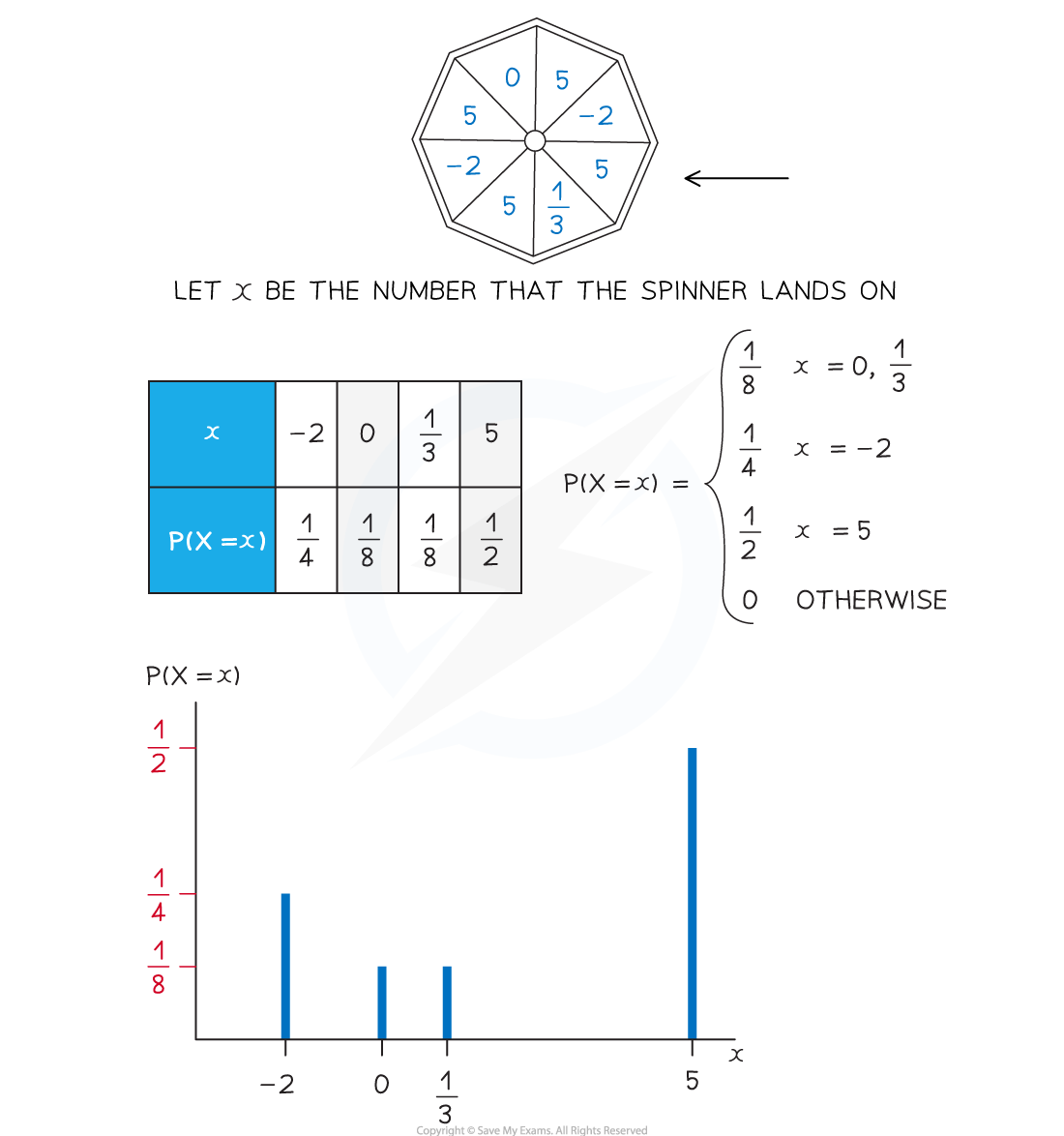
A discrete probability distribution fully describes all the values that a discrete random variable can take along with their associated probabilities
This can be given in a table
Or it can be given as a function (called a discrete probability distribution function or "pdf")
Or it can be represented by vertical line graph (the possible values along the horizontal axis, and the probability on the vertical axis)
The sum of the probabilities of all the values of a discrete random variable is 1
This is usually written
A discrete uniform distribution is one where the random variable takes a finite number of values each with an equal probability
If there are n values then the probability of each one is
How do I calculate probabilities using a discrete probability distribution?
First draw a table to represent the probability distribution
If it is given as a function then find each probability
If any probabilities are unknown then use algebra to represent them
Form an equation using
Add together all the probabilities and make the sum is equal to 1
To find
If is a possible value of the random variable then will be given in the table
If is not a possible value then
To find
Identify all possible values, , that can take which satisfy
Note that this includes
Add together all their corresponding probabilities
Some mathematicians use the notation to represent the cumulative distribution
Using a similar method you can find , and
As all the probabilities add up to 1 you can form the following equivalent equations:
How do I know which inequality to use?
would be used for phrases such as:
At most , no greater than , etc
would be used for phrases such as:
Fewer than, etc.
would be used for phrases such as:
At least , no fewer than , etc
would be used for phrases such as:
Greater than , etc
Worked Example
The probability distribution of the discrete random variable is given by the function
a) Show that .
Answer:

b) Calculate .
Answer:


Unlock more, it's free!
Join the 100,000+ Students that ❤️ Save My Exams
the (exam) results speak for themselves:

Was this revision note helpful?
Build on this topic