1
1 mark
Which one of the following is an element of the design mix?
Select one answer.
Cost
Price
Product
Quality
Was this exam question helpful?
Exam code: 1BS0
Which one of the following is an element of the design mix?
Select one answer.
Cost
Price
Product
Quality
Was this exam question helpful?
Mind Candy Ltd produces games and apps for computers and mobile devices. Its most successful game was Moshi Monsters. The game was aimed at young teenagers and was a global hit, with 80 million users in 2012.
In 2013, Mind Candy made large losses as sales revenue fell due to the falling popularity of its games. This was blamed on the short product life cycle of Moshi Monsters and increased competition in its market. As a result of these losses, Mind Candy reduced its workforce of software developers.
Mind Candy now needed to raise £1.2 million of extra finance. It required this finance to pay existing costs and fund the development of new apps such as Petlandia. Mind Candy believes Petlandia will allow it to return to organic growth. The app is free to download and allows players to design a virtual version of their own pet. This virtual pet can go on an adventure within the app. The adventure is then turned into a personalised storybook which can be purchased for £19.99.
Outline one method Mind Candy could use to extend the product life cycle of one of its games.
Was this exam question helpful?
Mind Candy Ltd produces games and apps for computers and mobile devices. Its most successful game was Moshi Monsters. The game was aimed at young teenagers and was a global hit, with 80 million users in 2012.
In 2013, Mind Candy made large losses as sales revenue fell due to the falling popularity of its games. This was blamed on the short product life cycle of Moshi Monsters and increased competition in its market. As a result of these losses, Mind Candy reduced its workforce of software developers.
Mind Candy now needed to raise £1.2 million of extra finance. It required this finance to pay existing costs and fund the development of new apps such as Petlandia. Mind Candy believes Petlandia will allow it to return to organic growth. The app is free to download and allows players to design a virtual version of their own pet. This virtual pet can go on an adventure within the app. The adventure is then turned into a personalised storybook which can be purchased for £19.99.
Outline one method Mind Candy could use to promote its new app.
Was this exam question helpful?
Kentucky Fried Chicken (KFC) is a fast food chain that sells fried chicken. Amongst its most popular products are Popcorn Chicken, Boneless Chicken boxes and Zinger Tower burgers. These are freshly cooked in batches in each of its 900 restaurants across the UK.
In 2017, KFC changed the company it used to transport its supplies of chicken. It replaced Bidvest with DHL. Bidvest had three distribution centres across the UK, but DHL only had one. In February 2018, DHL started to have logistical problems causing many KFC restaurants to run out of chicken. This led to a temporary closure of many KFC branches due to poor supplier reliability.
As a result of these closures, KFC started losing market share to rival fast food restaurants such as Burger King. KFC used social media and a viral advertising campaign to apologise to customers. It also considered lowering the prices of its most popular food items to win back lost customers and recapture market share
Outline one benefit to KFC of using social media to interact with its customers.
Was this exam question helpful?
Iceland is a supermarket that sells frozen food. Although the grocery industry is very competitive, Iceland enjoyed a successful 2017. Sales revenue increased by 2.0% allowing profits to increase by £9.5 million to £160 million.
Iceland believes this success has been due to improved marketing. It has introduced new products using the Slimming World and Millie’s Cookies brand names. It also launched a new advertising campaign called ‘The Power of Frozen’. In addition it has developed a new store format called ‘The Food Warehouse’. These stores are much larger than a normal Iceland store which allows them to stock more luxury products. Iceland hopes that The Food Warehouse will help it to appeal to high-income customers and it plans to open more stores.

In 2018, Iceland received positive publicity from its decision to ban all plastic packaging on its own-brand products by 2023. It intends to replace plastic with recycled paper, as shown in Figure 3. A survey of 5,000 of its customers showed that 80% of them agreed with the change. Pressure groups, such as Friends of the Earth, have welcomed Iceland’s decision. Plastic waste has caused pollution of the world’s oceans and has killed marine life.
Outline one factor that could influence Iceland’s choice of pricing strategy for its range of new products.
Was this exam question helpful?
Which one of the following is an example of a good?
Select one answer.
Cars
Education
Hairdressing
Broadband
Train Journeys
Was this exam question helpful?
Tesla is a public limited company based in California, USA. Its founder and main shareholder, Elon Musk, wanted to produce an electric car that is affordable to a large number of potential customers. This car is called the Tesla Model 3 (Figure 3).
Introduced in 2017, the basic version of the Model 3 was originally priced at $50 000 and the company wanted to reduce this price to $35 000 by 2019. However, this was difficult to achieve because Tesla’s California factory suffered from low levels of productivity. These problems resulted in Tesla making a $976 million loss in 2018.

Following the introduction of tariffs on US imports by the Chinese government in 2018, Tesla decided to invest $5 billion in the construction of a new car factory in Shanghai, China. This factory will use flow production. However, with only $2.4 billion of available capital, Tesla needs to raise external finance to fund it.
In 2019, Tesla decided to close most of its showrooms to reduce costs. The company believes customers will be happy to purchase electric cars using e-commerce.
Outline one drawback to Tesla of using e-commerce to generate sales.
Was this exam question helpful?
ASOS plc is an online fashion retailer which targets customers in their 20s. The company started in 2000 and since then it has grown significantly. One of the main reasons for its growth is what Chief Executive Nick Beighton calls, the ‘ASOS Experience’.

The company focuses on high quality logistics to distribute its products and increased use of warehouse technology. This has resulted in a warehouse and distribution system which is almost fully automated (Figure 4). This allows ASOS to deliver customer orders the next day, so long as the order is placed online before midnight. Automation has also given ASOS the ability to increase the range of clothes it can sell on its website.

However, the market for clothes in the UK is becoming increasingly competitive. Despite a significant growth in sales, ASOS’s profits have fallen. This has caused the company’s share price to fall. ASOS has responded by focusing on viral advertising. Its latest campaign is to get customers to use the hashtag #AsSeenOnMe (Figure 5) when they are showing off their latest ASOS outfit on social media. In return, ASOS gives customers the opportunity to be featured on the ASOS Instagram feed which has 7.1 million followers.
State one element of the marketing mix.
Was this exam question helpful?
Sales of Juanita's self-help book, Reach for the Moon, are growing rapidly after a slow start.
Which of the following is the stage of the product life cycle at which Juanita's book is currently placed?
Select one answer.
Introduction
Maturity
Growth
Decline
Was this exam question helpful?
Which one of the following is a benefit of retailing?
Select one answer.
Customers can buy products at any time of any day
Customers have the opportunity to browse and try products
Small businesses can easily compete with larger businesses
Businesses usually have lower rental costs
Was this exam question helpful?
Outline one drawback of using advertising as a promotional method.
Was this exam question helpful?
Mind Candy Ltd produces games and apps for computers and mobile devices. Its most successful game was Moshi Monsters. The game was aimed at young teenagers and was a global hit, with 80 million users in 2012.
In 2013, Mind Candy made large losses as sales revenue fell due to the falling popularity of its games. This was blamed on the short product life cycle of Moshi Monsters and increased competition in its market. As a result of these losses, Mind Candy reduced its workforce of software developers.
Mind Candy now needed to raise £1.2 million of extra finance. It required this finance to pay existing costs and fund the development of new apps such as Petlandia. Mind Candy believes Petlandia will allow it to return to organic growth. The app is free to download and allows players to design a virtual version of their own pet. This virtual pet can go on an adventure within the app. The adventure is then turned into a personalised storybook which can be purchased for £19.99
Outline one factor that may have affected Mind Candy's pricing strategy for Petlandia.
Was this exam question helpful?
State two stages of the product life cycle.
Was this exam question helpful?
Green Cleaners is a small family business that provides eco-friendly cleaning services to households in a suburban area. The business was started three years ago by two sisters, who now employ three cleaners. They use biodegradable cleaning products and market themselves as an environmentally responsible company.
The business advertises through leaflets, social media, and word-of-mouth recommendations. Its main customers are local families with busy lifestyles who want reliable cleaning services. The owners believe their focus on eco-friendly products sets them apart from larger national cleaning companies.
At present, Green Cleaners earns steady income from weekly and fortnightly home cleaning jobs. However, demand can fluctuate, and the owners are looking at ways to grow the business. They are considering two options:
Option 1: Employ more staff to take on additional home cleaning customers.
Option 2: Offer cleaning contracts to local offices, which may provide larger and more regular sources of revenue.
Eco-friendly cleaning products are more expensive than standard alternatives, which raises costs. The owners are confident that “green” cleaning is a growing trend, but they also know that customers often make decisions based on price as well as values. They must decide how best to secure the long-term success of the business.
Outline one disadvantage to Green Cleaners of promoting its services through leaflets.
Was this exam question helpful?
Which one of the following is a stage of the product life cycle?
Birth
Cancellation
Decline
Retirement
Marketing
Was this exam question helpful?
Which one of the following is an element of the design mix?
Cost
Packaging
Materials
Price
Quality
Was this exam question helpful?
Figure 1 shows a diagram of the product life cycle.
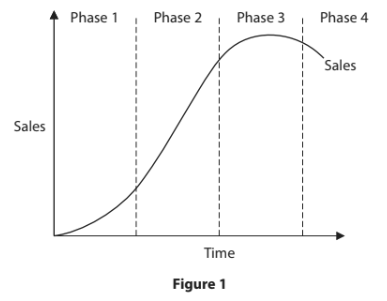
What is Phase 4 called?
Decline
Growth
Introduction
Maturity
Was this exam question helpful?
Which one of the following is an element of the design mix?
Function
Price
Productivity
Profit
Was this exam question helpful?
Ocado plc is an online grocery retailer that does not own physical shops. Ocado purchases its groceries from food manufacturers such as Heinz or from other grocery retailers such as Marks & Spencer. It then sells these groceries through the Ocado website or through its app. Groceries are then delivered to each customer’s home. The company already has a 62% ‘excellent’ rating on Trustpilot for its customer service. This is higher than other supermarkets, such as Asda, that also offer online grocery shopping. Ocado is considering introducing a one-hour, same day delivery service.
In 2020, Ocado’s sales rose by more than 40% as demand for online grocery shopping increased. Ocado has invested in new technology in its warehouses. This has allowed Ocado to use a just in time (JIT) stock management system. As part of this investment, Ocado’s robots now can pick a customer’s order in less than 5 minutes. The robots have artificial intelligence and know that they should place heavy items such as milk at the bottom of a bag. This level of automation allowed Ocado to process an extra 30,000 orders each week during 2020. In order to increase its share of the grocery market, Ocado is considering expanding its range of ‘own label’ products to improve its offer to customers.
State one possible influence on the pricing strategy used by Ocado.
Was this exam question helpful?
Which one of the following is an element of the design mix? (1)
Select one answer.
Aesthetics
Extension
Packaging
Production
Was this exam question helpful?
Which one of the following elements of the marketing mix relates to the distribution of a product to the consumer?
Select one answer.
Promotion
Price
Product
Place
Was this exam question helpful?
TechGear Ltd is a UK-based company specialising in wearable technology such as smartwatches and fitness trackers. The business has grown rapidly in the last five years, expanding into Europe and Asia. Its focus is on innovative design and advanced features.
However, the market is highly competitive, with strong rivals such as Apple and Samsung. TechGear faces high research and development costs and pressure to cut prices to remain competitive.
The directors are considering how to maintain growth and secure long-term success. They are discussing whether to continue investing heavily in research and development (R&D) or to shift focus towards lowering prices to attract more customers.
State one pricing strategy TechGear could use to attract more customers.
Was this exam question helpful?
JD Sports plc is a multinational sports, fashion and footwear retailer based in the UK. It owns a number of brands, including Footpatrol and Kukri. It has over 2,400 stores in 18 different countries. Most of its brands are targeted at the ‘athleisure’ market. This market consists of 16–24-year-olds who choose to wear sportswear outside of the gym. It uses targeted online advertising to direct customers to one of its websites, such as www.jdsports.co.uk. It also sponsors UK boxing star Anthony Joshua and Bournemouth Football Club.
In March 2019, JD Sports announced that it was taking over loss-making, rival sports footwear retailer Footasylum for £90.1 million. Footasylum, like JD Sports, had its headquarters in Greater Manchester and was started by an ex-JD Sports director, David Makin. Footasylum had 69 stores in the UK in similar locations to JD Sports. Footasylum also targeted the ‘athleisure’ market and used to sell identical trainer brands to JD Sports such as Nike, Adidas and Puma. JD Sports brands itself as the ‘King of Trainers' in an attempt to compete with main rival Sports Direct.
In July 2019, the Competition and Markets Authority (CMA) announced an investigation into the takeover. It was worried about the impact that the takeover might have on consumers and suppliers.
Outline one benefit to JD Sports of having a website.
Was this exam question helpful?
Ocado plc is an online grocery retailer that does not own physical shops. Ocado purchases its groceries from food manufacturers such as Heinz or from other grocery retailers such as Marks & Spencer. It then sells these groceries through the Ocado website or through its app. Groceries are then delivered to each customer’s home. The company already has a 62% ‘excellent’ rating on Trustpilot for its customer service. This is higher than other supermarkets, such as Asda, that also offer online grocery shopping. Ocado is considering introducing a one-hour, same-day delivery service.
In 2020, Ocado’s sales rose by more than 40% as demand for online grocery shopping increased. Ocado has invested in new technology in its warehouses. This has allowed Ocado to use a just-in-time (JIT) stock management system. As part of this investment, Ocado’s robots can now pick a customer’s order in less than 5 minutes. The robots have artificial intelligence and know that they should place heavy items such as milk at the bottom of a bag. This level of automation allowed Ocado to process an extra 30,000 orders each week during 2020. In order to increase its share of the grocery market, Ocado is considering expanding its range of ‘own label’ products to improve its offer to customers.
Outline one possible method, other than faster delivery, that Ocado could use to differentiate its service.
Was this exam question helpful?
Explain one method a business could use to differentiate its product.
Was this exam question helpful?
Explain one benefit to a business of withdrawing a product when it enters the decline phase of its product life cycle.
Was this exam question helpful?
Explain one benefit to a business from improving the aesthetic element of a product’s design mix.
Was this exam question helpful?
Explain one drawback to a business from differentiating its product.
Was this exam question helpful?
Explain one reason why aesthetics may be important in the design mix of a product.
Was this exam question helpful?
Discuss the likely impact on a business of carrying out extensive advertising.
Was this exam question helpful?
Kentucky Fried Chicken (KFC) is a fast food chain that sells fried chicken. Amongst its most popular products are Popcorn Chicken, Boneless Chicken boxes and Zinger Tower burgers. These are freshly cooked in batches in each of its 900 restaurants across the UK.
In 2017, KFC changed the company it used to transport its supplies of chicken. It replaced Bidvest with DHL. Bidvest had three distribution centres across the UK, but DHL only had one. In February 2018, DHL started to have logistical problems causing many KFC restaurants to run out of chicken. This led to a temporary closure of many KFC branches due to poor supplier reliability.
As a result of these closures, KFC started losing market share to rival fast food restaurants such as Burger King. KFC used social media and a viral advertising campaign to apologise to customers. It also considered lowering the prices of its most popular food items to win back lost customers and recapture market share.
Analyse the impact on KFC of changes to its marketing mix following the 2018 logistical problems.
Was this exam question helpful?
Explain one pricing method a business may use when launching a new product.
Was this exam question helpful?
Explain one benefit to a business of balancing its product's design mix.
Was this exam question helpful?
Discuss the benefits of using sponsorship of high-profile sport events as a promotional method.
Was this exam question helpful?
Explain one reason why place is an important element of a successful marketing mix.
Was this exam question helpful?
Tesla is a public limited company based in California, USA. Its founder and main shareholder, Elon Musk, wanted to produce an electric car that is affordable to a large number of potential customers. This car is called the Tesla Model 3 (Figure 3).
Introduced in 2017, the basic version of the Model 3 was originally priced at $50 000 and the company wanted to reduce this price to $35 000 by 2019. However, this was difficult to achieve because Tesla’s California factory suffered from low levels of productivity. These problems resulted in Tesla making a $976 million loss in 2018

Following the introduction of tariffs on US imports by the Chinese government in 2018, Tesla decided to invest $5 billion in the construction of a new car factory in Shanghai, China. This factory will use flow production. However, with only $2.4 billion of available capital, Tesla needs to raise external finance to fund it.
In 2019, Tesla decided to close most of its showrooms to reduce costs. The company believes customers will be happy to purchase electric cars using e-commerce.
Analyse the impact on Tesla of lowering the price of its Model 3 electric vehicle (EV).
Was this exam question helpful?
Explain one advantage of using social media for promotion.
Was this exam question helpful?
Sarah is the sole owner of a sandwich shop located in a busy town centre. The shop opened two years ago and employs two part-time staff members who help prepare food and serve customers. The shop sells freshly made sandwiches, soups and hot drinks, which are prepared on site each day.
The business attracts office workers, students and shoppers. Sarah prides herself on the freshness and quality of her products, which are made to order. Her prices are slightly higher than pre-packaged sandwiches sold in supermarkets.
Recently, a large supermarket chain opened nearby, selling cheaper sandwiches. Since then, Sarah has noticed her sales have started to fall. In March, Sarah’s revenue was £8,000, but in April this dropped by 15%. Her costs, however, have stayed the same at £6,200 per month.
Sarah is considering ways to respond. One option is to lower her prices to match the supermarket. Another option is to emphasise freshness, quality and customer service to encourage loyalty. She is also looking at launching online orders with local delivery to reach more customers and boost sales.
Analyse the benefits to Sarah of using online delivery for her sandwiches.
Was this exam question helpful?
Explain one advantage to a business of using the design mix when developing new products.
Was this exam question helpful?
QualQuick Ltd is a medium-sized supermarket chain with 120 stores across the UK. It focuses on fresh produce and convenience items, and has expanded steadily in recent years. The business aims to differentiate itself through high-quality local sourcing and eco-friendly packaging.
However, QualQuick faces growing competition from discount retailers such as Aldi and Lidl, which attract price-sensitive customers. Sales growth has slowed, and profit margins have fallen.
The directors are considering new strategies to increase competitiveness. They are debating whether to:
Option 1: Expand into online grocery deliveries.
Option 2: Focus on opening more small convenience stores in city centres.
Analyse the importance of product differentiation for QualQuick in a competitive supermarket market.
Was this exam question helpful?
Explain one method that a business could use to extend the life cycle of one of its products.
Was this exam question helpful?
Explain one reason why a business may increase its product range.
Was this exam question helpful?
Explain one reason why a business may use sponsorship to promote a product.
Was this exam question helpful?
Popeyes is an American fried chicken fast-food chain. It is well known for its Louisiana-style fried chicken that is marinated overnight in a mix of spices. As well as traditional chicken sandwiches and chicken wings, Popeyes has unusual items on its menu, such as American-style biscuits and Cajun gravy. The success of its restaurants has surprised the company. To meet the high level of demand for its fried chicken, Popeyes had to redesign the layout of its kitchens and serving areas and re-train employees. Since opening in 2021, its Stratford restaurant in London has become Popeyes’ best-performing outlet in the world, often with queues of between 50 to 100 people waiting outside.
However, Popeyes is not the only American fast-food chain that has found the UK attractive. Wendy’s, Shake Shack and Wingstop have all entered the UK market since 2018. Together with established chains, such as KFC and Burger King, this has made the UK fast-food market highly competitive. This has created problems for restaurant managers since they are struggling to find enough trained employees in places such as London and Birmingham. Skilled chefs and kitchen staff are in high demand, which has led to higher wage rates.
Analyse the importance to Popeyes of differentiating its products. (6)
Was this exam question helpful?
Kentucky Fried Chicken (KFC) is a fast food chain that sells fried chicken. Amongst its most popular products are Popcorn Chicken, Boneless Chicken boxes and Zinger Tower burgers. These are freshly cooked in batches in each of its 900 restaurants across the UK.
In 2017, KFC changed the company it used to transport its supplies of chicken. It replaced Bidvest with DHL. Bidvest had three distribution centres across the UK, but DHL only had one. In February 2018, DHL started to have logistical problems causing many KFC restaurants to run out of chicken. This led to a temporary closure of many KFC branches due to poor supplier reliability.
As a result of these closures, KFC started losing market share to rival fast food restaurants such as Burger King. KFC used social media and a viral advertising campaign to apologise to customers. It also considered lowering the prices of its most popular food items to win back lost customers and recapture market share.
In order to regain its lost market share, KFC considered two options:
Option 1: lower prices
Option 2: use viral advertising.
Justify which one of these two options KFC should choose.
Was this exam question helpful?
Iceland is a supermarket that sells frozen food. Although the grocery industry is very competitive, Iceland enjoyed a successful 2017. Sales revenue increased by 2.0% allowing profits to increase by £9.5 million to £160 million.
Iceland believes this success has been due to improved marketing. It has introduced new products using the Slimming World and Millie’s Cookies brand names. It also launched a new advertising campaign called ‘The Power of Frozen’. In addition it has developed a new store format called ‘The Food Warehouse’. These stores are much larger than a normal Iceland store which allows them to stock more luxury products. Iceland hopes that The Food Warehouse will help it to appeal to high-income customers and it plans to open more stores.

In 2018, Iceland received positive publicity from its decision to ban all plastic packaging on its own-brand products by 2023. It intends to replace plastic with recycled paper, as shown in Figure 3. A survey of 5,000 of its customers showed that 80% of them agreed with the change. Pressure groups, such as Friends of the Earth, have welcomed Iceland’s decision. Plastic waste has caused pollution of the world’s oceans and has killed marine life. Pressure groups hope that Iceland’s decision will be repeated by other supermarkets in the UK.
Evaluate whether Iceland is likely to benefit from its decision to ban all plastic packaging on its own-brand products. You should use the information provided as well as your knowledge of business.
Was this exam question helpful?
ASOS plc is an online fashion retailer which targets customers in their 20s. The company started in 2000 and since then it has grown significantly. One of the main reasons for its growth is what Chief Executive Nick Beighton calls, the ‘ASOS Experience’.

The company focuses on high quality logistics to distribute its products and increased use of warehouse technology. This has resulted in a warehouse and distribution system which is almost fully automated (Figure 4). This allows ASOS to deliver customer orders the next day, so long as the order is placed online before midnight. Automation has also given ASOS the ability to increase the range of clothes it can sell on its website

However, the market for clothes in the UK is becoming increasingly competitive. Despite a significant growth in sales, ASOS’s profits have fallen. This has caused the company’s share price to fall. ASOS has responded by focusing on viral advertising. Its latest campaign is to get customers to use the hashtag #AsSeenOnMe (Figure 5) when they are showing off their latest ASOS outfit on social media. In return, ASOS gives customers the opportunity to be featured on the ASOS Instagram feed which has 7.1 million followers.
In order to increase its profits, ASOS is considering two options:
Option 1: lower prices
Option 2: advertise on more social media channels.
Justify which one of these two options ASOS should choose.
Was this exam question helpful?
Greggs plc is a company that produces baked goods such as sausage rolls, savoury snacks and cakes. It has more than 1,900 shops and a number of factories located across the UK.
In 2018, Greggs planned to open a further 130 shops to cope with its continued growth in sales. It wanted to increase the use of technology in its factories, where it uses batch production. To be able to cope with this expansion, Greggs also planned to invest in improved logistics.
The growth of Greggs has been a UK high street success story. From originally being based in Newcastle and the north-east, it has expanded rapidly across the whole of the UK. It has switched away from selling traditional bakery products, such as bread, to become more like a fast food chain. As a result, Greggs now sell a variety of takeaway goods such as pizza, soup, coffee and sandwiches and operates in the very competitive ‘food-to-go’ market. Its main rivals are Pret a Manger, Costa and Starbucks.
In 2019, Greggs gained national publicity by becoming the first food retailer to start selling vegan sausage rolls. It is hoped that products such as this will help Greggs stand out from its rivals. The vegan sausage roll is priced at £1, 10p more than the meat-based equivalent.
In order to continue the growth in its sales, Greggs is considering two options:
Option 1: differentiate its product range
Option 2: lower its prices.
Justify which one of these two options Greggs should choose.
Was this exam question helpful?
JD Sports plc is a multinational sports, fashion and footwear retailer based in the UK. It owns a number of brands including Footpatrol and Kukri. It has over 2,400 stores in 18 different countries. Most of its brands are targeted at the ‘athleisure’ market. This market consists of 16–24 year olds who choose to wear sportswear outside of the gym. It uses targeted online advertising to direct customers to one of its websites, such as www.jdsports.co.uk. It also sponsors UK boxing star, Anthony Joshua and Bournemouth football club.
In March 2019, JD Sports announced that it was taking over loss-making, rival sports footwear retailer Footasylum for £90.1 million. Footasylum, like JD Sports, had its headquarters in Greater Manchester and was started by an ex-JD Sports director, David Makin. Footasylum had 69 stores in the UK in similar locations to JD Sports. Footasylum also targeted the ‘athleisure’ market and used to sell identical trainer brands to JD Sports such as Nike, Adidas and Puma. JD Sports brands itself as the ‘King of trainers’, in an attempt to compete with main rival Sports Direct.
In July 2019, the Competition and Markets Authority (CMA) announced an investigation into the takeover. It was worried about the impact that the takeover might have on consumers and suppliers.
In order to improve its competitive advantage, JD Sports is considering two options:
Option 1: targeted online advertising
Option 2: sponsorship.
Justify which one of these two options JD Sports should choose.
Was this exam question helpful?
Ocado plc is an online grocery retailer that does not own physical shops. Ocado purchases its groceries from food manufacturers such as Heinz or from other grocery retailers such as Marks & Spencer. It then sells these groceries through the Ocado website or through its app. Groceries are then delivered to each customer's home. The company already has a 62% 'excellent' rating on Trustpilot for its customer service. This is higher than other supermarkets, such as Asda, that also offer online grocery shopping. Ocado is considering introducing a one-hour, same day delivery service.
In 2020, Ocado's sales rose by more than 40% as demand for online grocery shopping increased. Ocado has invested in new technology in its warehouses. This has allowed Ocado to use a just in time (JIT) stock management system. As part of this investment, Ocado's robots now can pick a customer's order in less than 5 minutes. The robots have artificial intelligence and know that they should place heavy items such as milk at the bottom of a bag. This level of automation allowed Ocado to process an extra 30,000 orders each week during 2020. In order to increase its share of the grocery market, Ocado is considering expanding its range of 'own label' products to improve its offer to customers.
In order to increase its share of the online grocery market, Ocado has considered two options:
Option 1: offering a faster delivery service
Option 2: expanding its product range.
Justify which one of these two options Ocado should choose.
Was this exam question helpful?
Cineworld plc is the UK’s largest cinema chain. It owns 127 multi-screen cinemas in a variety of city centre and out of town locations. Several sites have 4DX screens, which have seats that move ‘in sync’ with what is happening in the movie. In 2019, Cineworld had accumulated £2.3 billion of debt due to rapid external growth. Due to the global health crisis in 2020, the government forced a shut-down of all cinemas. Since re-opening in 2021, ticket sales at Cineworld cinemas have been low. The blockbuster movies that normally attract people to the cinema, such as ‘Spider-Man: No Way Home’, have been lacking in number and quality. Home streaming services, such as Apple TV and Netflix, have made visiting the cinema less attractive. These factors led to Cineworld making a £537 million loss in 2022, leaving the company close to failure. The Cineworld share price has fallen from over £3 in 2019 to less than 2p in 2023. The company needs cash to cover its loan repayments.
Rival cinema companies, such as Vue, have encountered similar problems and have reduced the price of a ticket to £6.99 to attract people back to watching movies at the cinema. However, Cineworld has so far refused to do this. It still charges £18.69 for its most expensive tickets.
Evaluate the importance of charging lower prices to allow Cineworld to return to profit. You should use the information provided as well as your knowledge of business.
Was this exam question helpful?