Acids & Alkalis (AQA GCSE Combined Science: Synergy: Physical Sciences): Exam Questions

Exam code: 8465

1 hour11 questions
1a
1 mark

This question is about acids and alkalis.

Which ion is produced by all acids in aqueous solution?

  • Cl-

  • H+

  • Na+

  • OH-

1b
1 mark

The pH scale is a measure of the acidity or alkalinity of a solution.

What is used to measure the pH of a solution?

  • Iodine solution

  • Limewater

  • Universal indicator

1c
1 mark

Give one safety precaution used when measuring the pH of an acid.

1d
1 mark

Sodium hydroxide solution reacts with sulfuric acid to produce a salt and one other product.

Which salt is produced when sodium hydroxide solution reacts with sulfuric acid?

  • Sodium chloride

  • Sodium nitrate

  • Sodium sulfate

1e
1 mark

What is the other product when sodium hydroxide solution reacts with sulfuric acid?

  • Oxygen

  • Sodium

  • Water

1f
2 marks

Draw one line from each solution to the pH of that solution.
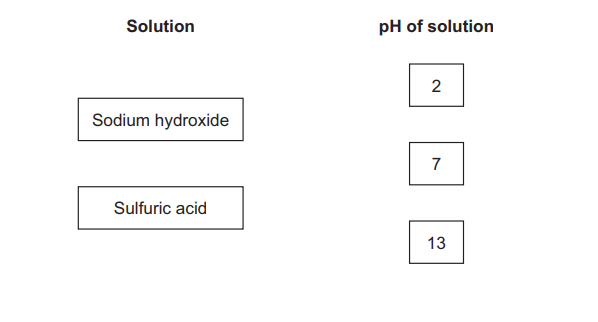
Diagram asking to match solutions sodium hydroxide and sulphuric acid with pH values 2, 7 and 13 shown in separate boxes
1g
1 mark

What is the type of reaction when sodium hydroxide solution reacts with sulfuric acid?

  • Combustion

  • Decomposition

  • Neutralisation

2a
2 marks

This question is about acids and alkalis.

Magnesium reacts with acids to produce a salt and hydrogen.

The ionic equation for the reaction is:

Mg + 2H+ → Mg2+ + H2

In a redox reaction, both oxidation and reduction occur.

Explain why this reaction is described as a redox reaction.

2b
1 mark

What happens to the pH of an acid when the hydrogen ion concentration decreases by a factor of ten?

Select your answer.

  • The pH decreases by 1.

  • The pH decreases by 10.

  • The pH increases by 1.

  • The pH increases by 10.

2c
2 marks

Write the ionic equation that represents the neutralisation reaction between an acid and an alkali in aqueous solution.

You should include state symbols.

2d
3 marks

Potassium reacts with water to form a solution with a pH of 13.

Explain why the solution has a pH of 13.

You should refer to ions in your answer.

2e
3 marks

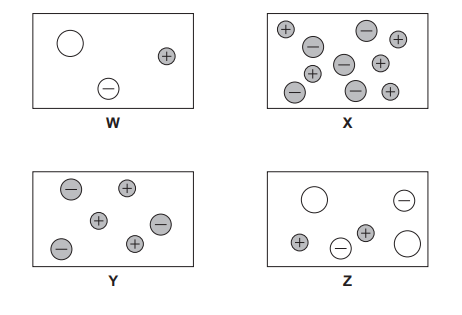
Figure 12 shows four models representing the same volume of:

  • a strong acid at two different concentrations

  • a weak acid at two different concentrations.

[IMAGE: Figure 12 — Four models labelled W, X, Y and Z showing particles in containers. Each model shows different numbers and types of particles (ionised and un-ionised) representing different acids at different concentrations.]

Which model represents the weak acid with the higher concentration?

Select your answer.

W

X

Y

Z

Justify your answer.

2f
2 marks

Give two limitations of using the models in Figure 12 to represent acids.

3a
1 mark

This question is about acids and alkalis.

Universal indicator is used to measure the pH of solutions.

Which is a pH value of an alkaline solution?

  • 5

  • 7

  • 9

3b
1 mark

Which is a colour of universal indicator in an alkaline solution?

  • Blue

  • Red

  • Yellow

3c
1 mark

What piece of equipment measures the pH of a solution more accurately than universal indicator?

3d
1 mark

Which ion do all acids produce in aqueous solution?

  • H+

  • OH-

  • O2-

3e
1 mark

The reaction between an acid and an alkali produces water.

What is the name of this type of reaction?

  • Combustion

  • Decomposition

  • Neutralisation

4a
1 mark

Calcium reacts with hydrochloric acid.

The word equation for the reaction is:

calcium + hydrochloric acid → calcium chloride + hydrogen

Which state symbol is used for the hydrogen produced in this reaction?

  • (aq)

  • (g)

  • (l)

  • (s)

4b
1 mark

TABLE 4 shows the mass of calcium chloride produced when different masses of calcium react with hydrochloric acid.

TABLE 4

Mass of calcium reacted in grams

Mass of calcium chloride produced in grams

0.0

0.0

0.5

1.4

1.0

2.8

1.5

4.2

2.0

5.6

Complete the sentence.

Use TABLE 4.

As the mass of calcium reacted increases, the mass of calcium chloride produced __________________________ .

4c
4 marks

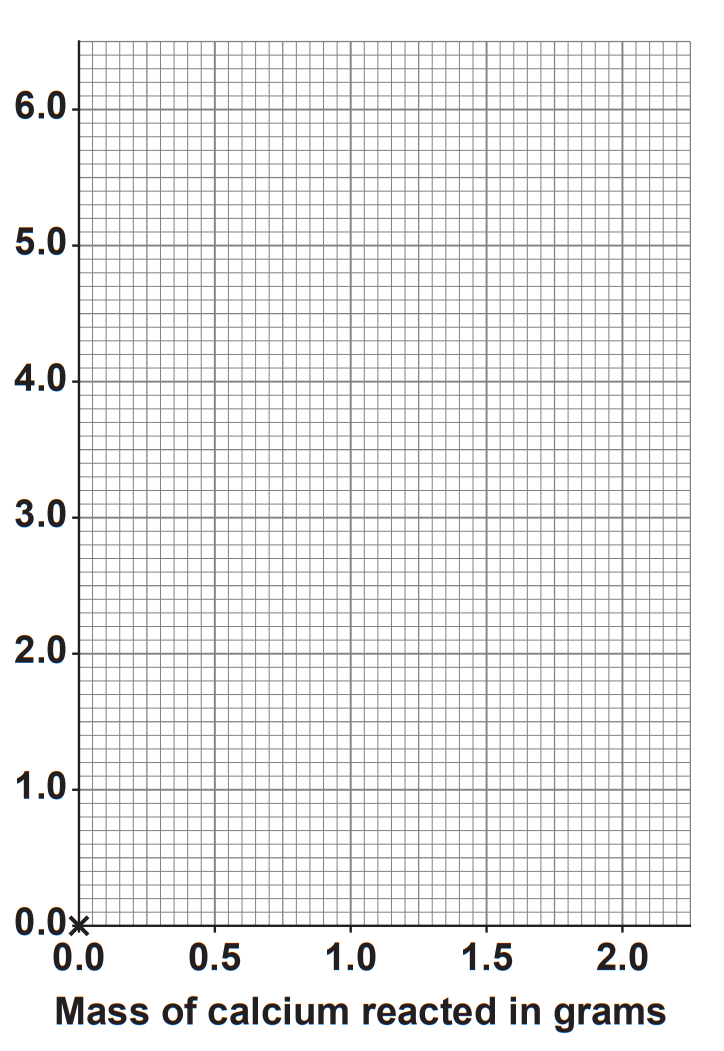
Complete FIGURE 11.

You should:

  • label the y-axis

  • plot the data from TABLE 4

  • draw a line of best fit.

The point at 0.0, 0.0 has been plotted for you.

Mass of calcium reacted in grams

Mass of calcium chloride produced in grams

0.0

0.0

0.5

1.4

1.0

2.8

1.5

4.2

2.0

5.6

FIGURE 11

Blank grid graph with x-axis labelled “Mass of calcium reacted in grams” from 0.0 to 2.0 and y-axis from 0.0 to 6.0, no data plotted
4d
1 mark

Predict the mass of calcium chloride produced when 1.25 g of calcium reacts with hydrochloric acid.

Use FIGURE 11.

Mass of calcium chloride = ___________ g

5a
2 marks

Copper carbonate reacts with hydrochloric acid to produce copper chloride and two other products.

Name the TWO other products formed when copper carbonate reacts with hydrochloric acid.

Do NOT refer to copper chloride.

5b
6 marks

Describe a method to make pure, dry crystals of copper chloride from copper carbonate and hydrochloric acid.

6a
6 marks

A student investigated the reaction between citric acid powder and sodium hydrogen carbonate solution.

The temperature of the reaction mixture decreased.

Plan a method to investigate how changing the mass of citric acid affects the lowest temperature reached by the mixture.

6b
1 mark

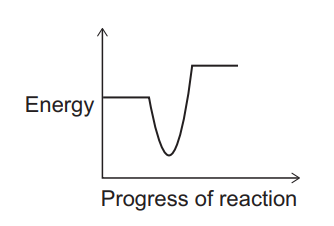
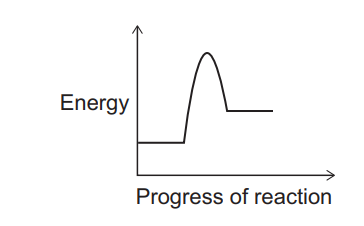
The reaction between citric acid and sodium hydrogen carbonate is endothermic.

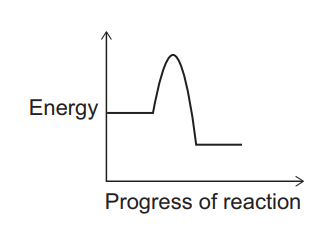
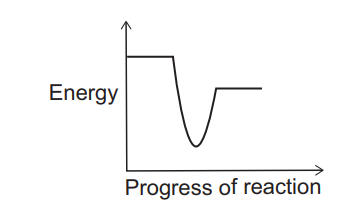
Which reaction profile represents an endothermic reaction?

Tick (✓) one box.

  • Energy profile graph showing reaction progress with reactants at medium energy, a dip to lower energy, then products at higher energy than reactants
  • Energy profile graph of a chemical reaction showing a low starting level, a peak activation energy hump, then a higher constant energy for products
  • Energy profile graph showing progress of reaction with a single peak activation energy and final energy level lower than the initial level
  • Energy profile graph showing a reactant plateau, a deep energy dip for an intermediate, then a higher product plateau versus progress of reaction
6c
2 marks

Explain why the rate of reaction is greater when powder is used instead of larger lumps.

Refer to surface area and collisions in your answer.

7a
1 mark

What is meant by a 'weak acid'?

7b
1 mark

Name ONE weak acid.

7c
1 mark

The pH value of a solution decreases by one.

How does the hydrogen ion concentration of this solution change?

Tick (✓) ONE box.

  • Decreases by a factor of 10

  • Decreases by a factor of 100

  • Increases by a factor of 10

  • Increases by a factor of 100

8a
6 marks

The salt copper sulfate can be made by reacting copper carbonate with dilute sulfuric acid.

CuCO₃(s) + H₂SO₄(aq) → CuSO₄(aq) + H₂O(l) + CO₂(g)

Write a method that a student could use to prepare a pure, dry sample of copper sulfate.

You do not need to write a risk assessment or include safety points.

8b
Sme Calculator
4 marks

Calculate the number of molecules in 14 g of carbon dioxide.

Give your answer in standard form.

Relative atomic masses (Aᵣ): C = 14; O = 16

Answer = molecules

(Use the Avogadro constant: 1 mole = 6.02 × 10²³ molecules.)

9a
2 marks

This question is about acids and salts.

Nitric acid is a strong acid.

A solution of nitric acid can be dilute.

Explain how nitric acid can be both strong and dilute.

9b
1 mark

The pH value of a solution of nitric acid increases by 1.

How does the hydrogen ion concentration of the solution change?

Tick (✓) one box.

  • Decreases by a factor of 10

  • Decreases by a factor of 100

  • Increases by a factor of 10

  • Increases by a factor of 100

9c
5 marks

A student reacted nitric acid with excess calcium carbonate.

The word equation for the reaction is:

calcium carbonate + nitric acid → calcium nitrate + water + carbon dioxide

This is the method used.

  1. Measure 100 cm³ of nitric acid into a beaker.

  2. Add calcium carbonate powder to the nitric acid.

  3. Stir the mixture.

  4. Repeat steps 2 and 3 until the calcium carbonate is in excess.

  5. Filter the mixture.

Describe the additional steps that should be included in the method to determine the mass of calcium carbonate that reacted.

9d
1 mark

What is the formula of calcium nitrate?

Use the periodic table.

Tick (✓) one box.

  • CaNO₃

  • Ca(NO₃)₂

  • Ca₂NO₃

  • Ca₂(NO₃)₃

10a
2 marks

Excess hydrochloric acid in the stomach can cause pain. The excess hydrochloric acid can be neutralised by a calcium carbonate tablet.

A student investigated how the pH changed when a calcium carbonate tablet was added to hydrochloric acid.

This is the method used.

  1. Add 10 cm³ of hydrochloric acid to a beaker.

  2. Measure the pH of the hydrochloric acid using an indicator.

  3. Add a calcium carbonate tablet to the hydrochloric acid.

  4. Time for 3 minutes.

  5. Measure the pH of the mixture using an indicator.

Which two of the following pieces of equipment are needed in this method?

Tick (✓) two boxes.

  • Measuring cylinder

  • Newtonmeter

  • Ruler

  • Stop clock

  • Thermometer

10b
1 mark

Name an indicator used to measure pH.

10c
1 mark

Name a piece of equipment that gives a more accurate pH value than an indicator.

10d
1 mark

The word equation for the reaction is:

calcium carbonate + hydrochloric acid → calcium chloride + water + carbon dioxide

Why is fizzing seen during the reaction?

10e
1 mark

Give one safety precaution the student should have taken.

10f
1 mark

What is the pH of a neutral solution?

Tick (✓) one box.

  • 1

  • 4

  • 7

  • 10

10g
4 marks

A student reacted hydrochloric acid with excess calcium carbonate.

A solution of calcium chloride was produced.

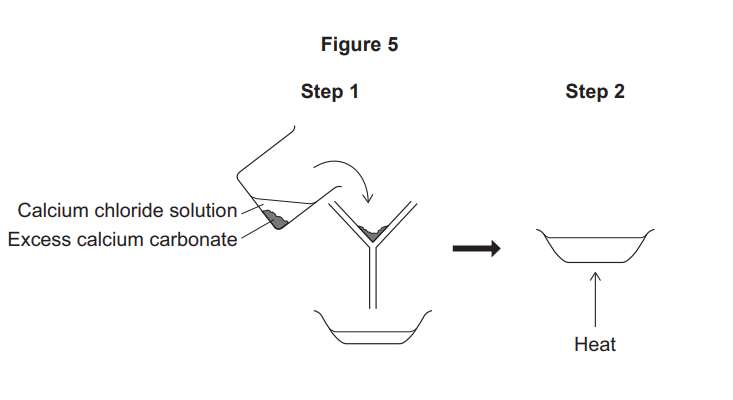
Figure 5 shows the method used to produce calcium chloride crystals from the reaction mixture.

Diagram showing calcium chloride solution and excess calcium carbonate filtered, then the filtrate heated in an evaporating basin in two experimental steps

Describe the method shown in Figure 5 to produce calcium chloride crystals from the reaction mixture.

Include the equipment used.

11a
1 mark

Acids produce hydrogen ions in aqueous solutions.

What is the ionic equation for neutralisation reactions?

Tick (✓) one box.

  • H⁺(aq) + H₂O(l) → H₃O⁺(aq)

  • H⁺(aq) + OH⁻(aq) → H₂O(l)

  • 2 H₂O(l) → H₃O⁺(aq) + OH⁻(aq)

  • H₂O(l) → 2 H⁺(aq) + O²⁻(aq)

11b
1 mark

Sulfuric acid reacts with copper carbonate to produce a salt, water and carbon dioxide.

\text{H}_2\text{SO}_4 + \text{CuCO}_3 \rightarrow \text{CuSO}_4 + \text{H}_2\text{O} + \text{CO}_2

What is the name of the salt produced?