11 mark
Complete the sentence below by underlining the correct word in brackets.
The ( acceleration / mass / speed ) of a car is a measure of its inertia.
Was this exam question helpful?
Exam code: 3430
Complete the sentence below by underlining the correct word in brackets.
The ( acceleration / mass / speed ) of a car is a measure of its inertia.
Was this exam question helpful?
Each crate of apples has a weight of 450 N.
The mass of the empty crate is 12 kg.
Calculate the mass of apples contained in the crate.
(On Earth, an object of weight 10 N has a mass of 1 kg.)
Mass of apples = .......... kg
Was this exam question helpful?
A group of students investigate if the terminal speed of falling paper cake cases depends on their mass. They follow the method given below.
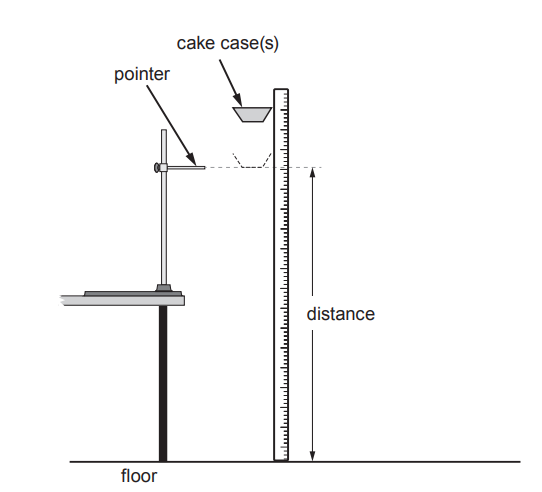
Set up a pointer in the clamp stand and set it 1.50 m above the ground.
Take a single cake case and record its mass using a balance.
Drop the cake case from 20 cm above the pointer.
Use a stopwatch to record the time it takes to fall from the level of the pointer to the floor.
Repeat steps 3 and 4 another four times.
Repeat steps 3–5 with extra cake cases in a stack.
(i) Give one reason why the students let the cake case fall for 20 cm before starting the stopwatch.
[1]
(ii) Give two reasons why the students take more than one repeat reading.
[2]
The following data are collected. The students assume that each of the cake cases has a mass of 0.5 g.
Number of cake cases | Mass of cake cases | Mean time taken to fall 1.50 m | Terminal speed (m/s) |
0 | 0 | — | 0 |
1 | 0.5 | 0.94 | 1.60 |
2 | 1.0 | 0.67 | 2.24 |
3 | 1.5 | 0.59 | 2.54 |
5 | 2.5 | .......... | 2.88 |
6 | 3.0 | 0.51 | 2.94 |
(i) Complete the table. Use an equation to calculate the missing value of the mean time.
[2]
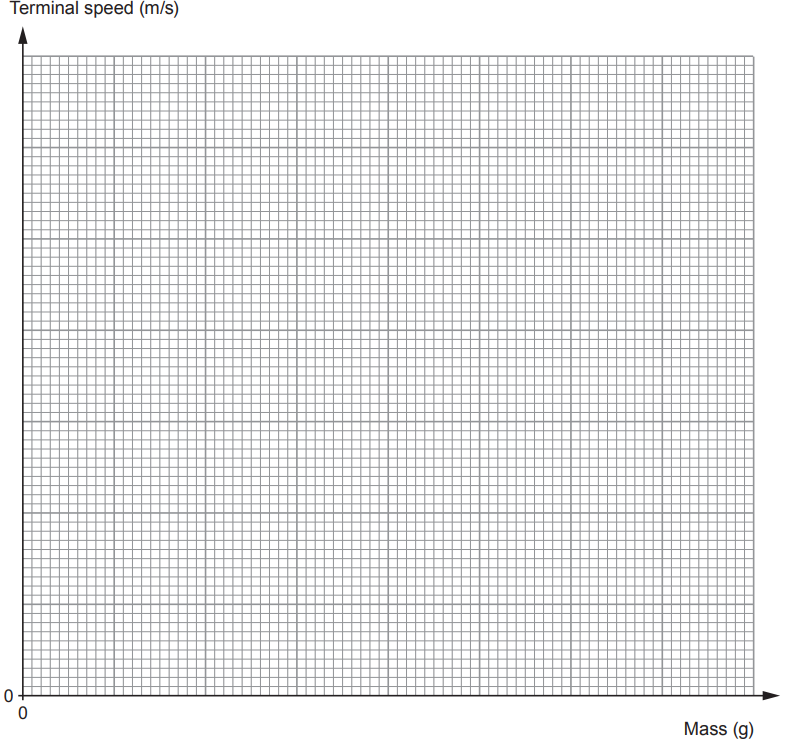
(ii) Plot the data on the grid below and draw a suitable line.
[4]
(iii) One of the students suggests that the terminal speed will always increase by a factor of 1.4 if the mass is doubled. The student finds that when the mass doubles from 0.5 g to 1.0 g this suggestion is true.
Explain if this is true for the other masses.
[3]
Apart from taking more repeat readings, suggest one way in which the method could be improved to collect better quality data and explain how the improvement would give better data.
Explaining your reasoning and using an equation from the formula sheet, calculate the size of the air resistance force acting on a stack of 5 cake cases when travelling at terminal speed.
(Gravitational field strength, g = 10 N/kg) [3]
Air resistance = .......... N
Was this exam question helpful?
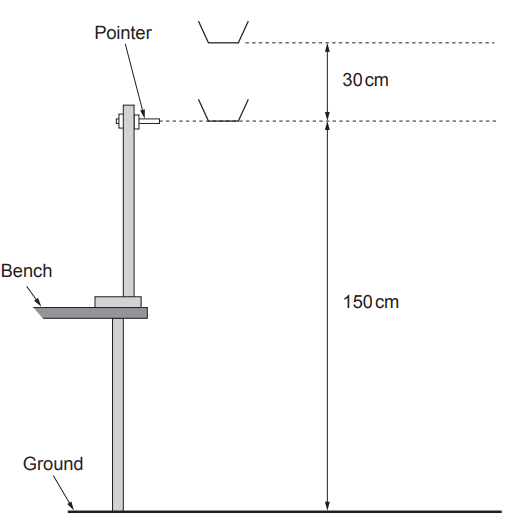
A group of students investigate the terminal speed of a number of cake cases.
They set up the following apparatus.
They drop the cake cases from rest at a point 30 cm above a pointer.
They measure the time taken for the different numbers of cake cases to fall 150 cm, from the pointer to the ground.
Complete the sentences below by underlining the correct phrase in the bracket.
[3]
(i) In this experiment, the independent variable is the
(number of cake cases / time of fall / height of pointer).
(ii) In this experiment, the dependent variable is the
(number of cake cases / time of fall / height of pointer).
(iii) During the first 30 cm of the fall, the cake cases
(speed up / slow down / fall at constant speed).
Five separate groups in the class carry out the same experiment.
Their results and calculated values are shown below.
Distance (cm) | Number of cake cases | Time of fall (s) | Terminal speed (m/s) | |||||
Group A | Group B | Group C | Group D | Group E | Mean | |||
0 | 0 | |||||||
150 | 1 | 0.86 | 0.88 | 0.91 | 0.90 | 0.85 | 0.88 | 1.7 |
150 | 2 | 0.72 | 0.72 | 0.67 | 0.65 | 0.66 | 0.68 | 2.2 |
150 | 3 | 0.60 | 0.59 | 0.62 | 0.60 | 0.61 | 0.60 | 2.5 |
150 | 4 | 0.55 | 0.56 | 0.55 | 0.75 | 0.58 | 2.7 | |
150 | 5 | 0.50 | 0.55 | 0.51 | 0.54 | 0.50 | 0.52 | 2.9 |
(i) Draw a circle around the anomalous result when 4 cake cases are dropped.
[1]
(ii) Calculate the mean time for 4 cake cases to fall 150 cm.
[2]
Mean time = .......... s
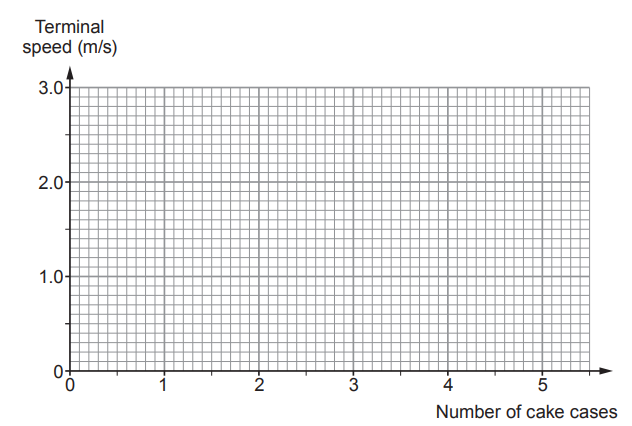
(i) Use the table below to plot the data on the grid and draw a suitable curve of best fit.
[3]
Number of cake cases | Terminal speed (m/s) |
0 | 0 |
1 | 1.7 |
2 | 2.2 |
3 | 2.5 |
4 | 2.7 |
5 | 2.9 |
(ii) Complete the following sentence below by underlining the correct phrase in each bracket.
[2]
As the number of cake cases increases, the terminal speed (increases / decreases / stays the same) at (an increasing / a decreasing/ a constant) rate.
Was this exam question helpful?
The safety of car drivers and passengers in the event of a collision has been the subject of an enormous amount of research in the last 50 years. As a result, the design of cars has developed to improve the safety of the occupants in the event of a head-on collision.
A crash dummy is positioned in the driving seat of a car, which is directed, under test conditions, into a solid concrete wall. The graph below shows the velocity of the dummy from the moment the car makes contact with the wall.
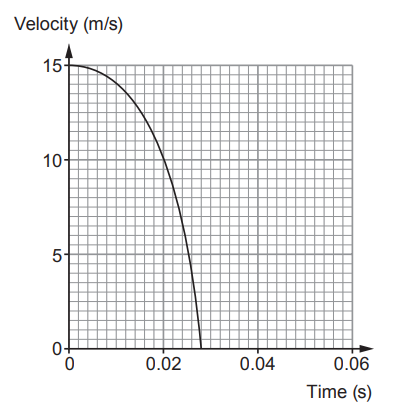
State Newton's third law of motion and explain how it applies to the car and the wall in this collision.
(i) Use the graph and equations to calculate the mean resultant force on the dummy of mass 85 kg during the collision.
Give your answer to two significant figures.
[3]
Mean resultant force = .......................... N
(ii) Use the graph to explain whether the resultant force is constant during the collision.
[2]
Was this exam question helpful?
The diagram shows a 5-carriage bi-modal electric/diesel train.

The table below shows information about two types of bi-modal electric/diesel trains.
Train | Mass (×105 kg) | Maximum speed (m/s) | Standard acceleration (m/s²) | Standard deceleration (m/s²) | Emergency deceleration (m/s²) |
5 carriage | 2.3 | 55.8 | 0.7 | 1.0 | 1.2 |
9 carriage | 4.4 | 55.8 | 0.7 | 1.0 | 1.2 |
For the journey from Swansea to London two of the 5-carriage trains are joined, making a 10-carriage train.
The 10-carriage train has the same speed and acceleration as a 5-carriage train.
(i) State Newton's second law of motion as an equation.
[1]
(ii) Use information from the table to answer the following questions.
I. Use an equation from page 2 to calculate the resultant force needed to accelerate the 10-carriage train.
[2]
Resultant force = .......... N
II. Use the equation:
acceleration =
to calculate the time taken to accelerate the 10-carriage train from rest to its maximum speed.
[2]
Time = .......... s
(iii) A student states that the 9-carriage train is approximately double the mass of the 5-carriage train and if they are both travelling at the same speed it will take approximately double the time to stop in an emergency.
Explain whether the 2 claims made by the student are correct.
[3]
Was this exam question helpful?
The same ball of mass 3 kg is dropped from the top of the building.
(i) Explain, in terms of named forces, why the ball reaches a terminal speed as it falls through the air.
[3]
(ii) Newton's 3rd law of motion applies to the ball as it falls.
Complete the table to describe the Newton's 3rd law force for each of the actions given.
[2]
Action | Newton's 3rd law force |
Earth pulls downwards on the ball | ........................................................... |
Ball pushes downwards against the air | ........................................................... |
Was this exam question helpful?
Newton’s third law states that if a body A exerts a force on body B, body B exerts an equal and opposite force on body A.
The diagram (not to scale) shows an apple of weight 1.5 N falling to the Earth.
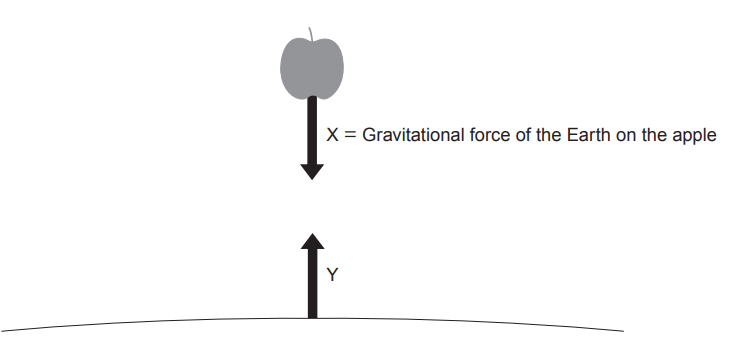
(i) Underline the correct word in the brackets to describe force Y.
[2]
Force Y is the (gravitational / magnetic / mass) force of the apple on the (air / Earth / Moon).
(ii) State how the two forces, X and Y, compare.
[1]
(iii) Use an equation to calculate the mass of the apple.
( = 10 N/kg = 10 m/s²)
[2]
mass = .......... kg
The apple is dropped from rest.
(i) State the initial acceleration of the apple.
[1]
acceleration = .......... m/s²
(ii) At some time later in the fall, the air resistance acting on the apple is 0.25 N.
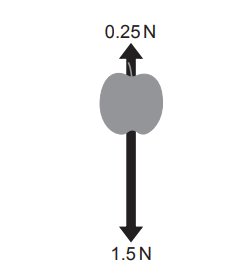
Determine the size of the resultant force acting on the apple.
[1]
resultant force = .......... N
(iii) Use the equation:
resultant force = mass acceleration
to calculate the new acceleration of the apple.
[3]
acceleration = .......... m/s²
The Apollo 15 astronaut David Scott performed an experiment on the Moon, where there is no air.
He predicted that if a hammer and a feather were dropped together from the same height, they would hit the Moon's surface at the same time.
Explain whether you agree with this prediction.
Was this exam question helpful?
A group of students is investigating how the terminal speed of cake cases is affected by the number being dropped.
They set up the apparatus as shown in the diagram below.
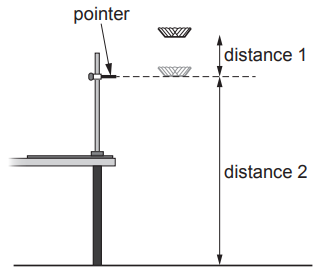
Describe a suitable method for this investigation. {align=right} [6 QER]
You should include in your answer:
how the apparatus is set up
suitable values for distances 1 and 2
the measurements taken.
The results from the investigation are shown in the table below.
Number of cake cases | Mass of cake cases (g) | Terminal speed (m/s) |
0 | 0.0 | 0.0 |
2 | 1.0 | 2.5 |
3 | ...................... | 4.8 |
4 | 2.0 | 4.3 |
5 | 2.5 | 5.0 |
6 | 3.0 | 5.5 |
(i) Complete the table.
[1]
(ii) I. Plot the data on the grid below.
[2]
II. Circle the anomalous result on the grid below.
[1]
III. Draw a suitable curve of best fit.
[1]
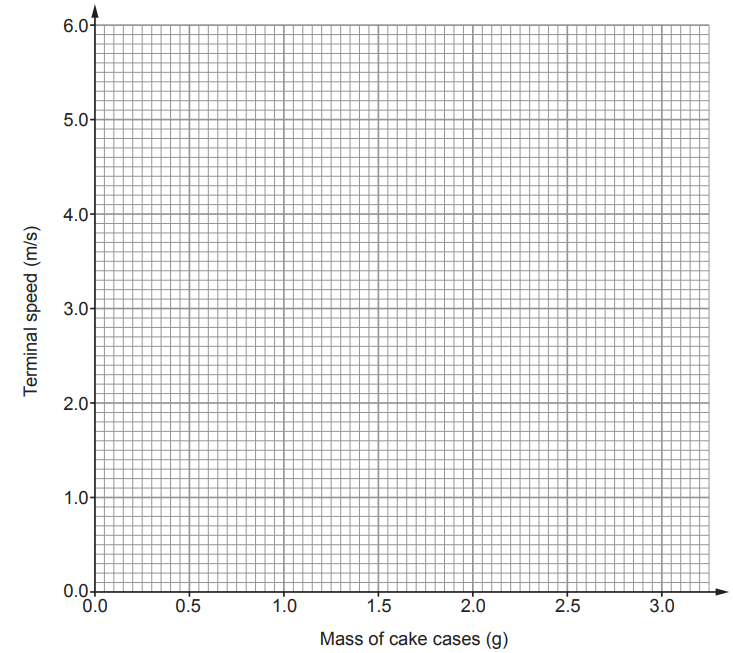
(iii) Use the graph to find the terminal speed for 1 cake case.
[1]
terminal speed =.........................m/s
Was this exam question helpful?
An experiment was carried out by students to investigate the mean speed of a stack of 6 cake cases falling from different heights.
The weight of 6 identical cake cases was measured 5 times.
Their results are shown below in Table 1 and there were no anomalies.
Table 1
Measurement | 1 | 2 | 3 | 4 | 5 |
Weight of 6 cake cases (N) | 0.036 | 0.032 | 0.033 | 0.034 | 0.030 |
(i) Calculate the mean weight of the 6 cake cases.
[1]
Mean weight = .......... N
(ii) Use the equation:
uncertainty =
to calculate the uncertainty in the mean weight of the 6 cake cases.
[1]
Uncertainty in the mean = .......... N
(iii) The teacher states if the percentage uncertainty in the mean is less than 10% the data is repeatable.
Use the equation:
percentage uncertainty =
to determine if the data collected is repeatable.
[2]
A graph of mean speed against drop height for the 6 cake cases is shown below.
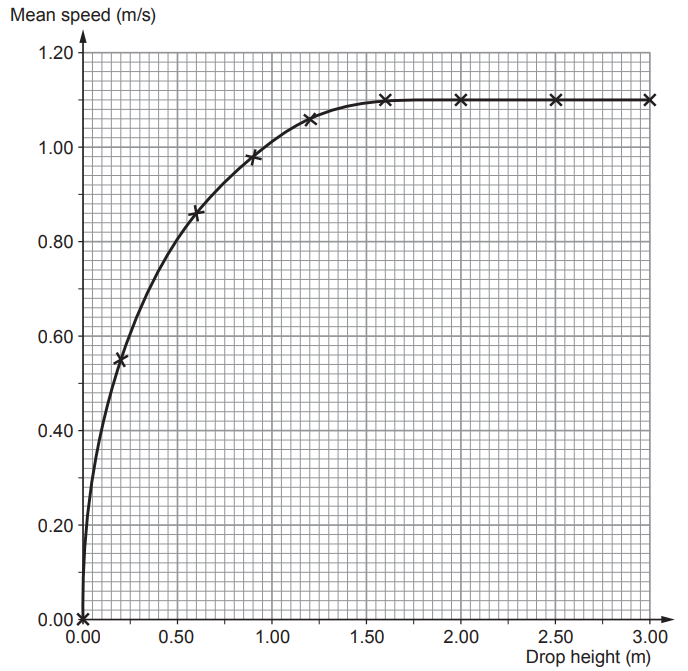
(i) Describe how the mean speed varies with drop height between 0.00 m and 1.50 m.
[2]
(ii) Use the graph to state the value of terminal speed for the cake cases.
[1]
Terminal speed = .......... m/s
(iii) I. Name the two forces acting on the falling cake cases.
[1]
II. Compare the size of these two forces when the cake cases fall at terminal speed.
[1]
Was this exam question helpful?
State what is meant by the inertia of a car.
Was this exam question helpful?
Students investigate the terminal speed of falling paper cake cases.
The apparatus they use is shown below.
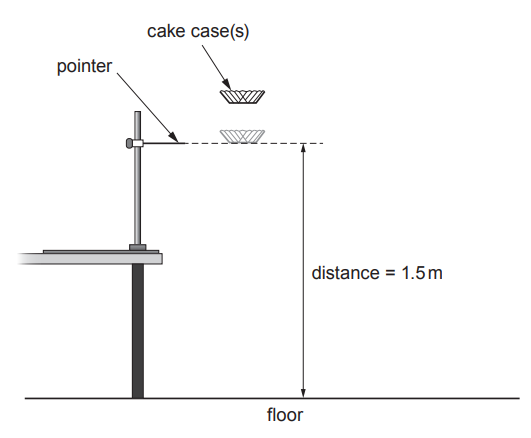
Their results are given in the table.
Number of cake cases | Time to fall (s) | ||||
Trial 1 | Trial 2 | Trial 3 | Mean | Terminal speed (m/s) | |
1 | 0.85 | 0.94 | 0.91 | 0.90 | 1.7 |
2 | 0.68 | 0.62 | 0.65 | 0.65 | 2.3 |
3 | 0.58 | 0.62 | 0.57 | 0.59 | 2.5 |
4 | 0.52 | 0.26 | 0.54 | 0.44 | 3.4 |
6 | 0.44 | 0.48 | 0.46 | 0.46 | 3.3 |
Use the results in the table to answer the following questions.
(i) Circle the anomalous result, in the table, for the time to fall.
[1]
(ii) Tom says that the mean time for 4 cake cases to fall is wrong.
Explain whether Tom is correct.
[2]
Tom thinks that as the number of cake cases doubles the terminal speed doubles.
Explain whether you agree with Tom.
(i) For 6 cases the times taken to fall are 0.44 s, 0.48 s and 0.46 s.
Use the equation:
to calculate the uncertainty in the measurements of time for 6 cake cases to fall.
[2]
uncertainty = .......... s
(ii) State one random error that is a cause of uncertainty when doing this experiment.
[1]
Was this exam question helpful?
Students investigate the terminal speed of falling paper cake cases.
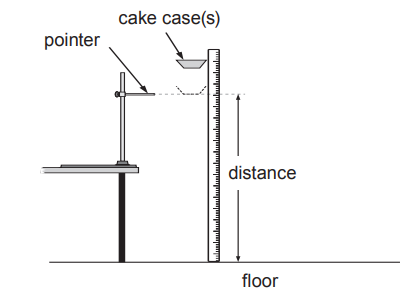
(i) State what is meant by terminal speed.
[1]
(ii) Describe how you would carry out the investigation to find out how the mass of falling paper cake cases affects their terminal speed.
[6]
Was this exam question helpful?
As part of a charity event a woman jumps from a tall tower and she safely lands on a large air bag that is beneath.
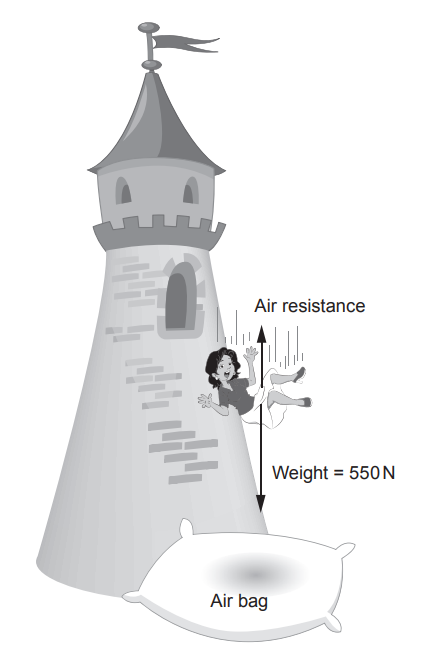
On Earth, an object of 1 kg has a weight of 10 N.
Calculate the mass of the woman.
Mass = .......... kg
Was this exam question helpful?