Work & Energy (WJEC GCSE Science (Double Award): Physics): Exam Questions

Exam code: 3430

2 hours15 questions
1
Sme Calculator
2 marks

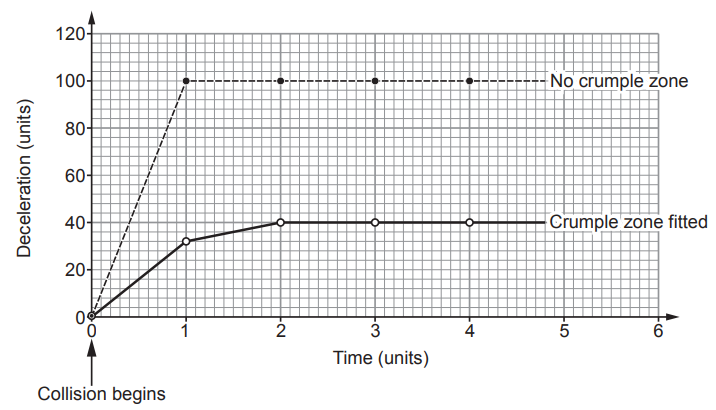
The graph below shows how the deceleration of car passengers compares during a collision with and without crumple zones fitted.
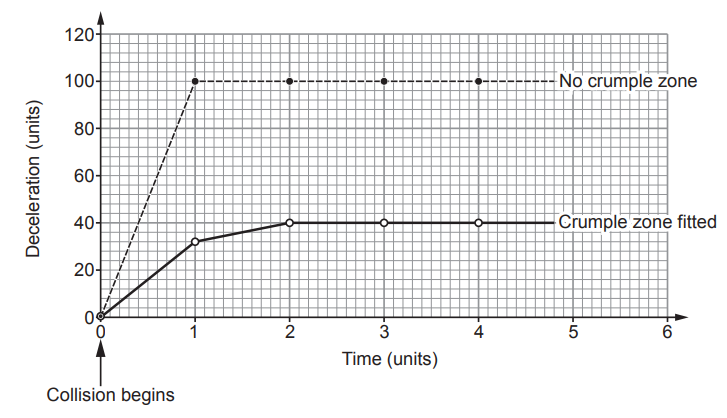
Graph of deceleration against time comparing a car with crumple zone, lower and spread over 4 units, and without, rising sharply to 100 units and staying constant

Use the information above to answer the following questions.

(i) When a crumple zone is fitted, state how long it takes to reach maximum deceleration after a collision begins.

[1]

time =.............................units

(ii) State the value of the maximum deceleration when the car has no crumple zone.

[1]

maximum deceleration =...............................units

2
Sme Calculator
5 marks

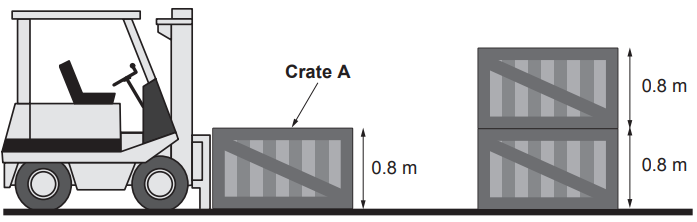
On a farm a fork-lift truck is used to stack wooden crates of Welsh apples.

Fork-lift truck positioned to lift crate A, 0.8 m high, on level ground, with two identical 0.8 m crates stacked vertically in the distance.

(i) Each crate of apples has a weight of 450 N and is 0.8 m high.

Use an equation W italic equals F d to calculate the work done in putting crate A on top of the 2 other crates.

[3]

Work done = .......... J

(ii) State the gain in potential energy (PE) of the crate when lifted on to the stack.

[1]

Gain in PE = .......... J

(iii) Give a reason why the fork-lift truck uses more energy lifting crate A than the work done calculated in part (i).

[1]

3
Sme Calculator
2 marks

Explain, in terms of the work done, how a crumple zone at the front of the car would improve the safety of the driver in a head-on collision.

4
Sme Calculator
10 marks

A ball of mass 3 kg has 750 J of potential energy when held at the top of a building.

The ball is then dropped from rest.

(i) Use the equation PE = mgh to calculate the height, h, of the building.

(acceleration due to gravity, g = 10 m/s²)

[3]

height, h = .................................. m

(ii) When the ball hits the ground it has 600 J of kinetic energy.

Use the equation KE = \frac{1}{2}mv^{2} to calculate the velocity of the ball at this moment.

[3]

velocity = .................................. m/s

(iii) Use the information above to calculate the work done against air resistance as the ball falls.

[1]

work done = .................................. J

(iv) Use the equation W = Fd and your answers to parts (a)(i) and (a)(iii) to calculate the mean force of air resistance during the fall.

[3]

mean force = .................................. N

5a
Sme Calculator
3 marks

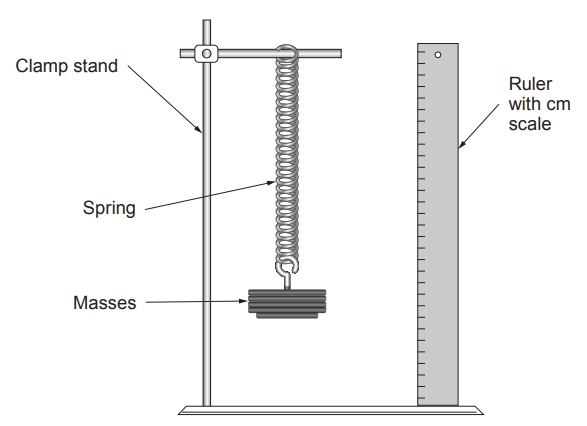
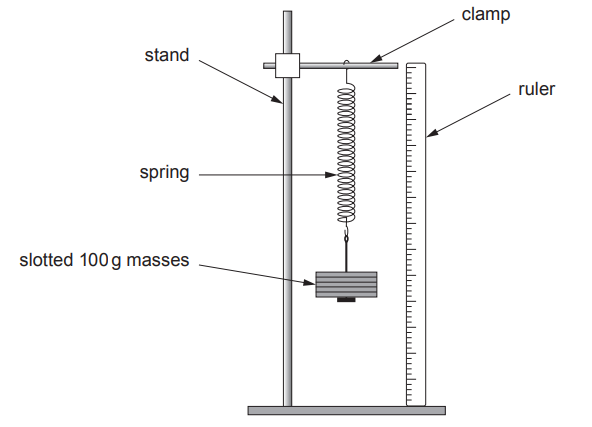
The diagram shows a spring being stretched by adding masses.

The spring is stretched within its elastic limit.

Diagram of a clamp stand holding a vertical spring with hanging masses, next to an upright centimetre ruler used to measure the spring’s extension

Part of the method used for investigating the extension of the spring is shown below.

METHOD

  1. Record the original length of the spring.

  2. Suspend the spring from the clamp and attach the 100 g mass hanger.

  3. ..........

  4. Add a further 100 g to the spring and record the new length.

  5. ..........

  6. Remove all masses and repeat steps 1–5 once more.

  7. ..........

  8. ..........

Complete the method by writing the letters A, B, C, D from the table below into the correct gaps in the method above.

A

Calculate the mean length for each mass added.

B

Record the new length of the spring.

C

Repeat step 4 until a total mass of 700 g has been added.

D

Calculate the mean extension for each mass added.

5b
Sme Calculator
2 marks

One source of inaccuracy in this experiment is measuring the length of the spring.

State two ways this measurement could be improved.

5c
Sme Calculator
5 marks

The spring has an extension of 8 cm when a mass of 400 g is suspended from it.

(i) State the weight of the 400 g mass. [100 g weighs 1 N]

[1]

Weight = .......... N

(ii) Use the equation:

spring constant = \frac{\text{weight}}{\text{extension}}

to calculate the spring constant for an extension of 8 cm.

[2]

Spring constant = .......... N/cm

(iii) John says that a mass of 200 g would stretch the spring by 2 cm.

Explain whether his claim is correct.

[2]

6a
Sme Calculator
4 marks

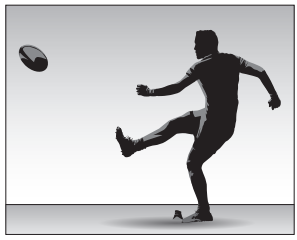
A rugby player kicks a ball up into the air.

Silhouette of a rugby player kicking a ball from a tee, with the ball in mid-air against a simple grey background.

Ignore the effects of air resistance when answering the following questions.

Place one tick (✓) in each row to show what happens to each property as the ball rises. One row has been completed for you.

Property of the ball

Stays constant

Gets smaller

Gets larger

acceleration

speed

kinetic energy

potential energy

total energy

6b
Sme Calculator
6 marks

The rugby ball has a mass of 0.46 kg.

(i) Use the equation:

\text{resultant force} = \text{mass} \times \text{acceleration}

to calculate the force on the ball due to gravity as it moves through the air.

[2]

(acceleration due to gravity, g = 10m/s2 )

resultant force =........................... N

(ii) The rugby ball rises 15 m into the air.

Use your answer in (b)(i) and the equation:

\text{work done} = \text{force} \times \text{distance}

to calculate the work done by gravity on the ball.

Give the correct unit.

[3]

work done =....................

unit =..........................

(iii) John says the resultant force calculated in (b)(i) is the same as the weight of the ball.

He thinks this because:

\text{weight} = \text{mass} \times \text{gravitational field strength}

Explain whether you agree with John.

[1]

7a
Sme Calculator
3 marks

Almost all cars rely on fossil fuels as their source of energy. However with supplies of fossil fuels decreasing and concerns over climate change increasing, it is important to make cars as energy efficient as possible. One type of car which is very efficient is a hybrid electric vehicle, which has both a conventional engine and an electric motor which runs from batteries. These hybrid vehicles use regenerative braking where some of the kinetic energy transferred when the brakes are applied is used to charge the batteries rather than all being lost as heat. This has a maximum energy transfer of 60%.

Data about a hybrid electric/petrol car is given below.

Time taken to accelerate from 0–100 km/h (0–28 m/s)

11.8 s

Mass of car

1 160 kg

Mean CO₂ emissions

8.9 cross times 10-2 kg/km

Mean fuel economy

31.6 km/litre

The car uses 10 litres of fuel per week. Calculate the mean mass of CO₂ emitted by the car in a year (52 weeks).

Mean mass of CO2 = ................................................ kg

7b
3 marks

Energy can be lost from cars in a variety of ways such as inertial losses, rolling resistance losses and idling losses. State the design features that manufacturers can use to reduce each of these energy losses.

7c
Sme Calculator
4 marks

During a journey the car slows down from 30 m/s to 10 m/s.

Use an equation to calculate how much electrical energy is transferred to the battery if the regenerative braking process is at its maximum energy transfer.

(Mass of car = 1 160 kg)

Energy transferred = ................................................ J

8
Sme Calculator
4 marks

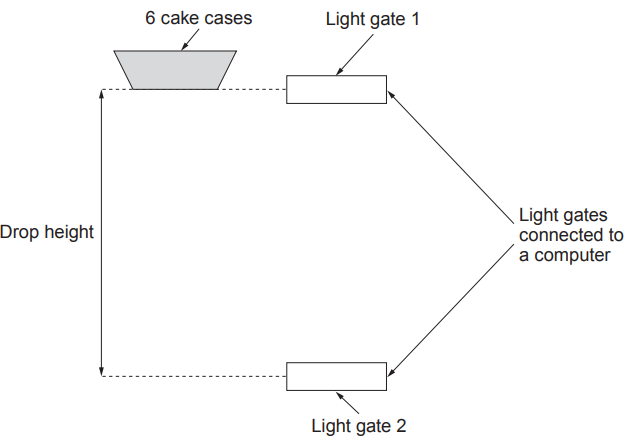
Light gates were used to time the falling cake cases.

The vertical distance between the two light gates was adjusted so that different drop heights could be investigated.

The apparatus is shown below.

Diagram of six cake cases falling from a set height through two vertically spaced light gates linked by wires to a computer for timing the descent

Their results are shown in Table 2 below.

Table 2

Drop height (m)

Time taken for the stack of 6 cake cases to fall (s)

Mean speed (m/s)

Trial 1

Trial 2

Mean

0.00

0.00

0.20

0.365

0.366

0.366

0.55

0.60

0.698

0.697

0.698

0.86

0.90

0.916

0.920

0.918

0.98

1.20

1.133

1.131

1.132

1.06

1.60

1.455

1.454

1.455

1.10

2.00

1.816

1.820

1.818

1.10

2.50

2.270

2.274

2.272

1.10

3.00

2.729

2.725

2.727

1.10

(i) Give a reason why light gates, rather than a stopwatch, are used to measure the time taken for the stack of cake cases to fall.

[1]

(ii) A student correctly notices that the mean speed of the cake cases at a drop height of 1.60 m is double the mean speed at a drop height of 0.20 m.

The student states that the cake cases have 4 times more kinetic energy after falling 1.60 m compared to 0.20 m.

Use an equation KE space equals space 1 half m v squaredto investigate whether the claim is correct.

The total mass of the 6 cake cases is 3.3 × 10⁻³ kg.

[3]

9a
3 marks

An engineering firm in South Wales makes springs for trampolines.

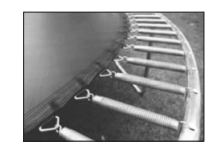
Close-up of a trampoline edge showing metal springs evenly spaced along the circular frame, attaching the taut jumping mat to the outer rim

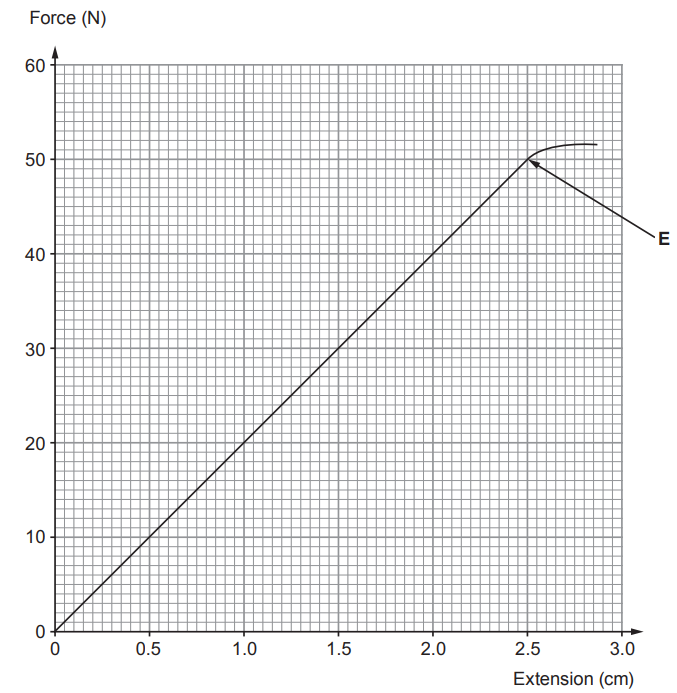
A trampoline is an elastic disc connected to a frame by many springs. The spring will be permanently stretched if it extends beyond the elastic limit (point E) where Hooke's Law is no longer obeyed.

The graph shows how far a particular spring extends when forces are applied.

Force–extension graph: straight line from 0 to 2.5 cm and 50 N, then curves, labelled point E at the turning, axes marked Force (N) and Extension (cm).

(i) Use the graph to find the largest force at which Hooke's Law is still obeyed.

[1]

Force = .......... N

(ii) Each spring in one trampoline will experience a maximum force of 58 N.

Explain whether this particular spring is suitable for use in the trampoline.

[2]

9b
Sme Calculator
5 marks

(i) Calculate the spring constant for this spring up to point E using the equation:

\text{spring constant} = \frac{\text{force}}{\text{extension}}

[3]

Spring constant = .......... N/cm

(ii) Add a line to the graph for a spring with a smaller spring constant.

[2]

10a
Sme Calculator
6 marks

Describe how the apparatus shown below is used to investigate the extension of a spring.

Diagram of a vertical stand with clamp holding a hanging spring carrying slotted 100 g masses, next to a ruler for measuring the extension.

Include the following in your answer:

  • how the apparatus is set up,

  • a description of the method used to obtain the results,

  • how the results are analysed.

10b
Sme Calculator
5 marks

A spring is 3 cm long. When an object is added to it, its length increases to 18 cm.

(i) Calculate the extension produced by the object.

[1]

extension = .......... cm

(ii) The spring constant of the spring is 0.8 N/cm.

Use an equation F equals k x to calculate the force produced by the object on the spring.

[2]

force = .......... N

(iii) This force is the weight of the object.

Use the equation:

\text{mass} = \frac{\text{weight}}{\text{gravitational field strength}}

to calculate the mass of the object. (Gravitational field strength, g = 10 N/kg)

[2]

mass = .......... kg

11a
Sme Calculator
2 marks

Springs are used in a wide variety of applications, ranging from those used in the suspension systems of heavy vehicles to those used in retracting ball-point pens.

The table below shows the properties of a number of springs available from a particular supplier.

Spring

Coil diameter
(mm)

Wire diameter
(mm)

Maximum load
(N)

Unstretched length
(mm)

Spring constant
(N/mm)

Maximum length
(mm)

A

16.00

0.165

1.252

6.350

0.17

13.716

B

16.00

0.165

1.031

6.350

0.14

13.716

C

16.00

0.165

6.350

0.12

17.050

D

16.00

0.165

1.257

9.524

0.09

23.495

E

16.00

0.230

1.768

7.950

0.24

14.016

F

16.00

0.230

1.524

7.950

0.12

20.650

(i) Write down the spring that can withstand a maximum load of at least 1.2 N and has a maximum extension close to 14 mm.

[1]

Spring = ...................

(ii) Express the spring constant for spring A in standard units of N/m.

[1]

Spring constant, k = .......................... N/m

11b
Sme Calculator
11 marks

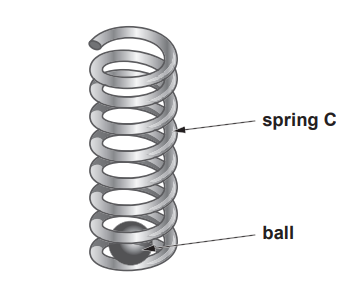
A group of students want to use a spring to project a small ball vertically upwards. They choose to use spring C. The bottom of their spring holds the ball within it and the top of the spring is fixed in position.

The bottom of the spring is pulled down and released to project the ball vertically upwards.

Diagram of a vertical coil spring labelled spring C with a ball resting at its base, showing the ball held inside the spring.

(i) Use equations from the formula sheet to calculate the energy stored in the spring when it is stretched to its maximum length.

[3]

Stored energy = .......................... J

(ii) Use an equation from the formula sheet to calculate the maximum theoretical height that the ball would reach given that its mass is 15 grams.
(g = 10 N/kg) [3]

Height = .......................... m

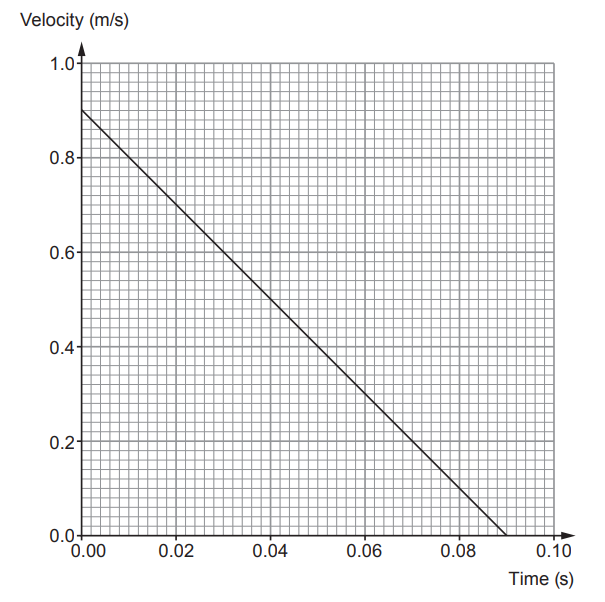
(iii) A data logger is used to monitor the motion of the ball as it rises from the spring. A graph is produced showing how the velocity of the ball changes with time.

Velocity–time graph showing a straight line decreasing from 1.0 m/s at 0 s to 0 m/s at 0.1 s, indicating uniform deceleration.

I. One student states that the height reached by the ball is different from that calculated in (b)(ii). Show that this statement is true.

[2]

II. Explain why the height reached by the ball is different from the theoretical height.

[2]

III. Suggest one change that could be made that would enable a ball to reach a greater height in this experiment.

[1]

12a
Sme Calculator
8 marks

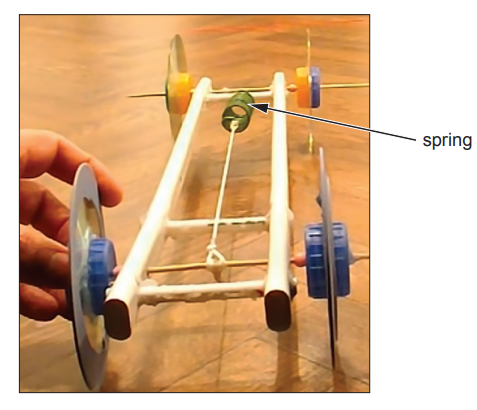
Some students make a car powered by a spring.

The spring is stretched as the back wheels on the car are wound-up.

Homemade toy car with CD wheels and blue plastic hubs, shown from the front as a hand holds it; an arrow labels a small green spring in the centre.

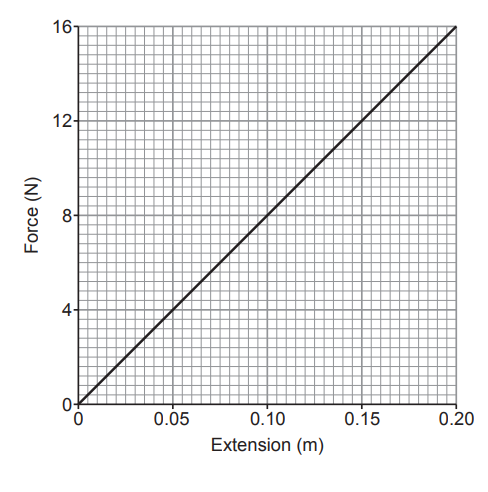
A force-extension graph for the spring used in the car is shown below.

Line graph of force versus extension for a spring, showing a straight line from 0 N at 0 m to 16 N at 0.20 m, indicating directly proportional behaviour.

(i) Use the graph and an equation from page 2 to calculate the work done in stretching the spring by 0.15 m.

[2]

work done = ........................................................ J

(ii) When the car is released the work done in stretching the spring is transferred to the car as kinetic energy.

Use your answer to part (i) and the equation:

kinetic energy = \frac{1}{2} × mass × velocity²

to calculate the theoretical maximum velocity of the car if its mass is 0.075 kg.

Give the unit with your answer.

[4]

velocity = .......................................................

unit = ....................................

(iii) Explain why, in practice, the car will not reach the theoretical maximum velocity.

[2]

12b
Sme Calculator
3 marks

The car's maximum kinetic energy is found to be 0.8 J.

A force brings it to rest in a distance of 1.5 m.

Use the equation:

work done = force × distance

to determine the size of the force.

force = .......... N

12c
Sme Calculator
2 marks

The spring constant of the spring used in the toy car is 80 N/m.

Maddie suggests that it would be better to use a spring with a spring constant of 160 N/m because for the same extension, double the energy would be stored in the spring.

Explain whether you agree.

13a
Sme Calculator
2 marks

One type of efficient car is a hybrid electric vehicle, which has both a conventional fuel engine and an electric motor.

Data about a hybrid electric / petrol car is given below.

Minimum time to accelerate from 0 to 30 m/s

12 s

Mass of car

1 100 kg

Mean CO₂ emissions

90 g/km

Mean fuel economy

32 km/litre

The car travels 160 km per week.

(i) Calculate the mean mass of CO₂ emitted by the car in a week.

[1]

CO₂ = .......... g

(ii) Calculate how many litres of fuel are used every week.

[1]

Fuel used = .......... litres

13b
1 mark

State one other way cars are made more energy efficient.

14a
Sme Calculator
2 marks

State two ways of improving the efficiency of motor cars.

14b
Sme Calculator
3 marks

The graphs below show how the deceleration of a car compares during a collision with and without crumple zones fitted.

Graph of deceleration against time showing lower, longer-lasting deceleration with a crumple zone compared with a short, high peak without one.

Use data from the graphs to explain why crumple zones provide some protection during a collision.

15
Sme Calculator
6 marks

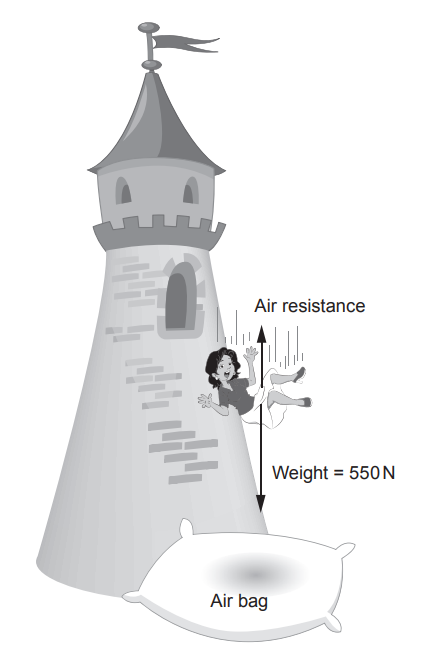
The woman hits the air bag with 5.60 kJ of kinetic energy.

The airbag stops her in a distance of 2.8 m.

Person falling from a tall tower onto an air bag, with arrows showing weight of 550 N downward and air resistance upward

(i) Convert 5.60 kJ into joules.

[1]

Kinetic energy = .......... J

(ii) Use the equation:

\text{mean force} = \frac{\text{work done}}{\text{distance}}

to calculate the mean force bringing the woman to rest.

[2]

Mean force = .......... N

(iii) It is suggested that it would be safer if the air bag were filled with water. The distance to stop the same woman falling from the same tower would be 0.8 m instead of 2.8 m. Without further calculation explain whether you agree with the suggestion.

[3]