Half-Life (WJEC GCSE Science (Double Award): Physics): Exam Questions

Exam code: 3430

1 hour6 questions
1a
Sme Calculator
3 marks

Pupils in a class were given 200 coins to use in an experiment to simulate radioactive decay.

They were asked to shake the coins in a bag, throw them out on the table then remove those showing “heads”. The number removed were counted and recorded in a table.

The remainder of the coins were put back in the bag and the process was repeated again and again.

Their results are shown in the table below.

Throw number

Total number of coins removed

Number of coins remaining

0

0

200

1

104

96

2

149

51

3

..........

26

4

..........

20

5

..........

6

6

..........

4

(i) Complete the table.

[1]

(ii) After two throws, the number of coins remaining was 51. How many coins would you have expected to remain?

[1]

(iii) After how many throws would the number of remaining coins fall to about one eighth of the original number?

[1]

1b
Sme Calculator
2 marks

Carbon-14 is a radioactive form of carbon that is present in all living material. Each nucleus of carbon-14 undergoes radioactive decay by emitting a beta particle to form nitrogen-14 according to the following decay equation, which is incomplete.

{}^{14}_{6}\text{C} \rightarrow {}^{\ldots}_{\ldots}\text{N} + {}^{0}_{-1}\text{e}

Complete the nuclear equation above.

1c
Sme Calculator
5 marks

A sample of 800 million carbon nuclei decays to create nuclei of nitrogen.

The decrease in the sample creates an increase in the number of nuclei of nitrogen according to the following graph.
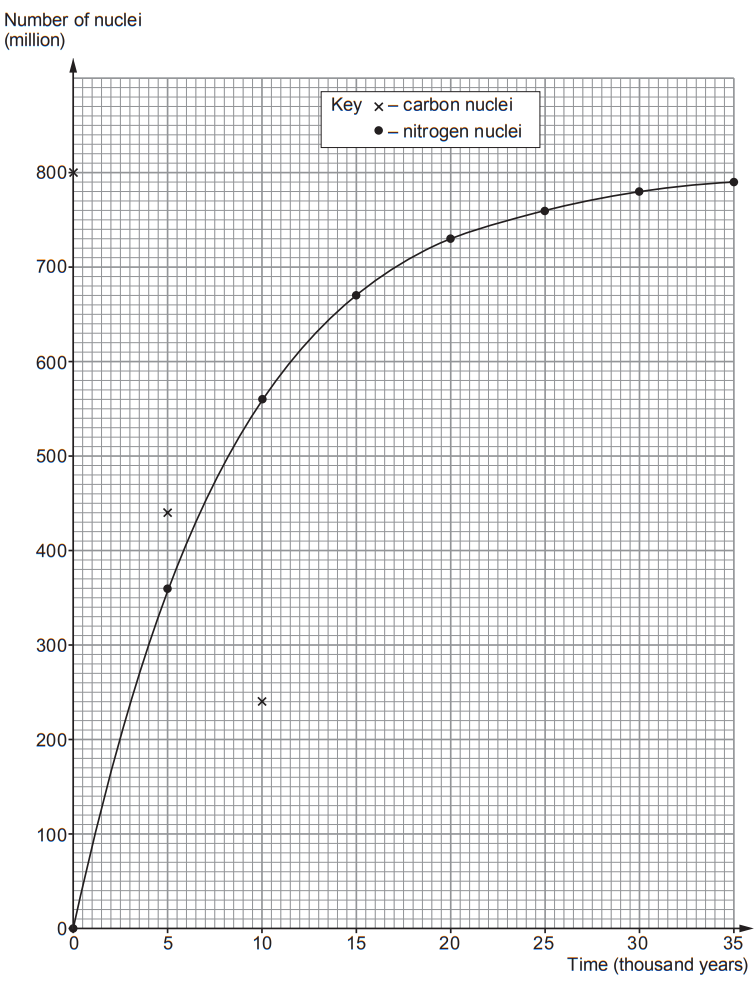
Graph of number of carbon and nitrogen nuclei (millions) against time in thousand years, showing nitrogen curve rising and levelling near 800 million, carbon as scattered crosses

(i) Complete the following table.

[2]

Time
(thousand years)

Total number of nuclei
(million)

Number of nitrogen nuclei
(million)

Number of carbon nuclei
(million)

0

800

0

800

5

..........

360

440

10

..........

560

240

15

..........

670

..........

20

..........

730

..........

25

..........

760

..........

30

..........

780

..........

35

..........

790

..........

(ii) On the grid opposite, plot points showing the decay of the carbon-14 nuclei. The first three crosses showing the numbers of carbon nuclei have been plotted for you.

Draw a suitable line.

[3]

1d
Sme Calculator
3 marks

(i) State the meaning of “the half-life” of a radioactive substance.

[2]

(ii) Use the graph to determine the half-life of carbon-14.

[1]

Half-life = .......... thousand years

1e
Sme Calculator
2 marks

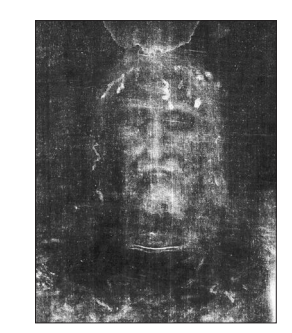
Carbon dating is used to find the age of some ancient objects because carbon-14 is present in all once-living material. The process has been used to identify the age of the Turin shroud. This is a sheet of cloth that was claimed to be about 2 000 years old. Three independent radiocarbon dating tests, carried out recently, attempted to identify the age of the cloth.
Faded monochrome image of a bearded man’s solemn face, front-facing, emerging ghostlike from a dark, textured background

Out of 80 million carbon-14 nuclei which were present in each sample of the original cloth, around 6 million have decayed into nitrogen. Use this information to explain whether the claim about its age is correct.

2a
Sme Calculator
3 marks

Two radioisotopes released from the Chernobyl accident were iodine-131 (I-131) and caesium-137 (Cs-137).

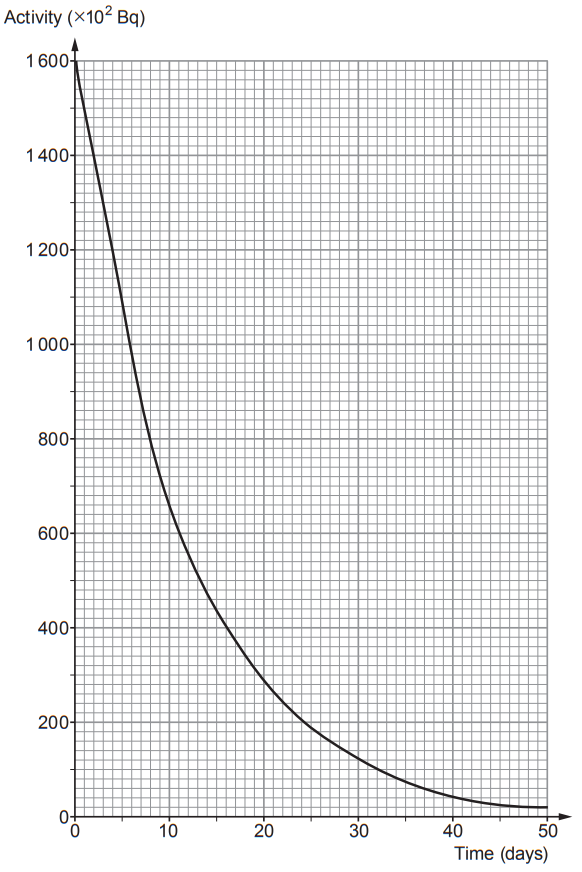
The decay curve for a sample of I-131 is shown on the graph below.

Graph of radioactive activity versus time, showing an exponential decay from about 1600 ×10² Bq at day 0 to near zero by day 50

(i) State the meaning of half-life.

[2]

(ii) Use information from the graph to determine the half-life of I-131.

[1]

Half-life = .......... days

2b
Sme Calculator
3 marks

A sample of Cs-137, with an activity of 1.5 kBq, was obtained from near Chernobyl.

Calculate the time taken for this sample to reach a safe limit of \frac{1}{512} of its original activity.

The half-life of Cs-137 is 30.2 years.

Time taken = .......... years

2c
Sme Calculator
2 marks

Explain why in 2021, 35 years after the nuclear accident, scientists were concerned about the Cs-137 contamination in the Chernobyl area but not I-131.

3a
Sme Calculator
3 marks

A class investigates radioactive decay.

They model decay using 8-sided dice.

Blue ten-sided gaming die showing the number eight on the front face, with other white numerals visible on surrounding faces

Each of the 10 groups has 50 dice.

They throw the dice and remove all which land with an 8 facing upwards.

These represent decayed nuclei.

They repeat 7 more times and record the number of dice remaining after each throw.

Each group's results are then added together.

(i) Freya suggests that it is good practice to add the results together to give a larger sample size.

Explain whether you agree.

[1]

(ii) The teacher calculates that after the first throw around 440 of the 8-sided dice should remain out of the 500.

Explain how she determined this number.

[2]

3b
Sme Calculator
7 marks

The results from the experiment are given in the table below.

Number of throws

Number of dice remaining

0

500

1

435

2

380

3

335

4

291

5

256

6

224

7

196

8

171

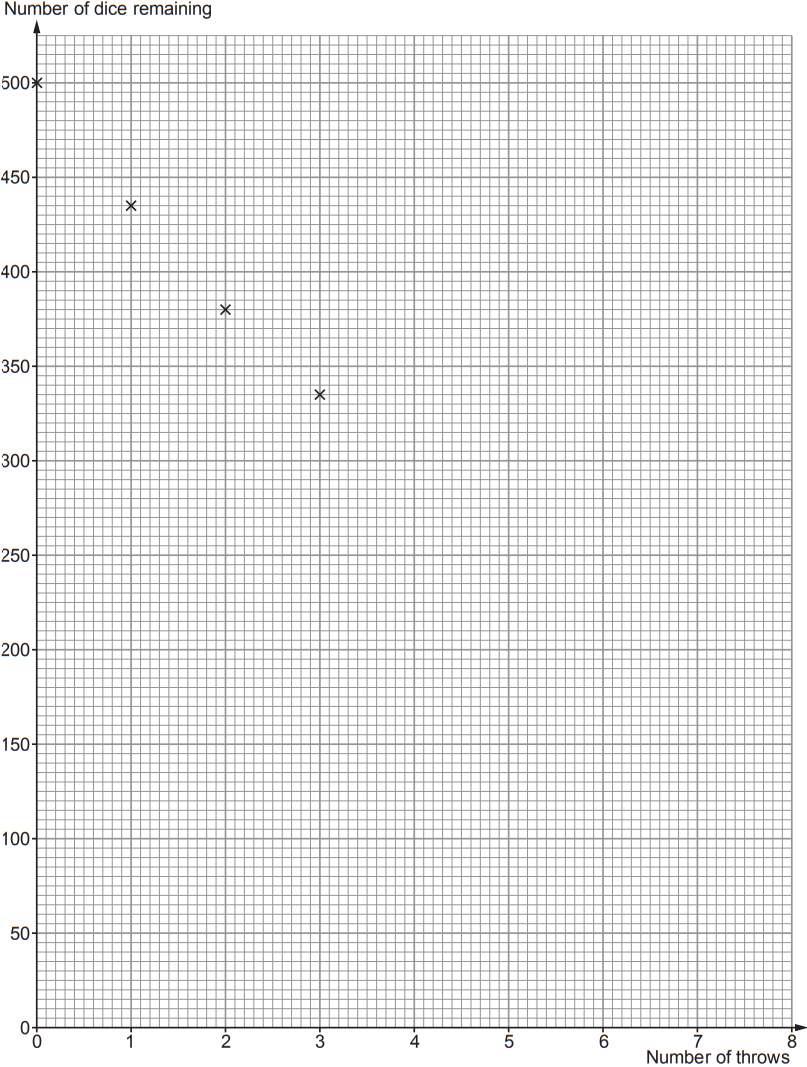
(i) Plot the data on the grid below and draw a suitable curve.

The first 4 points have been plotted for you.

[3]

Grid graph of number of dice remaining against number of throws, with four plotted crosses showing dice counts decreasing from about 500 to 330 over three throws

(ii) Add lines to the graph to find the number of throws required to halve the number of dice. This is the half-life.

Give your answer to 1 decimal place.

[2]

number of throws = ..........

(iii) The experiment is repeated with 10-sided dice.

Ieuan suggests the data could be used to model nuclear decay with a shorter half-life than with 8-sided dice.

Explain whether you agree.

[2]

4a
Sme Calculator
4 marks

The table gives information about some radioactive isotopes.

Radioactive isotope

Radiation emitted

Half-life

Use

sodium-24

beta and gamma

15 hours

detecting leaks in underground pipes

technetium-99m

gamma

6 hours

radioactive tracer injected into blood

iridium-192

gamma

74 days

detecting cracks inside steel plates

francium-223

alpha or beta

22 minutes

no uses

palladium-103

beta

17 days

treating tumours by direct injection

radon-222

alpha

3.8 days

early warning for earthquakes

Use the information to answer the questions below.

The time for radioactive isotopes to decay to a safe level is different for each one.

(i) State which radioactive isotope decays most quickly.

[1]

(ii) Complete the table below, which shows the time to decay to a fraction of 1 over 32.

[3]

Fraction remaining

Time

Palladium-103

Sodium-24

Technetium-99m

1

0

0

0

1 half

17 days

15 hours

..........................

1 fourth

34 days

30 hours

............................

1 over 8

51 days

45 hours

............................

1 over 16

68 days

..........................

...........................

1 over 32

85 days

75 hours

..........................

4b
Sme Calculator
7 marks

Use the information in the table from part (a) to answer the following questions.

(i) Explain why iridium-192 is suitable for detecting cracks inside steel plates.

[2]

(ii) Explain why palladium-103 is suitable for treating cancer by directly injecting it into a tumour.

[2]

(iii) I. Radon-222 gas can be dangerous when breathed in. Explain why.

[2]

II. State why radon-222 levels vary across the UK.

[1]

5a
Sme Calculator
2 marks

Radioactive isotopes decay at different rates.

The decay rate depends on the half-life of a particular radioisotope and the number of radioactive atoms remaining.

State what is meant by the term half-life.

5b
Sme Calculator
3 marks

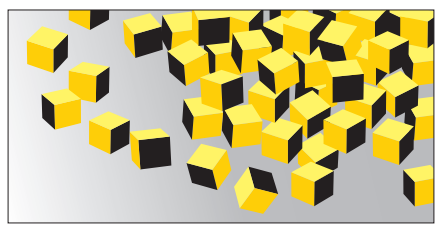
The decay of a radioactive isotope can be modelled using 60 cubes.

Each cube has one face shaded black.

These cubes are called 1F cubes.

Scattered yellow and black 3D cubes on a grey gradient background, creating an abstract geometric pattern across the image

Describe the method used to collect results to find the half-life.

5c
Sme Calculator
6 marks

In a class experiment, 12 groups of students are each given 60 of these 1F cubes.

The table below shows the results from one group and for the entire class.

Throw

Number of 1F cubes remaining

For the group

For the class

0

60

720

1

50

600

2

42

500

3

36

420

4

29

350

5

24

290

(i) The results of all the groups were added to give a class result.

State why the class result is used to plot a graph and not just the result for one group.

[1]

(ii) The class repeats the experiment with different cubes.

The 2F cubes have two faces shaded black and the 3F cubes have three faces shaded black.

The class results are shown below.

Throw

Number of cubes remaining in the class

For 2F cubes

For 3F cubes

0

720

720

1

480

360

2

320

180

3

210

90

4

144

45

5

95

23

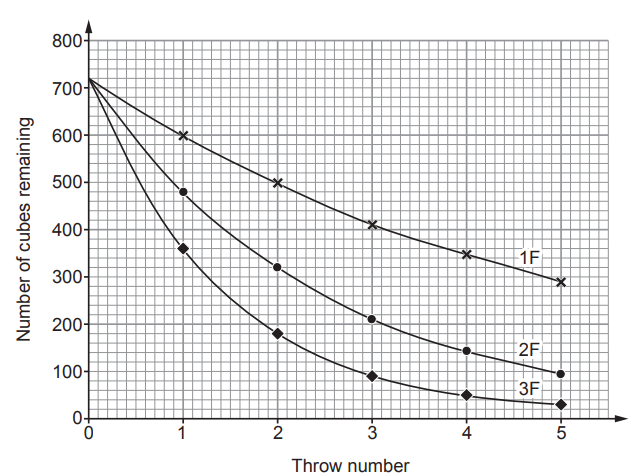
The class results for 1F, 2F and 3F cubes are plotted on the grid below.

Line graph with three decreasing curves (1F, 2F, 3F) showing number of cubes remaining from 700 to 0 over five throws, each curve dropping more steeply.

I. Add lines to the graph to determine the half-life of the 2F cubes.

[2]

half-life =..........................throws

II. Use the information in the graphs or tables to tick (✓) the boxes next to the three correct statements.

[3]

1F cubes show decay at the slowest rate box enclose space space space space space space end enclose

2F cubes show decay at the quickest rate box enclose space space space space space space end enclose

3F cubes show the equivalent of two half-lives after 2 throws box enclose space space space space space space end enclose

3F cubes have the longest half-life box enclose space space space space space space end enclose

1F cubes could also have been replaced with 720 coins and the number of heads counted after each throw box enclose space space space space space space end enclose

The number of 2F cubes remaining after 4 throws is about 1 fifth of the original box enclose space space space space space space end enclose

5d
Sme Calculator
3 marks

Sodium-24 is a radioactive isotope with a half-life of 15 hours.

A solution containing 48.0 mg of sodium-24 was injected into a patient for a medical investigation.

Calculate the mass of sodium-24 that will be left after 75 hours.

mass =......................mg

6a
Sme Calculator
5 marks

(i) Explain what is meant by the statement: The half-life of strontium-90 is 29 years.

[2]

(ii) Calculate the time taken for the activity of strontium-90 to fall to 1 over 8 th of its initial value.

[3]

Time = .......... years

6b
Sme Calculator
4 marks

The teacher measures the radiation in the laboratory, recording 150 counts in 5 minutes. This allows her to work out the count rate of the background radiation.

(i) Calculate the background radiation count rate in counts per second (cps).

[2]

Background count rate = .......... cps

(ii) Suggest two ways in which the teacher could improve the accuracy of her result.

[2]