Modelling Radioactive Decay (WJEC GCSE Science (Double Award): Physics): Revision Note
Exam code: 3430

Modelling Radioactive Decay
It cannot be predicted when a particular unstable nucleus will decay
This is because radioactive decay is a random process, this means that:
There is an equal probability of any nucleus decaying
It cannot be known which particular nucleus will decay next
It cannot be known at what time a particular nucleus will decay
The rate of decay is unaffected by the surrounding conditions
It is only possible to estimate the probability of nuclei decaying in a given time period
For example, a researcher might take some readings of background radiation
If they were to reset the counter to zero, wait one minute and then take the readings again, they might obtain a set of results such as:
32 11 25 16 28
The readings don't appear to follow a particular trend
This happens because of the randomness of radioactive decay
The random nature of radioactive decay can be demonstrated by observing count rate with a Geiger-Muller (GM) tube
When a GM tube is placed near a radioactive source, the counts are found to be irregular and cannot be predicted
Each count represents a decay of an unstable nucleus
These fluctuations in count rate on the GM tube provide evidence for the randomness of radioactive decay
Count Rate for a Radioactive Substance

The variation of count rate with time of a radioactive substance. The fluctuations show the randomness of radioactive decay
Modelling Radioactive Decay
A model, or analogy, is a way of understanding an idea by using a different but similar situation
Radioactive decay can be modelled using
A large collection of dice or coins
A computer simulation or spreadsheet programme
Rolling dice is a good analogy for radioactive decay because it is also a random process
Dice represent the random nature of radioactive decay
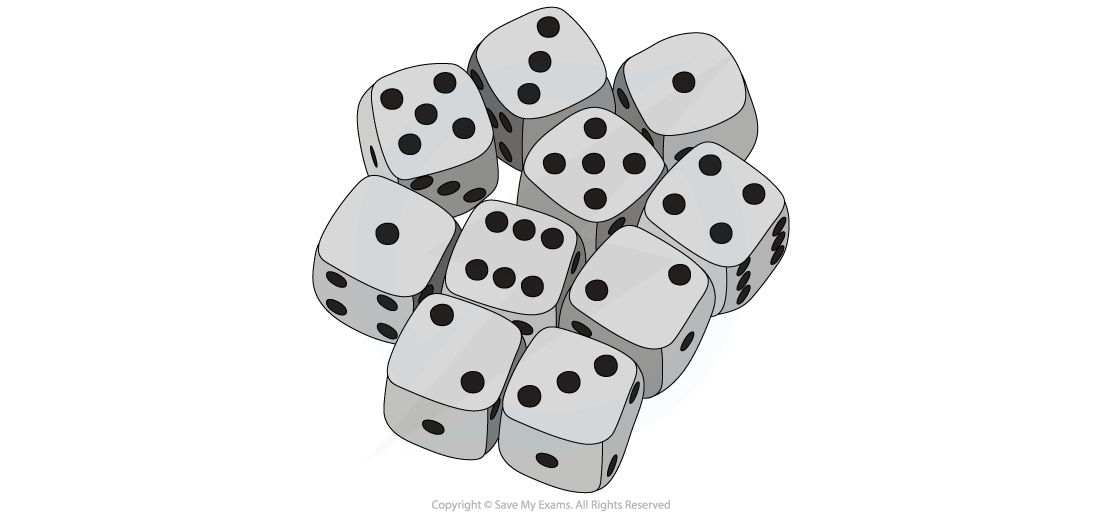
A dice roll is a random process because you don't know when you will roll a particular value. However, you can determine the probability of a particular result
Imagine rolling a dice and hoping to roll a '6'
Each time you roll the dice, you cannot know what the result will be, but you know there is a 1/6 probability that it will be a '6'
If you rolled the dice 1000 times, you can expect to roll a '6' around 1000 ÷ 6 ≈ 127 times
Examiner Tips and Tricks
Another common model is to use the flip of a coin to model radioactive decay. For each coin, the probability of a landing 'heads' is 1/2, but as with rolling a die, we still cannot predict the outcome or confidently say when a 'heads' will appear, this is why it's important to use a very large sample of coins (or dice!) to represent the process of radioactive decay.

Unlock more, it's free!
Join the 100,000+ Students that ❤️ Save My Exams
the (exam) results speak for themselves:

Was this revision note helpful?
Build on this topic