Pupils in a class were given 200 coins to use in an experiment to simulate radioactive decay.
They were asked to shake the coins in a bag, throw them out on the table then remove those showing “heads”. The number removed were counted and recorded in a table.
The remainder of the coins were put back in the bag and the process was repeated again and again.
Their results are shown in the table below.
Throw number | Total number of coins removed | Number of coins remaining |
0 | 0 | 200 |
1 | 104 | 96 |
2 | 149 | 51 |
3 | .......... | 26 |
4 | .......... | 20 |
5 | .......... | 6 |
6 | .......... | 4 |
(i) Complete the table.
[1]
(ii) After two throws, the number of coins remaining was 51. How many coins would you have expected to remain?
[1]
(iii) After how many throws would the number of remaining coins fall to about one eighth of the original number?
[1]
Carbon-14 is a radioactive form of carbon that is present in all living material. Each nucleus of carbon-14 undergoes radioactive decay by emitting a beta particle to form nitrogen-14 according to the following decay equation, which is incomplete.
Complete the nuclear equation above.
A sample of 800 million carbon nuclei decays to create nuclei of nitrogen.
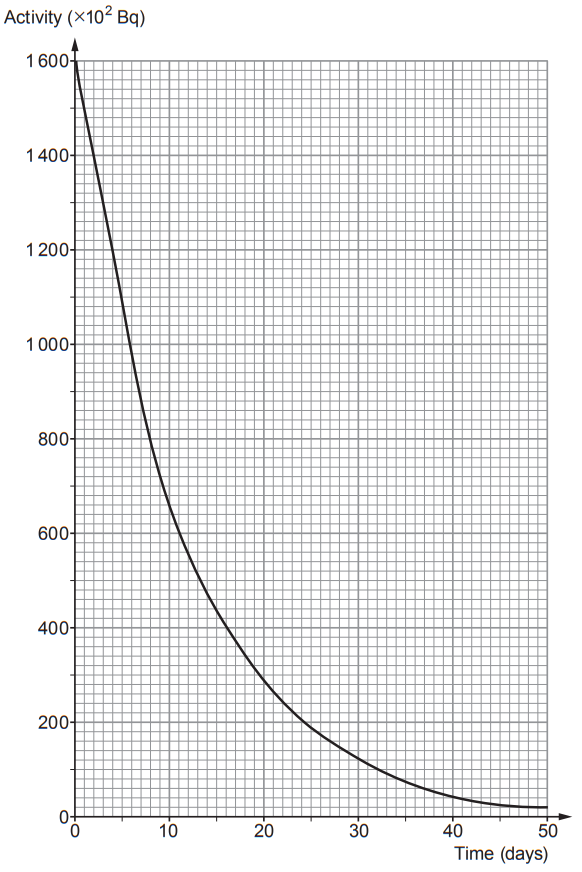
The decrease in the sample creates an increase in the number of nuclei of nitrogen according to the following graph.
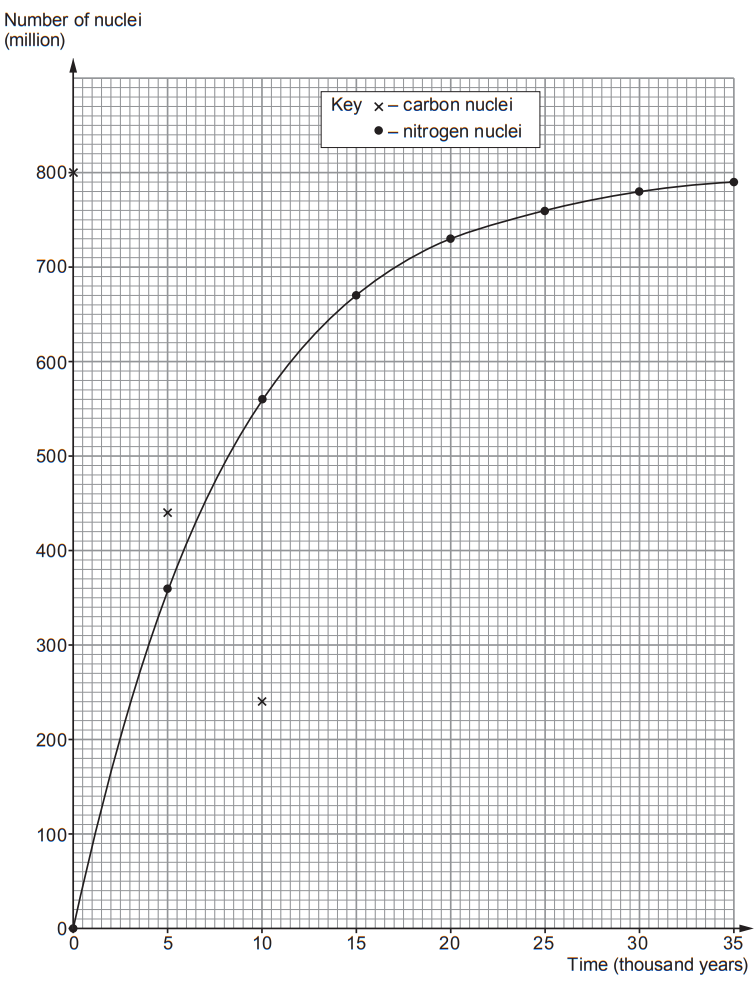
(i) Complete the following table.
[2]
Time | Total number of nuclei | Number of nitrogen nuclei | Number of carbon nuclei |
0 | 800 | 0 | 800 |
5 | .......... | 360 | 440 |
10 | .......... | 560 | 240 |
15 | .......... | 670 | .......... |
20 | .......... | 730 | .......... |
25 | .......... | 760 | .......... |
30 | .......... | 780 | .......... |
35 | .......... | 790 | .......... |
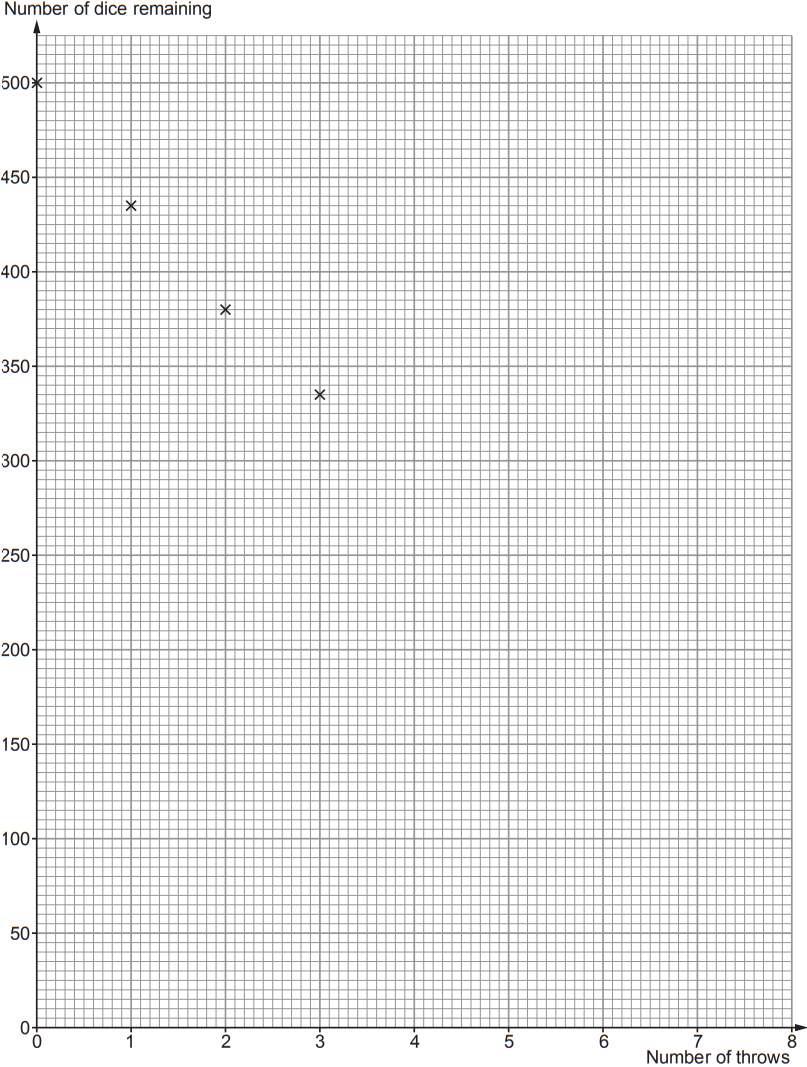
(ii) On the grid opposite, plot points showing the decay of the carbon-14 nuclei. The first three crosses showing the numbers of carbon nuclei have been plotted for you.
Draw a suitable line.
[3]
(i) State the meaning of “the half-life” of a radioactive substance.
[2]
(ii) Use the graph to determine the half-life of carbon-14.
[1]
Half-life = .......... thousand years
Carbon dating is used to find the age of some ancient objects because carbon-14 is present in all once-living material. The process has been used to identify the age of the Turin shroud. This is a sheet of cloth that was claimed to be about 2 000 years old. Three independent radiocarbon dating tests, carried out recently, attempted to identify the age of the cloth.
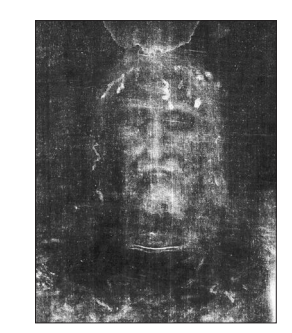
Out of 80 million carbon-14 nuclei which were present in each sample of the original cloth, around 6 million have decayed into nitrogen. Use this information to explain whether the claim about its age is correct.
Was this exam question helpful?