A Level History Topics by Exam Board: Full List

Written by: Natasha Smith
Reviewed by: Emma Dow
Published
Contents
No two A Level History courses look the same. Your school picks from a big menu of options, so while you're deep in the Wars of the Roses, your friend at the school down the road could be studying Tsarist Russia. Same qualification, completely different content.
That makes revision confusing. You end up digging through exam board PDFs, checking your teacher's handouts, and still not being totally sure you've covered everything.
This guide sorts that out. Below, you'll find all the A Level History topics for AQA, Edexcel, and OCR, plus exactly which paper each one shows up in. No hunting required.
Key Takeaways
A Level History has three exam boards - AQA (opens in a new tab), Edexcel (opens in a new tab), and OCR (opens in a new tab) - and each one offers different topics.
Your course is split into components or papers, each covering a different type of history: breadth, depth, thematic, or your own independent investigation.
Knowing exactly which topics you're doing, and which paper they land in, is the foundation of a good revision timetable.
Why It's Important to Know Your Exam Board
Exam boards teach different topics and ask different types of questions too.
A revision trick that nails an AQA source question won't necessarily help you with an OCR thematic essay. Practise with the wrong board's past papers, and you could end up training for the wrong skills entirely.
So before anything else: check your exam board and specification code. You'll find it on your timetable, in your school's exams office documents, or just by asking your teacher.
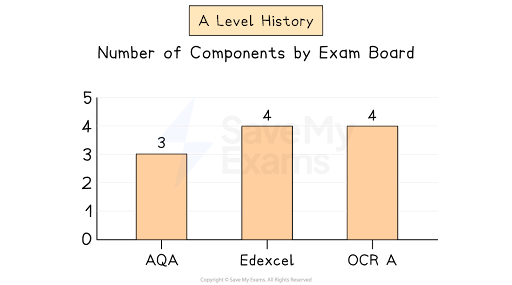
Bar chart showing the number of topics in A Level History by exam board.
AQA A Level History Topics (7042)
AQA A Level History has three components.
Component | Focus | Weighting |
|---|---|---|
Component 1: Breadth Study | An extended period of around 100 years, looking at change and continuity | 40% |
Component 2: Depth Study | A shorter, more intense period, using primary sources | 40% |
Component 3: Historical Investigation (NEA) | Your own independent enquiry into a 100-year period | 20% |
Component 1: Breadth Study options
You’ll study one of these options:
Option | Period |
|---|---|
The Age of the Crusades | c1071–1204 |
Spain in the Age of Discovery (A Level only) | 1469–1598 |
The Tudors: England | 1485–1603 |
Stuart Britain and the Crisis of Monarchy | 1603–1702 |
Russia in the Age of Absolutism and Enlightenment (A Level only) | 1682–1796 |
Industrialisation and the People: Britain | c1783–1885 |
Challenge and Transformation: Britain | c1851–1964 |
Tsarist and Communist Russia | 1855–1964 |
The British Empire | c1857–1967 |
The Making of a Superpower: USA | 1865–1975 |
The Quest for Political Stability: Germany | 1871–1991 |
Component 2: Depth Study options
You’ll study one of these options:
Option | Period |
|---|---|
Royal Authority and the Angevin Kings | 1154–1216 |
The Wars of the Roses | 1450–1499 |
The Reformation in Europe (A Level only) | c1500–1564 |
Religious Conflict and the Church of England | c1529–1570 |
The English Revolution | 1625–1660 |
The Sun King: Louis XIV, France and Europe (A Level only) | 1643–1715 |
The Birth of the USA | 1760–1801 |
France in Revolution (A Level only) | 1774–1815 |
America: A Nation Divided (A Level only) | c1845–1877 |
International Relations and Global Conflict (A Level only) | c1890–1941 |
Italy and Fascism | c1900–1945 |
Wars and Welfare: Britain in Transition | 1906–1957 |
Revolution and Dictatorship: Russia | 1917–1953 |
Democracy and Nazism: Germany | 1918–1945 |
The Transformation of China | 1936–1997 |
The American Dream: Reality and Illusion | 1945–1980 |
The Cold War | c1945–1991 |
The Making of Modern Britain | 1951–2007 |
The Crisis of Communism: The USSR and the Soviet Empire (A Level only) | 1953–2000 |
Component 3: Historical Investigation
There's no set topic list here. You'll pick your own question, with your teacher's help, based on an issue spanning roughly 100 years - and it can't overlap with your Component 1 or 2 choices.
You'll write 3,500-4,500 words, not counting your bibliography, footnotes, or appendices, with a hard cap of 4,500 words.
It's worth 40 marks - 20% of your A Level - marked by your teacher and moderated by AQA.
Here are some examples of possible historical investigations:
Assessing how Puritanism changed during the Seventeenth Century.
Assessing the extent to which the condition of the Russian peasant improved over the period of 1850-1950.
Assessing the extent to which the Glorious Revolution successfully settled relations between the Crown and Parliament in the context of the Stuart period.
Assessing the extent to which Tsar Nicholas I changed the nature of Tsarist rule set against the period of Catherine the Great, Alexander and Nicholas I
Which AQA A Level History paper covers which topic?
Component | Paper | What it assesses |
|---|---|---|
Component 1 | Written exam, 2hr 30min | Section A: one compulsory interpretations question (30 marks). Section B: two essays from a choice of three (50 marks) |
Component 2 | Written exam, 2hr 30min | Section A: one compulsory source-based question (30 marks). Section B: two essays from a choice of three (50 marks) |
Component 3 | Non-exam assessment | Marked by your teacher, moderated by AQA |
Next steps: Use Save My Exams AQA A Level History revision notes and past papers to nail your History grade.
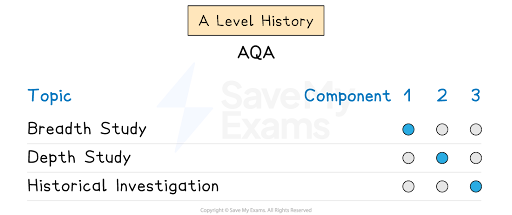
Structured topic list for AQA A Level History showing which topics are assessed in each exam paper.
Edexcel A Level History Topics (9HI0)
Edexcel A Level History has three exam papers plus coursework.
Paper | Focus | Weighting |
|---|---|---|
Paper 1: Breadth Study with Interpretations | Historical significance, change and continuity, plus historians' interpretations | 30% |
Paper 2: Depth Study | Causes and consequences in one specific period | 20% |
Paper 3: Themes in Breadth with Aspects in Depth | A big-picture theme with detailed case studies | 30% |
Coursework | Your own investigation into a historical interpretation debate | 20% |
Paper 1: Breadth Study options
Option | Period |
|---|---|
The Crusades | c1095–1204 |
England, 1509–1603: Authority, Nation and Religion | 1509–1603 |
Britain, 1625–1701: Conflict, Revolution and Settlement | 1625–1701 |
Britain, c1785–c1870: Democracy, Protest and Reform | c1785–c1870 |
Russia, 1917–91: From Lenin to Yeltsin | 1917–1991 |
In Search of the American Dream: the USA | c1917–96 |
Germany and West Germany | 1918–89 |
Britain Transformed | 1918–97 |
Paper 2: Depth Study options
Option | Period |
|---|---|
Anglo-Saxon England and the Anglo-Norman Kingdom | c1053–1106 |
England and the Angevin Empire in the Reign of Henry II | 1154–89 |
Luther and the German Reformation | c1515–55 |
The Dutch Revolt | c1563–1609 |
France in Revolution | 1774–99 |
Russia in Revolution | 1894–1924 |
The Unification of Italy | c1830–70 |
The Unification of Germany | c1840–71 |
Mao's China | 1949–76 |
The German Democratic Republic | 1949–90 |
India: The Road to Independence | c1914–48 |
South Africa: From Apartheid State to 'Rainbow Nation' | 1948–94 |
The Rise and Fall of Fascism in Italy | c1911–46 |
Spain: Republicanism, Francoism and the Re-establishment of Democracy | 1930–78 |
The USA: Boom, Bust and Recovery | c1920–55 |
The USA: Conformity and Challenge | 1955–92 |
Paper 3: Themes in Breadth with Aspects in Depth options
Option | Period |
|---|---|
Lancastrians, Yorkists and Henry VII | 1399–1509 |
Rebellion and Disorder under the Tudors | 1485–1603 |
The Golden Age of Spain | 1474–1598 |
The Witch Craze in Britain, Europe and North America | c1580–c1750 |
Industrialisation and Social Change in Britain: Forging a New Society | 1759–1928 |
Poverty, Public Health and the State in Britain | c1780–1939 |
Britain: Losing and Gaining an Empire | 1763–1914 |
The British Experience of Warfare | c1790–1918 |
Protest, Agitation and Parliamentary Reform in Britain | c1780–1928 |
Ireland and the Union | c1774–1923 |
The Changing Nature of Warfare: Perception and Reality | 1859–1991 |
Germany: United, Divided and Reunited | 1871–1990 |
The Making of Modern Russia | 1855–1991 |
The Making of Modern China | 1860–1997 |
Civil Rights and Race Relations in the USA | 1850–2009 |
Mass Media and Social Change in Britain | 1882–2004 |
Coursework
There’s no set list here. Your teacher helps you land on a research question built around a historical controversy - just make sure it doesn't overlap with Papers 1-3.
You're looking at 3,000 to 4,000 words, worth 40 marks, and it's 20% of your overall grade. It’s marked in school and checked by an Edexcel moderator.
Which Edexcel A Level History paper covers which topic?
Paper | Assessment structure |
|---|---|
Paper 1 | Section A: choice of two essays (20 marks). Section B: choice of two essays (20 marks). Section C: compulsory interpretations question (20 marks) |
Paper 2 | Section A: choice of two source-based questions (20 marks). Section B: choice of four essays, answer two (40 marks) |
Paper 3 | Section A: compulsory source question (20 marks). Section B: choice of two essays (20 marks). Section C: choice of two essays (20 marks) |
Coursework | Marked by teachers, moderated by Edexcel |
Next steps: Use Save My Exams Edexcel A Level History revision notes and past papers to smash your grade.
OCR A Level History A Topics (H505)
OCR A Level History A has four units.
Unit group | Focus | Weighting |
|---|---|---|
British Period Study and Enquiry | A source-based dive into a period of British history | 25% |
Non-British Period Study | A period study outside British history | 15% |
Thematic Study and Historical Interpretations | A 100-year theme plus three in-depth topics | 40% |
Y100: Topic Based Essay (NEA) | Your own independent essay | 20% |
British Period Study and Enquiry options
Option | Period | Enquiry topic |
|---|---|---|
Alfred and the Making of England | 871–1016 | Alfred the Great |
Anglo-Saxon England and the Norman Conquest | 1035–1107 | Norman England 1087–1107 |
England | 1199–1272 | King John 1199–1216 |
England | 1377–1455 | Richard II 1377–1399 |
Lancastrians, Yorkists and Henry VII | 1445–1509 | Wars of the Roses 1445–1461 |
England: the Early Tudors | 1485–1558 | Mid Tudor Crises 1547–1558 |
England: the Later Tudors | 1547–1603 | Mid Tudor Crises 1547–1558 |
The Early Stuarts and the Origins of the Civil War | 1603–1660 | Execution of Charles I and the Interregnum 1646–1660 |
The Making of Georgian Britain | 1678–c1760 | The Glorious Revolution 1678–1689 |
From Pitt to Peel: Britain | 1783–1853 | Peel and the Age of Reform 1832–1853 |
Liberals, Conservatives and the Rise of Labour | 1846–1918 | England and a New Century c1900–1918 |
Britain | 1900–1951 | England and a New Century c1900–1918 |
Britain | 1930–1997 | Churchill 1930–1951 |
Non-British Period Study options
Option | Period |
|---|---|
The Rise of Islam | c500–750 |
Charlemagne | 768–814 |
The Crusades and the Crusader States | 1095–1192 |
Genghis Khan and the Explosion from the Steppes | c1167–1405 |
Exploration, Encounters and Empire | 1445–1570 |
Spain | 1469–1556 |
The German Reformation and the Rule of Charles V | 1500–1559 |
Philip II | 1556–1598 |
African Kingdoms: Four Case Studies | c1400–c1800 |
Russia | 1645–1741 |
The Rise and Decline of the Mughal Empire in India | 1526–1741 |
The American Revolution | 1740–1796 |
The French Revolution and the Rule of Napoleon | 1774–1815 |
France | 1814–1870 |
Italy and Unification | 1789–1896 |
The USA in the 19th Century: Westward Expansion and Civil War | 1803–c1890 |
Japan | 1853–1937 |
International Relations | 1890–1941 |
Russia | 1894–1941 |
Italy | 1896–1943 |
Democracy and Dictatorships in Germany | 1919–1963 |
The Cold War in Asia | 1945–1993 |
The Cold War in Europe | 1941–1995 |
Apartheid and Reconciliation: South African Politics | 1948–1999 |
Thematic Study and Historical Interpretations options
Option | Period |
|---|---|
The Early Anglo-Saxons | c400–800 |
The Viking Age | c790–1066 |
English Government and the Church | 1066–1216 |
The Church and Medieval Heresy | c1100–1437 |
The Renaissance | c1400–1600 |
Rebellion and Disorder under the Tudors | 1485–1603 |
Tudor Foreign Policy | 1485–1603 |
The Catholic Reformation | 1492–1610 |
The Ascendancy of the Ottoman Empire | 1453–1606 |
The Development of the Nation State: France | 1498–1610 |
The Origins and Growth of the British Empire | 1558–1783 |
Popular Culture and the Witchcraze | 16th–17th centuries |
The Ascendancy of France | 1610–1715 |
The Challenge of German Nationalism | 1789–1919 |
The Changing Nature of Warfare | 1792–1945 |
Britain and Ireland | 1791–1921 |
China and its Rulers | 1839–1989 |
Russia and its Rulers | 1855–1989 |
Civil Rights in the USA | 1865–1992 |
From Colonialism to Independence: The British Empire | 1857–1965 |
The Middle East: Ottomans to Arab Spring | 1908–2011 |
Y100: Topic Based Essay
There are no fixed topics here. You'll pitch your own question, with teacher guidance, as long as it doesn't overlap with your other three units.
It's an extended essay of 3,000-4,000 words, worth 40 marks and 20% of your grade. It makes up the final fifth of your overall A Level.
Which OCR A Level History paper covers which topic?
Unit | Assessment structure |
|---|---|
British Period Study and Enquiry | Section A: compulsory source question (30 marks). Section B: choice of two essays, answer one (20 marks) |
Non-British Period Study | Question A: shorter significance question (10 marks). Question B: period study essay (20 marks) |
Thematic Study and Historical Interpretations | Section A: compulsory interpretations question (30 marks). Section B: choice of three essays, answer two (50 marks) |
Y100 | Marked by teachers, moderated by OCR |
Next steps: Use Save My Exams OCR A Level History A Level past papers to hit your grade.
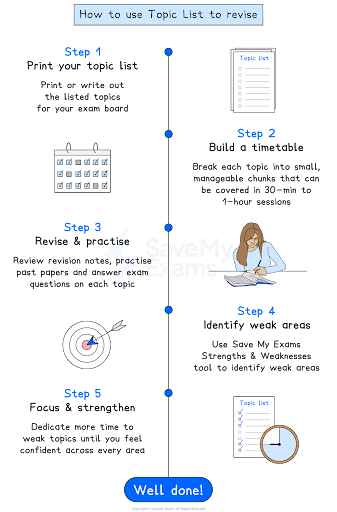
A step-by-step guide showing how to use topic lists in A Level History revision.
How to Use Topic Lists for Revision
First, match this list to your specification. Double-check the options with your teacher - schools sometimes swap options between year groups, so don't assume.
Then build your timetable around the weightings. Don't give a 15% unit the same revision time as a 40% one.
Then consider your weaker topics - these need more time. Consider each topic or component you’re studying and decide which are:
Solid - you could answer an exam question on this right now.
A bit shaky - you know the basics but freeze on detail or dates.
Still struggling - this needs a proper re-teach, not just a re-read.
Those you’re still struggling with are top priority. Tick off topics as you go. A long list turns into a satisfying progress tracker, and it makes gaps obvious before it's too late to fix them.
Frequently Asked Questions
Do I need to revise all A Level History topics for the exam?
No - just the specific options your school entered you for, not every topic your board offers. Not sure which ones apply to you? Ask your teacher.
Are these topics the same across all exam boards?
No. AQA, Edexcel, and OCR each set their own topics, date ranges, and question styles. Always revise using resources built for your exact board and option.
How do I know which topics I struggle with most?
Past papers are your best bet. Track your marks by topic as you go, then put extra time into whatever's scoring lowest or feels shakiest.
Boost Your Grade with Save My Exams
A clear topic list is where good revision starts. Once you know exactly what you're being examined on - and where it shows up in your A Level History papers - you can stop guessing and start revising with a plan.
Good luck!
References
AQA A Level History Specification (opens in a new tab)
Edexcel A Level History Specification (opens in a new tab)
OCR A Level History Specification (opens in a new tab)
Was this article helpful?
Sign up for articles sent directly to your inbox
Receive news, articles and guides directly from our team of experts.

Share this article

 written revision resources that improve your