Essays (AQA A Level Business): Revision Note
Syllabus Edition
First teaching 2023
Last exams 2027
Exam code: 7132

How to answer the 25-mark essay question
Overview
25-mark essays appear in Paper 1 only, in Sections C and D
There is no case study
Every argument should be tied to:
a named real business
e.g. Amazon, Dyson, Primark, a local café, a named start-up
a specific sector
e.g. retail, manufacturing, services, technology, construction
a realistic scenario that varies by business type or circumstances
e.g. a B2B supplier vs a cash-based retailer
These questions test all four assessment objectives
Knowledge
Worth 5 marks
Accurate use of business concepts, theory and definitions
Application
Worth 4 marks
Applying theory to named businesses, specific sectors or realistic scenarios
Analysis
Worth 6 marks
Developed chains of reasoning — cause → effect → consequence
Evaluation
Worth 10 marks (40% of the total)
Weighing up arguments and reaching a justified, supported judgement
Common command terms
"To what extent..."
"Evaluate..."
"Assess..."
"Justify your view"
How level of response marking works
These questions are marked using levels of response
The examiner reads the whole answer and decides which level it best fits overall
Level | Marks | What this looks like
|
|---|---|---|
Level 5 | 21–25 | An excellent response overall that is fully focused on the key demands of the question Provides an answer to the question set that:
|
Level 4 | 16–20 | A good response overall that focuses on many of the demands of the question Provides an answer to the question set that:
|
Level 3 | 11–15 | A reasonable response overall that focuses on some of the demands of the question Provides an answer to the question set that:
|
Level 2 | 6–10 | A limited response overall with little focus on the demands of the question Provides an answer to the question set that:
|
Level 1 | 1–5 | A weak response overall lacking focus on the demands of the question Provides an answer to the question set that:
|
The key difference between Level 3 and Level 5 is sustained, balanced evaluation
Top answers build judgements throughout the essay, not just in the conclusion, and show genuine engagement with arguments on both sides
Writing your essay
Recommended structure
There is no single correct format, but the following structure consistently produces high-scoring responses
Allow approximately 25–28 minutes per essay.
Introduction (2-4 sentences)
Define the key concepts in the question precisely
Set out the scope - acknowledge that the answer may vary by business type, sector, or circumstance
Briefly signal the main areas you will explore
Give a clear indication of your view
Paragraph 1
Your strongest argument, supporting the statement
Develop a full, contextualised chain of analysis with a mini-evaluation
Paragraph 2
Your second supporting argument
Approach from a different angle or business type to show range
Again, develop a full, contextualised chain of analysis with a mini-evaluation
Paragraph 3
A fully developed counterargument
Show when and why the opposite applies
This paragraph needs a contrasting context, with a developed chain of reasoning
Also include a mini-evaluation to show balance
Paragraph 4
Further nuance
For example, consider business size, sector or external factors that change the answer
Conclusion (4–6 sentences)
Directly answer the question command
Weigh up: which argument is most significant, and under what conditions?
Prioritise: state which factor matters more and explain why
Developing chains of reasoning
A good way to build paragraphs in the main body of your essay is to use PEEAL
Letter | Stands for | What to do
|
|---|---|---|
P | Point |
|
E | Explain |
|
E | Example |
|
A | Analyse |
|
L+ | Link/Evaluate |
|
Examiner Tips and Tricks
Avoid vague summaries that just list both sides without weighing them, and generic conclusions that could apply to any question on the topic
An example essay response
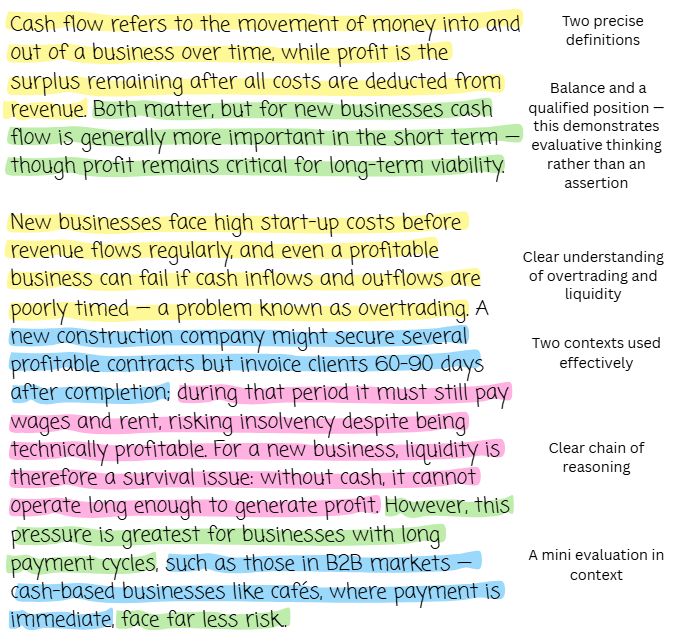
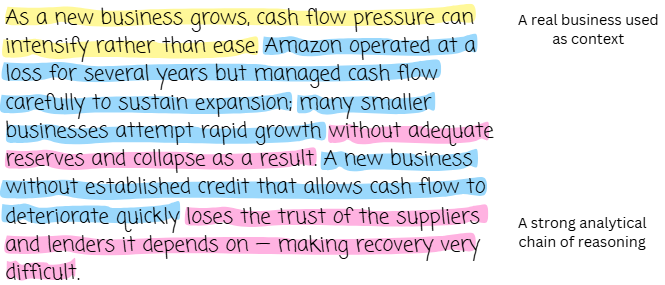
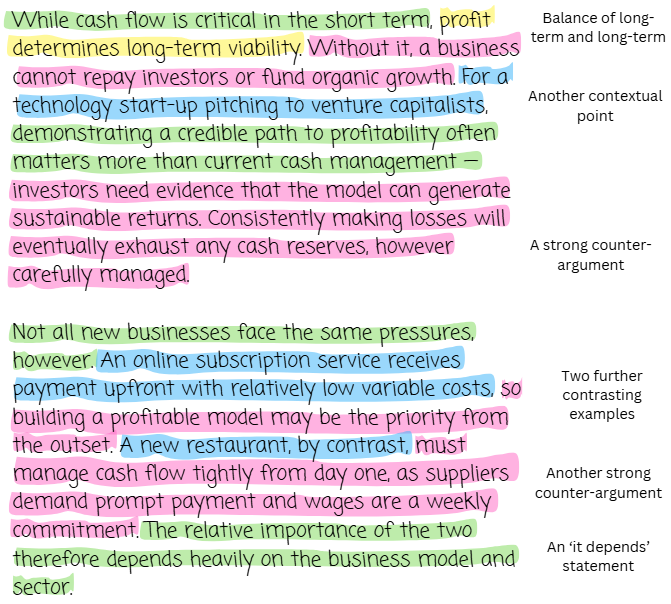
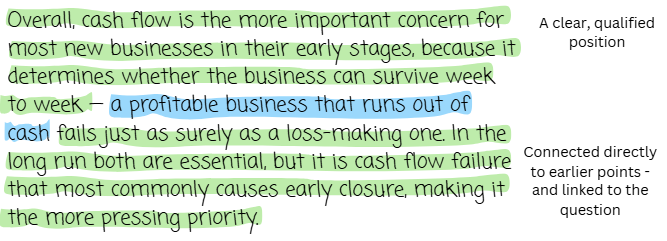
Is cash flow more important than profit for new businesses? Justify your view.
[25 marks]

Examiner Tips and Tricks
Plan before you write
Jot down 2 arguments in favour, 2 against, and decide your conclusion before you start
This ensures a balanced answer and stops you running out of ideas mid-essay.
Choose your question carefully
You have a choice of two in each section
Take 2 minutes to read both and pick the one where you can produce the most developed arguments
Build evaluation into each paragraph, not just the conclusion
Signpost phrases such as "however, this depends on...", "this is most significant when...", "for a small business..., whereas for a large multinational..." all demonstrate AO4
In the conclusion, take a clear side
Sitting on the fence rarely scores above Level 3 - examiners want a justified view, not a list of "on the one hand / on the other hand"
Aim for 550–650 words
This is enough for 3–4 developed paragraphs without rushing
Common mistakes
Describing instead of analysing
Explaining what something is without building a chain of cause and effect
One-sided answers
Covering only one side of the argument will not reach Level 4 or 5
Thin evaluation
A one-sentence conclusion does not meet the evaluation requirement
Evaluation must be built throughout each paragraph
Generic examples
E.g. "a business might..." is weak; "Amazon, for example,..." is better application
New ideas in the conclusion
The conclusion should weigh existing arguments, not introduce new ones

Unlock more, it's free!
Join the 100,000+ Students that ❤️ Save My Exams
the (exam) results speak for themselves:

Was this revision note helpful?