Managing Finance (Edexcel A Level Business): Exam Questions

Exam code: 9BS0

3 hours17 questions
1
Sme Calculator
4 marks

Read the following extracts (A to D) (opens in a new tab) before answering

Using the data in Extract B, calculate the difference in Morrisons’ acid test ratio between 2014 and 2015. You are advised to show your working

2
4 marks

Read the following extracts (E to H) (opens in a new tab) (opens in a new tab)before answering 

Explain one internal cause of the business failure of MG Rover Group

3
Sme Calculator
4 marks

Read the following extracts (D to G) (opens in a new tab) before answering

Using the information in Extract E, calculate the operating profit margin for Sports Direct in 2018. State your answer to two decimal places. You are advised to show your working

4
Sme Calculator
4 marks

Read the following extracts (A to D) (opens in a new tab) before answering

In order to persuade large retailers such as Boots to stock Pura Cosmetics products, Rose Dyson is considering halving the selling price of lip balms

Using the data in Extract B, calculate Pura Cosmetics' break even point if the selling price of lip balms is halved. You are advised to show your working

5
4 marks

Read the following extracts (A to D) (opens in a new tab) before answering

Explain the likely impact of the change in jet fuel prices between July 2008 and July 2015 on Spirit Airlines' profit budget

6
Sme Calculator
4 marks

Read the following extracts (E to H) (opens in a new tab) before answering

Using the data in extract G, calculate the percentage change in The Gym Group's gross profit margin between 2014 and 2015

7
Sme Calculator
4 marks

Read Extracts E to H (opens in a new tab) before answering

Using the data in Extract F, calculate the difference in Peloton’s gross profit margin between 2020 and 2021. State your answer to two decimal places. You are advised to show your working.

8
Sme Calculator
4 marks

Read extracts A to H before answering questions

Extract E

PulseTech plc

PulseTech plc is a UK-based public limited company that designs and sells wearable technology products, including fitness trackers and smart health monitors. Its products are sold online and through electronics retailers in the UK, Europe and North America.

PulseTech’s strategy focuses on innovation and data analytics. Its products allow users to track physical activity, sleep patterns and heart rate. The business invests heavily in research and development (R&D) to differentiate its products and maintain a competitive advantage.

Extract F

PulseTech plc – selected financial information (2023)

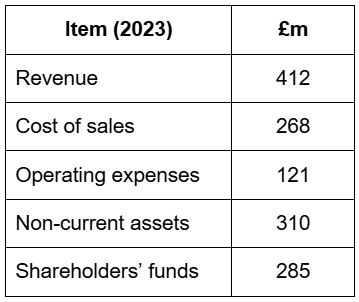
Table displaying financial data for 2023 in million pounds: Revenue 412, Cost of sales 268, Operating expenses 121, Non-current assets 310, Shareholders’ funds 285.

PulseTech’s directors are under pressure from shareholders to improve profitability, following a slowdown in revenue growth during 2023.

Extract G

Production capacity and outsourcing

PulseTech currently assembles its products at a factory in Eastern Europe. The factory is operating at 92% capacity utilisation.

Demand forecasts suggest that sales could increase by up to 30% over the next two years if PulseTech launches a new health-monitoring device. To meet this demand, PulseTech is considering two options:

  • Expanding its existing factory

  • Outsourcing production to a specialist electronics manufacturer in Asia

Outsourcing would reduce PulseTech’s control over production but could lower unit costs.

Extract H

The global wearable technology market

The global wearable technology market has grown rapidly over the past decade. The market was valued at $61.3bn in 2020 and is forecast to reach $150.6bn by 2030, representing strong long-term growth.

Growth is driven by increased health awareness, advances in sensor technology and the integration of wearable devices with smartphones and health apps.

However, the market is characterised by:

  • Rapid technological change

  • Short product life cycles

  • High levels of research and development spending

PulseTech’s senior managers must decide how best to position the business to benefit from future market growth.

Using the data in Extract F, calculate PulseTech plc's gross profit margin for 2023.

You are advised to show your working.

1
Sme Calculator
12 marks

Read the following extracts (E to H) (opens in a new tab) before answering

Assess whether Monarch Airlines’ business failure was due to internal causes

2
Sme Calculator
8 marks

Read the following extracts (E to H) (opens in a new tab) before answering

Assess two ways Derby Theatre could improve its liquidity

3
10 marks

Read the following extracts (A to D) (opens in a new tab) before answering

With reference to Extract C, assess the usefulness of government interventions in solving working capital shortages such as those experienced by Jamie's Italian in 2019

1
Sme Calculator
20 marks

Read the following extracts (E to H) (opens in a new tab) before answering

In 2016, had it not been for the Competition and Markets Authority, Pure Gym may have been able to reach its target growth by taking over The Gym Group, rather than LA Fitness.

Using the data in Extracts G and H calculate appropriate accounting ratios for The Gym Group and, using other non-financial information, evaluate these two options and recommend which company it would have been better for Pure Gym to take over to achieve its growth target.
2
Sme Calculator
20 marks

Read the following extracts (E to H) (opens in a new tab) (opens in a new tab)before answering 

VW’s new Chief Executive has been given the aim of increasing the company’s profitability. The two options VW is considering are to develop a new range of self-driving cars or to improve productivity.

Evaluate these two options and recommend which is most suitable to achieve the aim of increasing profitability, for a business such as VW.

3
Sme Calculator
20 marks

Read the following extracts (A to D) (opens in a new tab) before answering

Pura Cosmetics has set the objective of managing its cash-flow more effectively.To achieve this, it is considering two options; either to increase its overdraft facility or to reduce the credit period given to its retail customers.

Evaluate these two options and recommend which one Pura Cosmetics should choose in order to achieve the objective of managing its cash-flow more effectively.

4
Sme Calculator
20 marks

Read the following extracts (E to H) (opens in a new tab) before answering

Liz and Les have set themselves the objective of managing Bluebells’ finances more effectively. They are considering whether to focus more on improving cash flow or increasing profit.

Evaluate these two options and recommend which one is more suitable for Liz and Les to achieve this objective.

5
Sme Calculator
8 marks

Read extracts E to H before answering questions

Extract E

Company profile: Sweetcraft Ltd

Sweetcraft Ltd is a family-owned business based in Burnley, Lancashire, specialising in traditional boiled sweets, toffee, and fudge. Founded in 1992, the company employs 72 people and generates annual revenue of approximately £9.8 million.

Operating from a single site, Sweetcraft sells through independent retailers, farm shops, garden centres, tourist attractions, and its website. The business has built a reputation for high-quality, handcrafted products using traditional recipes, priced 40-60% above mass-market equivalents.

The core customer base consists of older consumers valuing traditional British confectionery. The company has developed a growing gift range, with seasonal assortments popular for Christmas and Easter.

Co-founders Sarah and Michael Chen remain hands-on in operations. Sweetcraft faces rising ingredient costs, competition from larger manufacturers, and difficulties attracting younger consumers.

Extract F

Financial performance 2022-2024

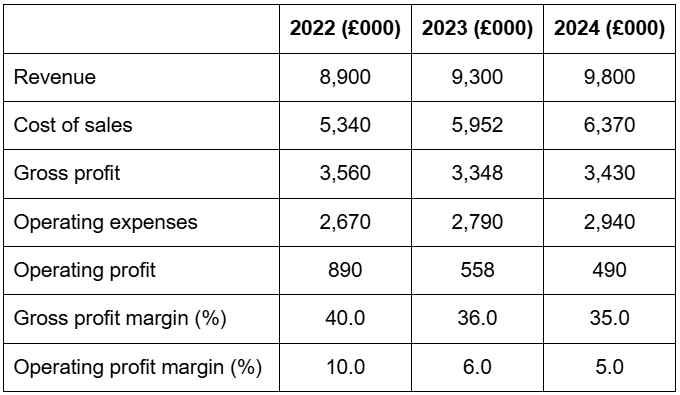
Financial table showing revenue, costs, and margins from 2022 to 2024, with decreasing operating profit margins: 10% in 2022 to 5% in 2024.

Additional data (2024)

  • Non-current assets: £3.2m

  • Current assets: £1.8m

  • Current liabilities: £1.4m

  • Long-term loans: £1.5m

  • Rising cost of sales (sugar, glucose syrup, butter, packaging) increased from 60% to 65% of revenue

    • Competitive pressures and retailer price sensitivity limited price increases.

  • Operating expenses rose due to higher energy costs, wage inflation, and digital marketing investment.

Source: adapted from Sweetcraft Ltd financial statements

Extract G

Operations and workforce challenges

Sweetcraft's factory operates at 68% capacity, producing around 780 tonnes annually using traditional batch production with semi-automated packaging. Production is highly seasonal, peaking before Christmas and Easter. During peaks, the factory runs extended shifts with up to 20 temporary workers. Outside peaks, underutilisation causes fixed cost inefficiencies.

Labour turnover averaged 24% in 2024, above the industry average of 15%. Employees leave for higher-paid positions in nearby distribution centres. The workforce is aging - 45% of production employees are over 50 - and the company struggles to attract younger workers.

Sarah Chen commented: "We're competing with logistics operators offering higher wages. Our traditional sweet-making roles require specialist skills that are increasingly rare. Training takes time and impacts productivity."

Extract H

Strategic options

Sweetcraft's management has identified two growth strategies:

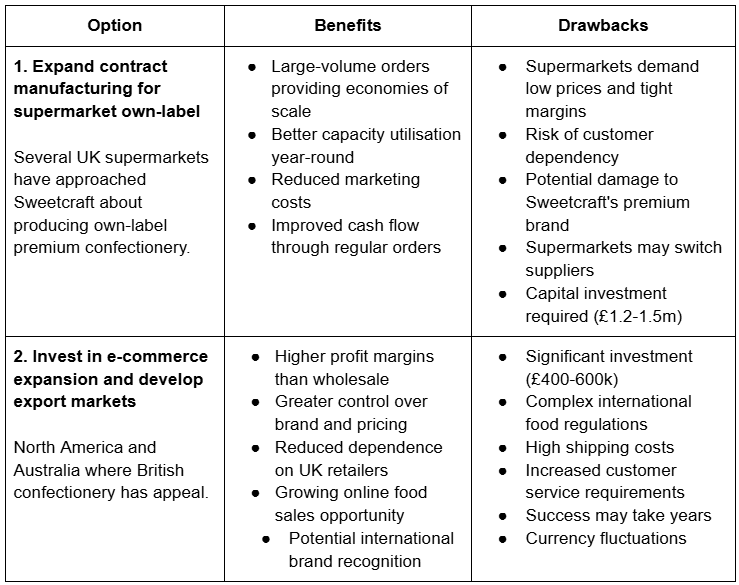
Table showing two options for Sweetcraft: contract manufacturing for supermarkets and e-commerce expansion. Lists benefits and drawbacks for each option.

Management is divided. Some argue contract manufacturing offers lower-risk capacity utilisation, while others believe protecting the Sweetcraft brand and pursuing direct sales creates greater long-term value.

Source: adapted from strategic planning documents

Assess two possible reasons for the decline in Sweetcraft Ltd's operating profit between 2022 and 2024 (Extract F)

6
Sme Calculator
12 marks

Read extracts E to H before answering questions

Extract E

Company profile: Sweetcraft Ltd

Sweetcraft Ltd is a family-owned business based in Burnley, Lancashire, specialising in traditional boiled sweets, toffee, and fudge. Founded in 1992, the company employs 72 people and generates annual revenue of approximately £9.8 million.

Operating from a single site, Sweetcraft sells through independent retailers, farm shops, garden centres, tourist attractions, and its website. The business has built a reputation for high-quality, handcrafted products using traditional recipes, priced 40-60% above mass-market equivalents.

The core customer base consists of older consumers valuing traditional British confectionery. The company has developed a growing gift range, with seasonal assortments popular for Christmas and Easter.

Co-founders Sarah and Michael Chen remain hands-on in operations. Sweetcraft faces rising ingredient costs, competition from larger manufacturers, and difficulties attracting younger consumers.

Extract F

Financial performance 2022-2024

Financial table showing revenue, costs, and margins from 2022 to 2024, with decreasing operating profit margins: 10% in 2022 to 5% in 2024.

Additional data (2024)

  • Non-current assets: £3.2m

  • Current assets: £1.8m

  • Current liabilities: £1.4m

  • Long-term loans: £1.5m

  • Rising cost of sales (sugar, glucose syrup, butter, packaging) increased from 60% to 65% of revenue

    • Competitive pressures and retailer price sensitivity limited price increases.

  • Operating expenses rose due to higher energy costs, wage inflation, and digital marketing investment.

Source: adapted from Sweetcraft Ltd financial statements

Extract G

Operations and workforce challenges

Sweetcraft's factory operates at 68% capacity, producing around 780 tonnes annually using traditional batch production with semi-automated packaging. Production is highly seasonal, peaking before Christmas and Easter. During peaks, the factory runs extended shifts with up to 20 temporary workers. Outside peaks, underutilisation causes fixed cost inefficiencies.

Labour turnover averaged 24% in 2024, above the industry average of 15%. Employees leave for higher-paid positions in nearby distribution centres. The workforce is aging - 45% of production employees are over 50 - and the company struggles to attract younger workers.

Sarah Chen commented: "We're competing with logistics operators offering higher wages. Our traditional sweet-making roles require specialist skills that are increasingly rare. Training takes time and impacts productivity."

Extract H

Strategic options

Sweetcraft's management has identified two growth strategies:

Table showing two options for Sweetcraft: contract manufacturing for supermarkets and e-commerce expansion. Lists benefits and drawbacks for each option.

Management is divided. Some argue contract manufacturing offers lower-risk capacity utilisation, while others believe protecting the Sweetcraft brand and pursuing direct sales creates greater long-term value.

Source: adapted from strategic planning documents

Using the information provided, calculate Sweetcraft Ltd's current ratio for 2024 (Extract F). Assess whether this indicates that Sweetcraft is in a strong financial position.