Business Failure (Edexcel A Level Business): Revision Note
Exam code: 9BS0

What is business failure?
Business failure is when a business is forced to stop trading, usually because it can no longer meet its financial obligations
It is closely linked to insolvency - a situation where a business cannot pay its debts as they fall due, or its liabilities are greater than its assets
Not every closure is a failure
Some owners choose to close a profitable business voluntarily, for example on retirement, so closure and failure are not always the same thing
Causes of business failure
Internal causes
Problems that come from within the business and are, at least partly, within its control
E.g. Poor management decisions
External causes
Problems that come from outside the business and are largely outside its control
E.g. a recession or new legislation
Financial factors
Problems directly affecting money and cash
Non-financial factors
Problems affecting the wider running of the business
Financial factors causing business failure
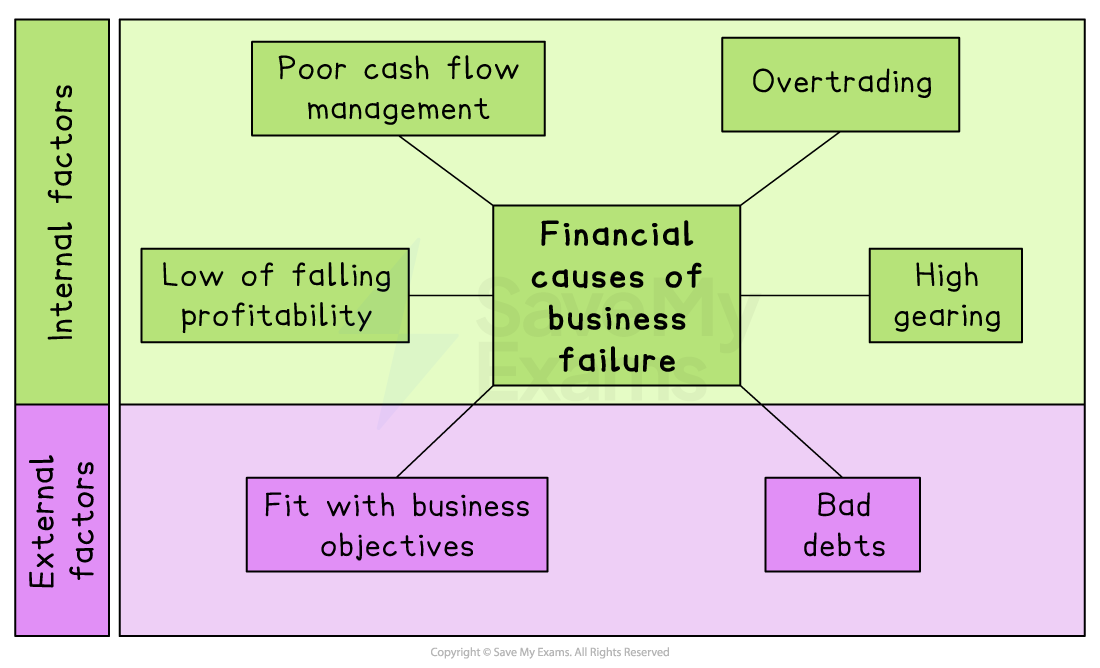
Internal factors
Poor cash flow management
A business can be profitable on paper but still fail if it does not have enough cash to pay staff, suppliers and other bills on time
For example, a business that lets customers take too long to pay invoices may run out of cash even while sales are growing
Overtrading
This happens when a business grows too quickly without enough working capital to support the higher level of activity
This puts severe strain on cash flow and can force closure even when demand is strong
Low or falling profitability
If costs rise faster than revenue, or prices cannot be set high enough, profit margins shrink
This leaves little or no financial buffer to survive a difficult period
High gearing
A business that relies heavily on borrowed money faces large interest payments regardless of how well it is trading
A fall in revenue can quickly make loan repayments unaffordable
External factors
Limited access to finance
Banks and investors may refuse to lend to a business they see as high risk or may only offer finance at a high rate of interest
This makes it harder to fund operations or growth
Bad debts
When customers fail to pay what they owe, this can create a serious cash shortfall
This is particularly problematic for a business with few customers or large individual orders
Non-financial factors causing business failure
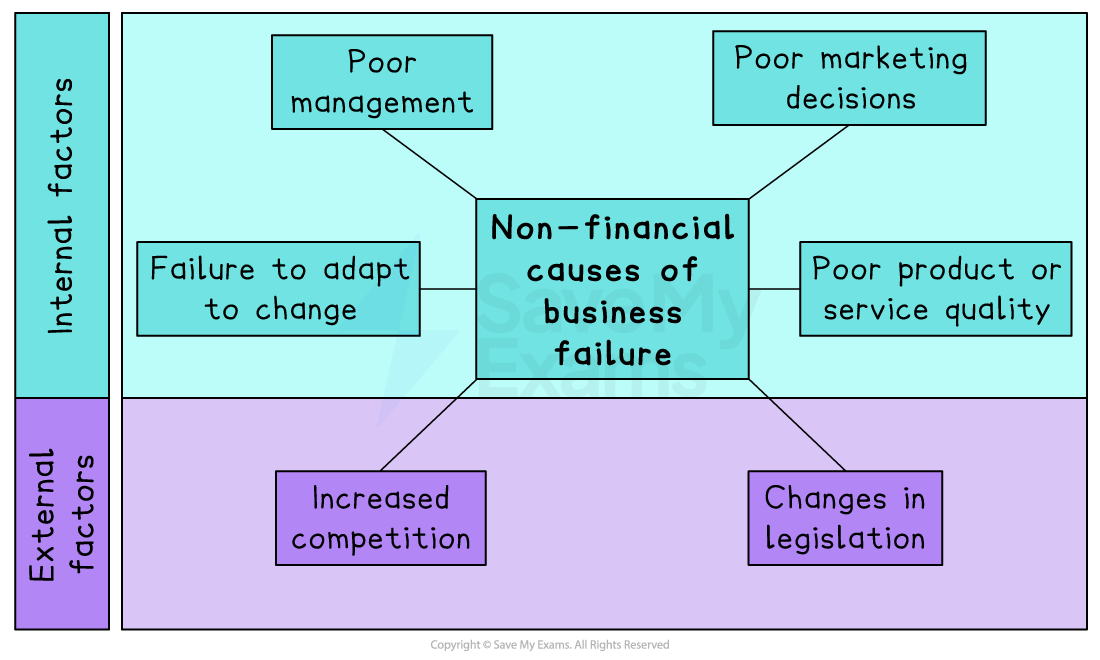
Internal factors
Poor management
Inexperienced or weak leadership can lead to bad decisions on pricing, staffing or expansion
A lack of clear direction makes it harder to respond to problems as they arise
Poor marketing decisions
A business that misjudges its target market, prices its product incorrectly, or fails to promote itself effectively may struggle to generate enough sales to survive
Failure to adapt to change
Markets, technology and consumer tastes change constantly
A business that does not keep up risks losing customers to competitors who do
For example, several well-known high-street chains have collapsed after failing to invest in online retailing
Poor product or service quality
Persistent quality problems damage a business's reputation
This leads to lost customers and negative reviews that are difficult to reverse
External factors
Increased competition
New entrants or more aggressive competitors can take market share, reduce pricing power and squeeze a business out of the market
Changes in legislation
New laws, for example around employment rights or environmental standards, can raise costs or restrict how a business operates
This puts pressure on businesses that cannot absorb the extra burden
Case Study
Loom

Loom was a mid-sized home textiles retailer with twelve UK stores, founded in 2009 by two former textile designers who had never run a large retail business before.
After a decade of steady growth, the founders expanded rapidly, opening five new stores in eighteen months without properly planning how the expansion would be funded. This overtrading left Loom short of cash, and suppliers were often paid late.
At the same time, more shoppers were buying home textiles online, but Loom had never invested in an online store or a clear marketing strategy, so it lost customers to competitors offering cheaper, more convenient options.
A rise in interest rates during a period of economic uncertainty made Loom's existing loans more expensive, while nervous consumers cut back on non-essential spending.
When Loom applied for extra finance to cover a difficult trading period, its bank refused, viewing the business as too high risk given its cash flow problems.
Unable to pay its suppliers or its rent, Loom entered administration and closed all twelve stores within six months, illustrating how financial and non-financial pressures can combine to cause business failure
Examiner Tips and Tricks
When you are asked to analyse or evaluate the causes of a business's failure, sort the causes into internal and external before you start writing your answer. This makes it easier to judge how much control the business actually had over its own failure, which is exactly the kind of judgement that earns the higher evaluation marks

Unlock more, it's free!
Join the 100,000+ Students that ❤️ Save My Exams
the (exam) results speak for themselves:

Was this revision note helpful?
Build on this topic