Role of an Entrepreneur (Edexcel A Level Business): Revision Note
Exam code: 9BS0

Entrepreneurs create and set up businesses
Businesses are usually started by an entrepreneur
An entrepreneur is a person who is willing and able to create a new business idea or invention and takes risks in pursuing success
Successful entrepreneurs can identify and pursue opportunities, create value for customers and build thriving businesses
What do entrepreneurs do?
Organise resources
An entrepreneur must be able to gather and coordinate the resources necessary to start and operate a business
E.g. When Michael Dell started his computer company from his garage, he had to organise resources, such as space, computers, software tools and employees, and manage the finances
Make business decisions
Entrepreneurs must be able to make decisions that will determine the success or failure of their business
E.g. A restaurant owner may need to decide what type of food to serve, where to locate the restaurant and what prices to charge
These decisions require a combination of market research, creativity and business skill
Making the wrong decisions can lead to wasted resources, lost opportunities and ultimately business failure
Take risks
Entrepreneurship involves taking risks - financial, personal or professional
E.g. an entrepreneur may invest their life savings into a new venture or quit a secure job to start their own business
They may also take risks by introducing new products or entering new markets
These risks can pay off with great rewards, but they can also lead to failure and financial loss
Entrepreneurs run and develop existing businesses
There are many examples of successful entrepreneurs who have been brought in to run or expand an existing business
These individuals bring a unique entrepreneurial spirit into the business, which helps to drive it forward and expand
Examples of entrepreneurial CEOs
Starbucks
In 1982, Schultz was hired by Starbucks as Director of Retail Operations and Marketing
He later left to start his own coffee company but returned to Starbucks in 1987 as CEO
Under his leadership, Starbucks expanded globally and became one of the most recognised brands in the world
Yahoo
Marissa Mayer was brought in to lead Yahoo! in 2012 as CEO
She implemented several initiatives to revitalise the struggling company, including acquisitions, product improvements and a renewed focus on mobile applications
Yahoo was, itself, sold to Verizon in 2017
Employees demonstrate entrepreneurship within a business
Intrapreneurship refers to the practice of promoting entrepreneurial thinking and behaviour within an existing business
It involves empowering employees to think and act like entrepreneurs
The business encourages them to take risks, innovate and develop new ideas and projects that may benefit the business
Intrapreneurship allows businesses to tap into the creative potential of their employees and generate new products, services or processes that can drive growth and competitive advantage
This helps to create a culture that generates a sense of ownership and engagement among employees, which increases motivation and helps to retain top talent
To promote intrapreneurship, businesses may provide resources to employees or offer incentives/rewards for successful projects
Examples of intrapreneurship
In 2004, Google introduced Gmail, a free email service that quickly gained popularity due to its large storage capacity and intuitive interface
Gmail was developed by a team of Google employees as part of the company's '20% time' initiative (now a more informal practice)
This policy allows employees to spend 20% of their work time on personal projects
Gmail became a huge success and is now one of the most widely used email services in the world
Sony
In the early 1990s, a group of engineers at Sony proposed the idea of creating a video game console to compete with Nintendo and Sega
Senior management initially rejected the proposal
Sony engineers persisted, and a senior executive eventually supported them
Sony PlayStation was launched in 1994 and quickly became one of the most popular gaming consoles of all time
3M
3M's "15% rule" is a policy that allows employees to spend up to 15% of their work time pursuing projects outside of their normal job
Post-It Notes were developed by two employees, Spencer Silver and Art Fry
Post-It Notes were initially marketed as a solution for bookmarking pages in books, but they quickly became popular for all sorts of purposes
Today, they generate billions of dollars in annual revenue for 3M
Barriers to entrepreneurship
Entrepreneurship can be a challenging journey, and many barriers can prevent individuals from starting or growing a successful business
Significant barriers to entrepreneurship
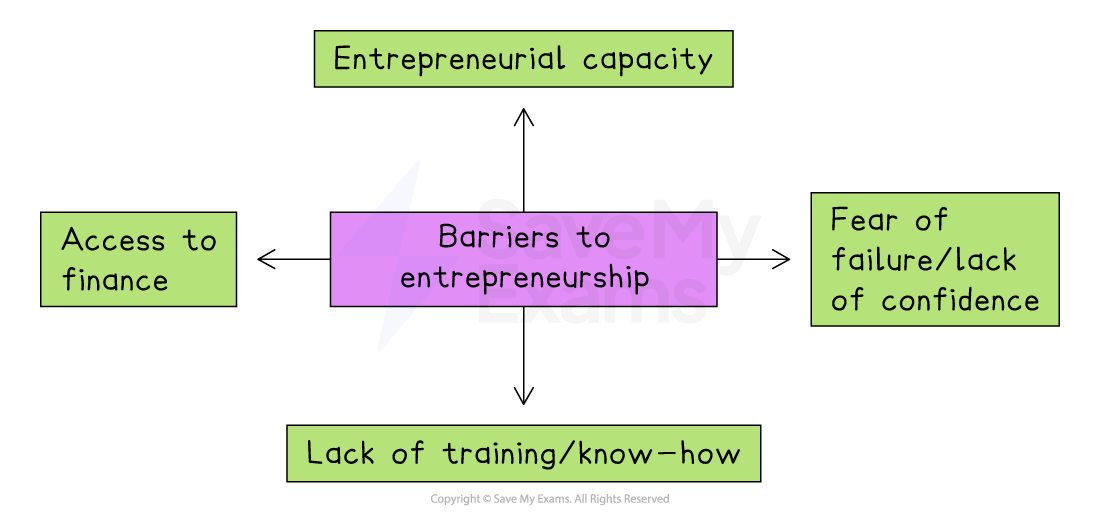
Entrepreneurial capacity
Entrepreneurial capacity is an individual's ability to think creatively, take risks and identify and seize business opportunities
A lack of entrepreneurial capacity can prevent someone from turning a good idea into a viable business, even where finance and training are available
Spotting and acting on an opportunity requires confidence and judgement that cannot simply be taught
Two people with equal access to finance and training may have very different levels of success
One may be naturally more willing to take calculated risks and act decisively when an opportunity arises
Access to finance
Many aspiring entrepreneurs struggle to secure the funding necessary to start or grow their businesses
Lack of access to finance (opens in a new tab) is a major barrier to entrepreneurship, especially for those from disadvantaged backgrounds
Lack of training/know-how
Starting and growing a successful business requires a range of skills, including marketing, finance, management and leadership
Aspiring entrepreneurs may struggle to develop a viable business plan, attract customers or manage their finances effectively
Fear of failure / lack of confidence
Entrepreneurship is inherently risky
Entrepreneurs may hold back for fear of failure or a lack of confidence
They may worry about the financial risks involved in starting a business or fear the stigma of failure
Entrepreneurs anticipate risk and uncertainty
Risk is something an entrepreneur can plan for
The probabilities of outcomes are known or at least understood and considered
Risk-taking is a conscious decision, and often in business, the greater the risk, the greater the reward
Risk vs. uncertainty
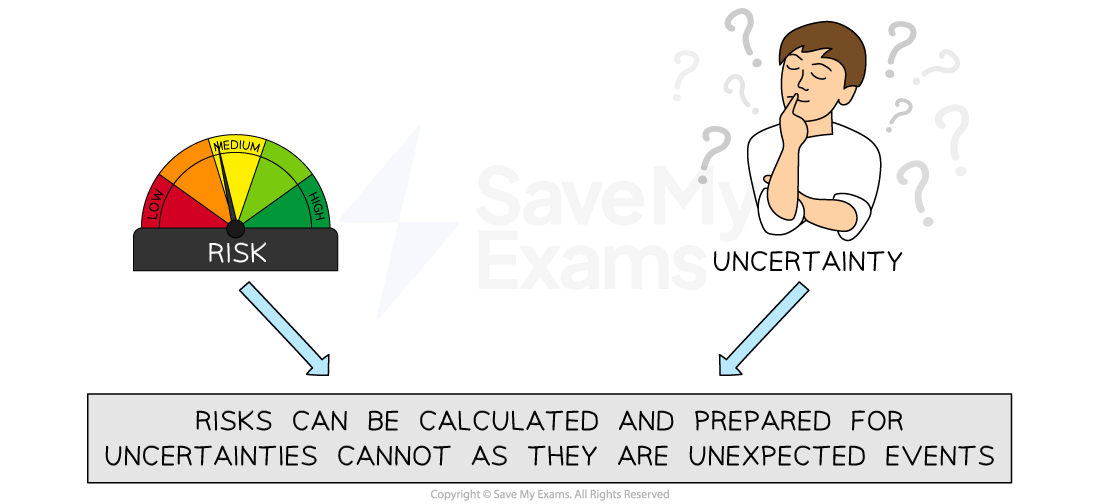
Uncertainty is caused by factors outside of the entrepreneur’s control
Factors that typically cause uncertainty include:
Environmental factors, such as the Japanese Tsunami in March 2011
Economic changes, such as Covid lockdowns, Brexit or collapses in the banking system
The entry of new competitors
Changes in local and national legislation (laws)
Changes in the political party governing the country
Successful entrepreneurs can manage risk and quickly respond to uncertainty in the business environment
Case Study
AirBnB and the COVID-19 pandemic
In 2020, the COVID-19 pandemic caused many people to cancel their travel plans and stay home to avoid exposure to the virus. This had a major impact on Airbnb's business.
Rather than wait for the pandemic to pass, owner Brian Chesky quickly pivoted his business strategy to meet the changing needs of their customers
Airbnb launched a new service called 'Online Experiences', which allowed people to participate in virtual tours, cooking classes and other experiences from the comfort of their own homes
Airbnb also took steps to address the health and safety concerns of its customers by implementing enhanced cleaning protocols and providing hosts with a guide on how to prepare their homes for guests during the pandemic
By quickly pivoting his business strategy and addressing the concerns of his customers, Chesky was able to drive his business forward and position Airbnb for continued success in the future

Unlock more, it's free!
Join the 100,000+ Students that ❤️ Save My Exams
the (exam) results speak for themselves:

Was this revision note helpful?
Build on this topic