Factors Contributing to Increased Globalisation (Edexcel A Level Business): Revision Note
Exam code: 9BS0

Trade liberalisation
Trade liberalisation is the removal or reduction of barriers to trade between different countries
Trade liberalisation can happen in several ways
Reducing or eliminating tariffs
Tariffs are taxes on imported goods
Removing quotas
Quotas are limits on the quantity of goods that can be imported
Cutting subsidies
Subsidies are government support that gives domestic producers an advantage over foreign competitors
Signing trade agreements
Countries negotiate deals to lower barriers between them, either bilaterally (between two countries) or by joining a trading bloc
Example
The UK officially joined the CPTPP (Comprehensive and Progressive Agreement for Trans-Pacific Partnership) in December 2024, becoming the first European member of the 12-country trade bloc
Over 99% of current UK exports to CPTPP member countries are now eligible for tariff-free trade
Evaluation of trade liberalisation
Advantages of trade liberalisation |
|
|---|---|
Disadvantages of trade liberalisation |
|
Examiner Tips and Tricks
When evaluating trade liberalisation, avoid treating it as universally positive - while it benefits large, competitive businesses that can access bigger markets, it can seriously harm smaller domestic firms or "infant industries" that aren't yet able to compete internationally. A strong answer weighs this trade-off against the specific business or country in the case study
Influences on globalisation
There are many reasons for the increasing levels of globalisation
The context of an individual country determines which of these reasons has had the greatest impact on its economy
Example
The USA has lost numerous manufacturing sectors as production has moved to lower-cost countries such as India and China
Reasons for increased globalisation
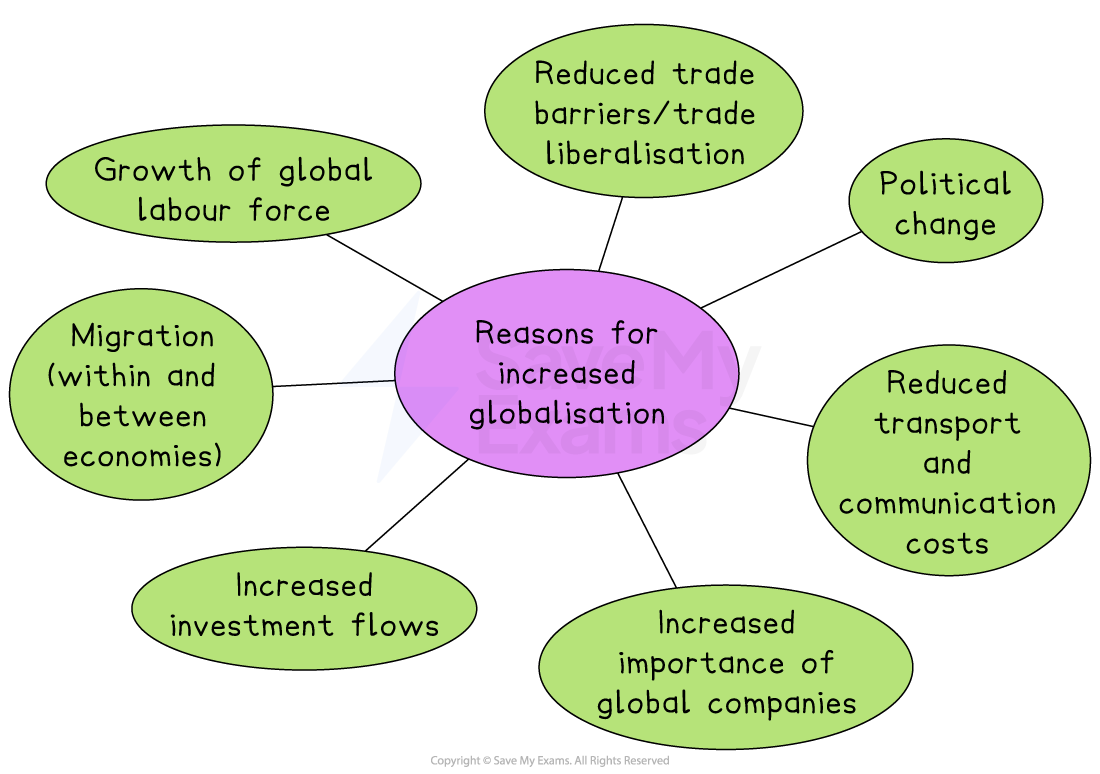
Political change
Changes in the government of a country can influence the country's attitude to trade
E.g. China joined the World Trade Organisation in 2001, which led to a significant increase in its exports
Reduced cost of transport and communication
Economies of scale due to innovation in containerisation on large ships have reduced business costs
Technological advancements due to the internet/mobile technology have made it easier for buyers and sellers to connect with one another
Increased significance of global companies
A transnational company is a business that operates in more than one country
These businesses will have their headquarters in one country but have branches in other countries
E.g. Nike has its headquarters in Oregon, United States. As of 2022, it has 1,046 retail stores throughout the world
With increasing numbers of transnational companies operating globally, there is increased pressure on countries to engage in free trade
Increased investment flows (FDI)
Foreign direct investment (FDI) is important for job and wealth creation within an economy
It allows businesses to establish themselves in countries where they may face trade barriers
Migration (within and between economies)
Migration is the movement of people from one location to another
Migration has led to increased globalisation, as better transportation and deregulation have allowed workers to have more flexibility when looking for work
E.g. in 2022, the United Arab Emirates had the highest proportion of immigrants, at 88%
Growth of the global labour force
The global labour force has grown significantly, especially due to the growth of emerging economies such as India and China
This has increased globalisation due to the following reasons:
More people working means more income to spend on goods and services, boosting global demand
An increased supply of labour leads to falling wages, which is beneficial in reducing business costs
More people working generates increased levels of entrepreneurship
Trade liberalisation
Reducing or removing trade barriers, such as tariffs and quotas, makes it easier and cheaper for businesses to export and import goods across borders, encouraging international trade
With fewer restrictions, businesses can more easily expand into new markets
This can lead to stronger economic links between countries and greater global interdependence
Structural change
Structural change occurs when a country, industry or market changes which sector it primarily operates in
For example moving away from agriculture and manufacturing and towards services
As countries develop, resources and labour shift towards higher-value sectors
This can make a country a more attractive location for certain types of business and increase its participation in global trade
Offshoring production to other countries is a common feature of structural change
It speeds up the process of globalisation by shifting manufacturing towards countries where it can be produced more cheaply
Structural change in the UK
The UK has undergone significant structural change over the past 35 years
Economic sectors as a share of GDP in the UK 1990-2025
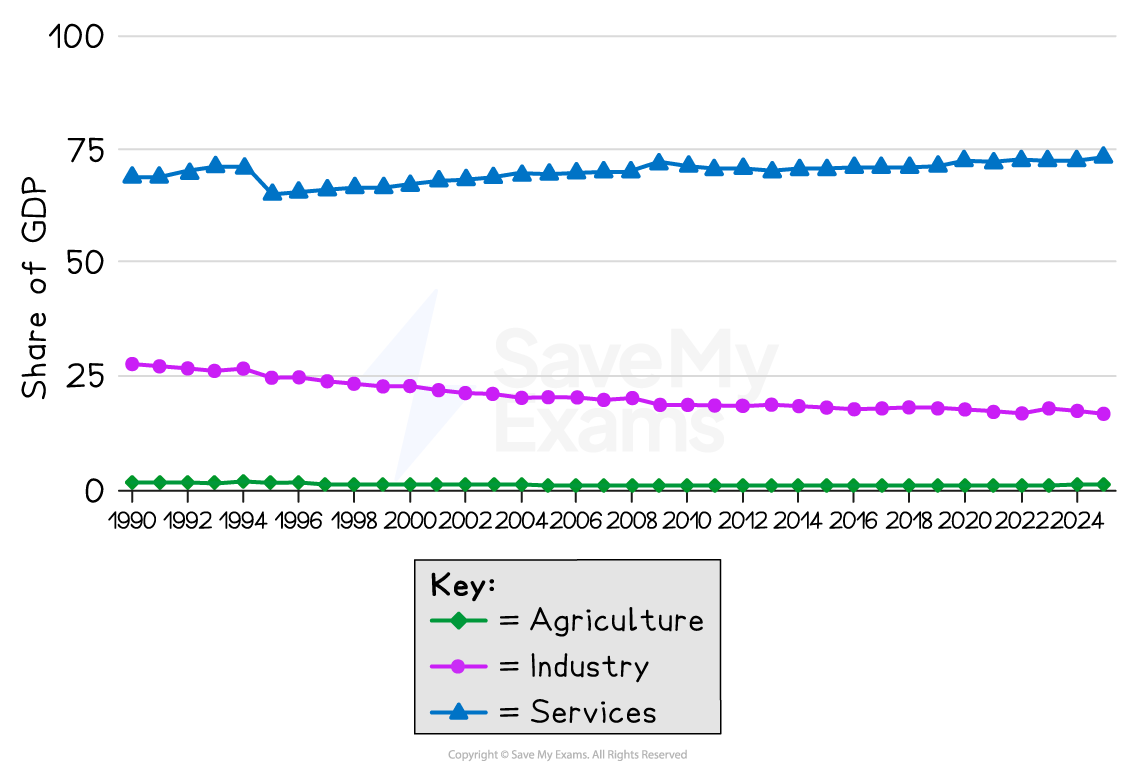
Services now account for around 73% of UK economic output, while manufacturing accounts for under around 17%, changing the types of goods and services the UK trades internationally

Unlock more, it's free!
Join the 100,000+ Students that ❤️ Save My Exams
the (exam) results speak for themselves:

Was this revision note helpful?
Build on this topic