Ethics (Edexcel A Level Business): Revision Note
Exam code: 9BS0

An introduction to ethics
Business ethics refers to the moral principles that guide how a business conducts itself and makes decisions, distinct from what it is merely legally required to do
They determine how it operates and its decision-making process
Unethical actions can damage the brand and result in a loss of profitability
Unethical actions are often pursued, as they result in higher levels of profit for the business (or its owners)
Customers around the world are putting more and more pressure on brands to behave ethically
Ethical considerations
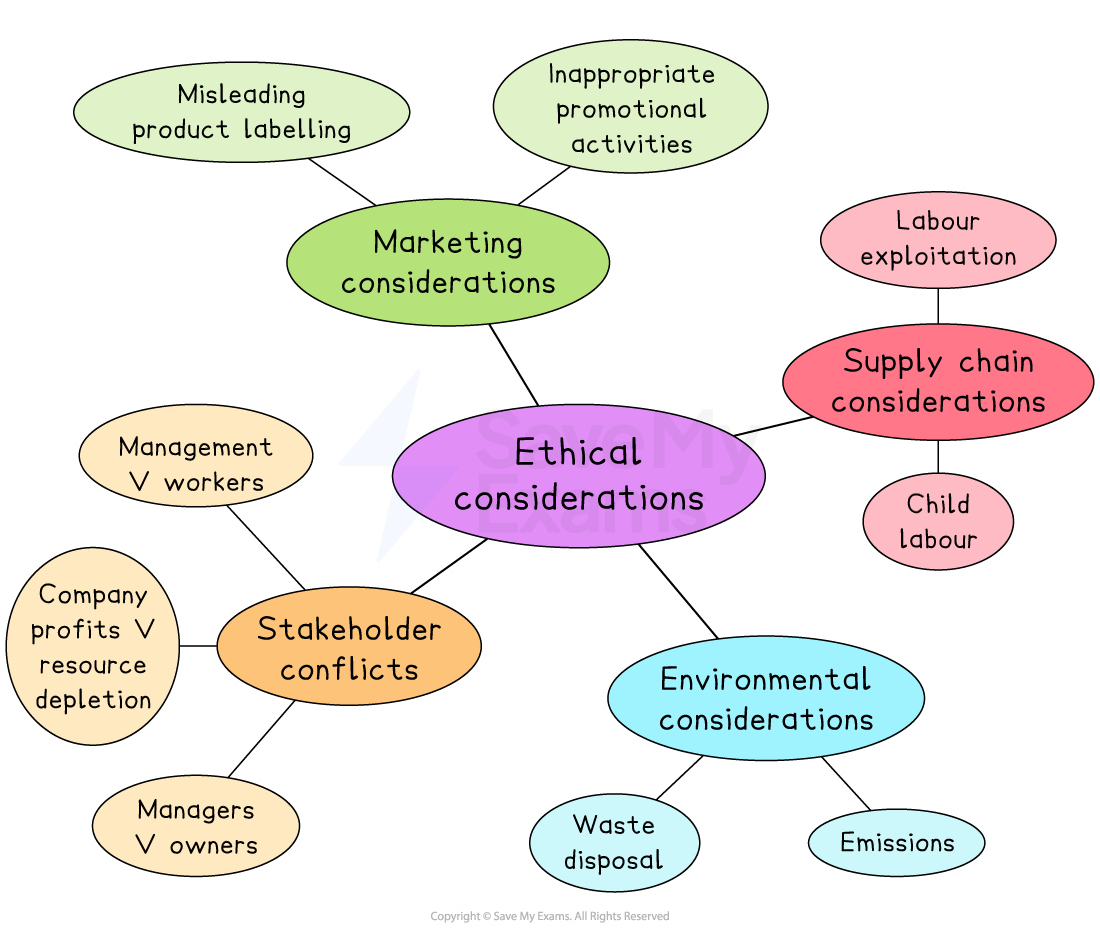
Ethical considerations explained
Stakeholder conflicts
A stakeholder is an individual or group that has an interest in or can be affected by a business
Different stakeholders have different levels of power and different priorities, which inevitably creates the potential for conflict
Conflicts between stakeholders
Conflict | Explanation |
|---|---|
Management vs workers |
|
Management vs owners |
|
Company profits vs resource depletion |
|
Pay and working conditions
Multinational corporations (MNCs) often operate in countries that have different employment regulations and working conditions
MNCs need to decide if they will comply with the regulations of their base location or the other country
MNCs may demonstrate unethical behaviour by exploiting workers in LEDCs by paying them lower wages
MNCs argue that the wages they pay provide a decent standard of living within that country
Example
In 2015, Apple came under scrutiny as its production facilities in China were found to pay workers approximately $1.85 an hour, nowhere near enough to cover workers' living expenses
Some MNCs also behave unethically by providing poor working conditions in order to cut costs
Factories and warehouses with poor working conditions are referred to as "sweatshops"
Nike was accused of using sweatshops in countries such as China and Vietnam, paying workers just 14 cents an hour
Environmental considerations
Climate change and global warming have become a priority for governments across the world
Governments are encouraging businesses to improve the environmental impact of their business activity
Waste management
Many developed countries have regulations about how businesses should dispose of their waste
LEDCs usually have less regulation and enforcement on waste management
There is usually poor waste management infrastructure
MNCs can also dispose of waste in LEDCs at a cheaper cost, which allows them to maintain their high profits
Example
Four major MNCs (Coca-Cola, Pepsi, Nestle and Unilever) dispose of half a million metric tonnes of plastic across six developing countries (Tearfund, 2020)
Emissions
Emissions are often released from factories or from products made by MNCs
Just 100 companies are responsible for 71% of the global emissions that cause global warming
The emissions MNCs produce have a negative impact on local communities, causing health issues such as asthma, cancer and skin irritations
Supply chain considerations
The supply chain consists of all the suppliers involved in the manufacturing of a product/service
Many MNCs have suppliers in different countries, and increasingly, they are held accountable for the working conditions of these suppliers
Many MNCs are now taking action to reduce unethical labour practices as part of their corporate social responsibility (CSR) practices
Child labour
Some MNCs have manufacturing facilities in countries where child labour is common
Usually in areas where children are working to generate income for the family
Example
Starbucks was found to have children under 13 working 40-hour weeks in Guatemala picking beans for as little as £5 a day
MNCs using child labour in their supply chain face backlash, which can damage their brand and affect sales
Example
Protests took place outside Primark's flagship Oxford Street store after a documentary revealed that child labour was used in its factories in India
Exploitation of labour
Exploitation of labour can take the form of low wages and poor working conditions
E.g. workers having to work long hours and with poor ventilation
MNCs are under increasing pressure from governments, customers and institutions, such as the International Labour Organisation, to take action to ensure that their products and services do not involve exploitative labour practices
Marketing considerations
When developing their marketing strategies, MNCs must consider the cultural and social (opens in a new tab)differences in the countries in which they operate
Misleading labelling
Labelling must comply with the regulations of the country
The information must be correct and not include any false information aimed at generating higher sales
Examples of misleading information include false information about a product's:
Size
Content
Features
Functionality
Example
Volkswagen was found to falsely promote "clean diesel" vehicles and had to pay approximately $34bn in fines, severely damaging the brand
Inappropriate promotional activities
Promotional activities should not be offensive or illegal
MNCs face a particular risk, as a campaign designed for one country may carry very different meanings or connotations in another
Promotion can be considered inappropriate if it
Uses imagery, language or symbols that cause offence in a particular culture or region
Draws on stereotypes about race, gender, religion or nationality
Makes misleading or exaggerated claims about a product's benefits
Fails to consider a country's political, historical or religious sensitivities
Example
Nivea had to pull its "White is purity" campaign for its deodorant in the Middle East, as the public believed it was promoting white supremacy
Examiner Tips and Tricks
Don't assume that acting legally means a business is acting ethically - the two are not the same thing.
A business can follow every law in the country it operates in (e.g. paying the local minimum wage) while still being widely regarded as unethical if that wage isn't enough for workers to live on. When evaluating a business's behaviour in a case study, always consider the legal and the ethical dimension separately, as strong answers often reward students who spot this distinction rather than treating "legal" as a synonym for "ethical."

Unlock more, it's free!
Join the 100,000+ Students that ❤️ Save My Exams
the (exam) results speak for themselves:

Was this revision note helpful?
Build on this topic