Corporate Objectives (Edexcel A Level Business): Revision Note
Exam code: 9BS0

Developing corporate objectives
Aims and objectives serve as a guide for a business's overall strategy and direction, helping to focus efforts and resources towards a common purpose
There is a hierarchy of objectives that cascades downwards
The hierarchy of objectives
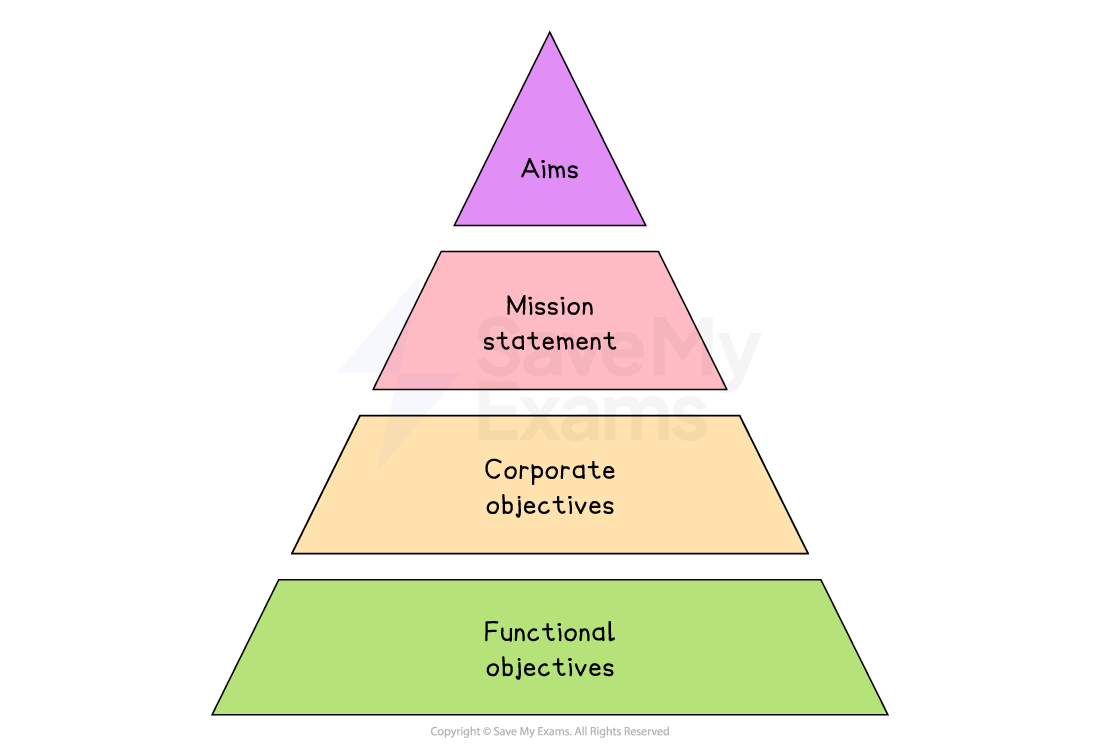
A business's mission flows from its overall aim and is usually expressed in inspirational terms
From this mission, corporate objectives and functional objectives that detail the achievable goals a business wants to meet over a specified period are developed
Components of the hierarchy of objectives
Component | Explanation | Example |
|---|---|---|
Aim |
| Macmillan Cancer Support: "To do whatever it takes to support people living with cancer" |
Mission statement |
| Age UK: "Making a positive difference by putting older people, and the people around them, at the heart of all we do; working with partner organisations to improve the quality of later life and provide effective, timely support for those who need it the most" |
Corporate objective |
| Mind UK: "Provide 3m employees in low-paid sectors with workplace wellbeing support" |
Functional objective |
| Scope UK: "Working with the Government and disabled people, we will create a Passenger Charter, an information resource to help disabled people find the information they need when using public transport" |
SMART objectives
Corporate objectives are quantifiable, allowing a business to determine when and to what extent they have been achieved
Achieving objectives contributes towards meeting the overall business aim
Objectives may focus on achieving specified levels of market share, profit, sales growth or new product/market development
Corporate and functional objectives should be
Specific
Measurable
Agreed
Realistic
Time-bound
Example SMART sales objective
Increase the volume of annual subscription renewals by 12% during Q3 2026
This objective is specific as it relates to annual subscription renewals
It is measurable as a percentage increase is given
We must assume that it is agreed and realistic
Gaining the agreement/buy-in of key stakeholders and ensuring it is something the business can achieve
It is time-related as it is targeted to be achieved by Q3 2026
Critical appraisal of mission statements and corporate aims
Businesses need to critically assess whether corporate aims and mission statements continue to reflect their current corporate vision
The content and expression of business aims will likely change over time to reflect changing social attitudes and norms
For example, Apple’s mission statement - "to make the best products on earth, and to leave the world better than we found it" - emphasises its commitment to sustainability, a key social trend
Mission statements are sometimes criticised as being little more than an exercise in public relations that does little to inform objective-setting or promote a common organisational goal
For example, in 2013, KFC’s mission was "To sell food in a fast, friendly environment that appeals to price conscious, health-minded consumers" - but in the same year, it launched a burger that replaced the bread bun with extra layers of deep-fried chicken
Businesses should decide whether changes to the corporate aim or mission statement need to be made by considering whether:
The short- to medium-term strategies adopted by the business support the aim and mission
The aim and objectives are realistic and achievable in the current trading environment
The mission statement message communicates the aim of the business effectively to stakeholders
Revising the business aim and revisiting the mission statement should be seen as a natural step for growing businesses
It is a chance to involve a variety of stakeholders (opens in a new tab), including workers and suppliers, in determining the direction of the business
Newly identified opportunities and threats can be acknowledged
Sharing refreshed priorities, particularly with the media, can generate positive publicity
Examiner Tips and Tricks
When assessing the nature or effectiveness of the objectives for a specific business based on a case study provided, you should consider the following:
What is the purpose of the objectives?
Who is the intended audience?
How does the corporate strategy followed by the business compare to the mission in reality?
Who is the mission statement aimed at, and how does the strategy affect different groups?

Unlock more, it's free!
Join the 100,000+ Students that ❤️ Save My Exams
the (exam) results speak for themselves:

Was this revision note helpful?
Build on this topic