Controlling MNCs (Edexcel A Level Business): Revision Note
Exam code: 9BS0

Factors to consider when managing multinational corporations
Both governments of LEDCs and MEDCs find it difficult to manage multinational corporations (MNCs)
MEDCs often benefit from the profits of MNCs, and these firms carry significant political influence on government policy
LEDCs often have key decision makers (autocratic rulers) who receive payment for access to the country’s resources
It is important to control the activities of MNCs so as to enhance the benefits and reduce the disadvantages of what they offer
Controlling MNCs
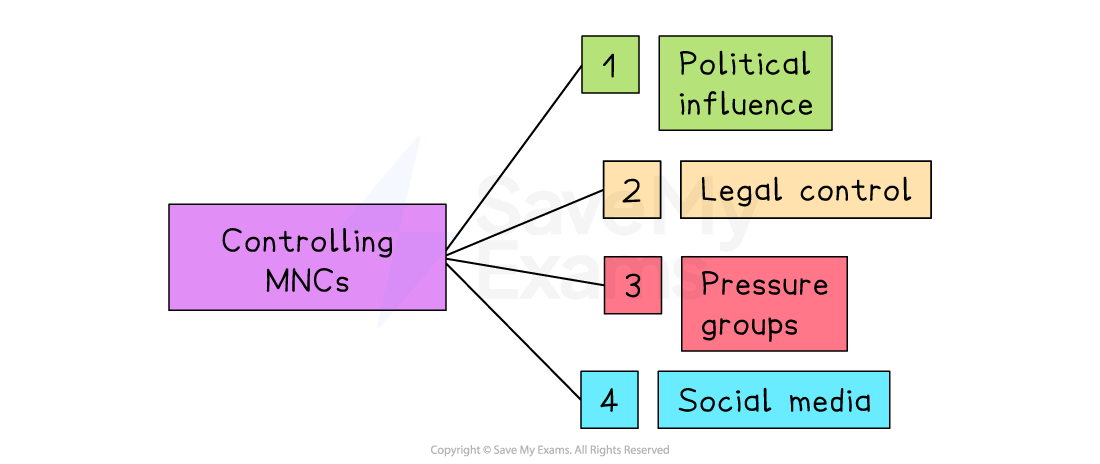
Political influence
Political institutions enforce laws and regulations that businesses need to adhere to
When MNCs establish themselves in a new country, they must work within the institutional framework of that country
MNCs in developed countries are often able to exert pressure on national governments through lobbying to create favourable conditions for their business
Another common issue occurs if politicians occupy roles on the board of directors for an MNC after retiring in return for reducing political control on the MNC whilst the politician is in power
MNCs in developing countries can influence governments, as they may establish deals that are beneficial to politicians
Bribes may be paid to secure lucrative contracts
Legal control
Governments can enforce legislation and regulations to control the operations of MNCs
The European Union's Competition Commission protects producers and consumers from anticompetitive or unfair practices
Example
Google was fined 2.42bn euros by the EU Competition Commission for abusing its market dominance in the search engine market
Governments want to attract MNCs to help boost their economy, so creating legal control in areas relating to taxes and employment ensures stability for the MNC
Prior to Brexit, MNCs were attracted by the stability of the UK economy, and it also offered them access to the full EU marketplace
Pressure groups
Pressure groups are organisations that operate to influence company and public policy in the interest of a particular cause
They can operate on a national or international scale
Example
In the UK Save the Arctic campaigned for Lego not to sell its products at Shell petrol stations
Greenpeace campaigned against Kimberly-Clark's unsustainable sourcing of wood pulp from Canada's boreal forest, pressuring the company to switch to recycled and sustainably-certified fibre
Pressure groups can take action in different forms, such as:
Naming and shaming
Direct action
E.g. protests, strikes and boycotting products
Lobbying by taking issues directly to the government
There are also pressure groups that work on behalf of MNCs, such as the Confederation of British Industry (CBI)
The CBI speaks and lobbies the government on behalf of member businesses
Social media
Social media involves the interaction of people via electronic devices using social media platforms
MNCs can use social media to their advantage to spread awareness and promote their business on a global scale
However, social media also enables stakeholders to freely share information about the unethical behaviour of MNCs
MNCs are forced to address the issues raised on social media, as there is a high level of public exposure, so information spreads rapidly
The influence of MNCs on social media may be limited in some countries, as certain countries have regulations in place to manage social media power
Example
The Chinese and Russian governments closely monitor social media to regulate information being spread
Case Study
Kestrel Minerals

Kestrel Minerals is a British-based multinational company that extracts copper from mines across several West African countries. In one country, Kestrel has cultivated close relationships with senior government ministers, several of whom have taken paid advisory roles with the company after leaving office, helping Kestrel secure favourable mining licences with minimal environmental restrictions.
This changed after an international pressure group, Earth Watch, launched a campaign accusing Kestrel of contaminating local water supplies, releasing drone footage of polluted rivers near one of its mines. The footage was shared millions of times on social media within days, forcing Kestrel to respond publicly and launch an independent investigation.
Facing mounting international pressure, the country's government introduced new legislation requiring MNCs to publish annual environmental impact reports and pay into a community remediation fund. Kestrel initially lobbied hard against the new rules through its government contacts, but ultimately complied once major international investors, alarmed by the negative publicity, threatened to withdraw funding unless Kestrel improved its practices.
Examiner Tips and Tricks
In Paper 1, when assessing the best way to control the actions of an MNC, you must consider the advantages and disadvantages of the different methods. When evaluating, you should also consider the most effective method within the context of the business in the extract. E.g. How large is the business? How well established is it? What is the reputation of the MNC in other countries?

Unlock more, it's free!
Join the 100,000+ Students that ❤️ Save My Exams
the (exam) results speak for themselves:

Was this revision note helpful?
Build on this topic