Trading Blocs (Edexcel A Level Business): Revision Note
Exam code: 9BS0

Expansion of trading blocs
A trading bloc is a group of countries that form an agreement to reduce or eliminate protectionist measures between each other
Joining a trading bloc is a key method of increasing trade liberalisation (opens in a new tab) and leads to trade creation
Trade creation means that businesses are able to enter new markets, which can lead to an increase in sales volume and sales revenue
Global trade blocs

The European Union (EU)
The EU is an economic union, originally formed in 1993
Countries in Europe can apply to join the union, and, as of 2026, there are 27 countries in the union
Being a member of the EU includes the free movement of goods and people between countries
Countries within the union have no trade restrictions between themselves
Countries within the union have common external barriers (e.g. tariffs) to countries outside of the union
The UK voted to leave the EU in 2016 and officially left in 2020
Association of Southeast Asian Nations (ASEAN)
ASEAN is a free trade area,originally formed in 1967
As of 2026, ASEAN has 11 member countries, following the admission of Timor-Leste in October 2025 - the bloc's first expansion in over two decades
A free trade area aims to achieve the free flow of goods in the region (eliminating trade barriers)
Free trade areas lower business costs, increase market size and help businesses generate economies of scale
The ASEAN free trade area is less integrated than the EU
It does not allow for the free movement of people between the countries, whereas the EU does
United States, Mexico and Canada (USMCA)
USMCA is the trade bloc that superseded NAFTA, which was established in 1994 between Canada, Mexico and the USA
The aim was to promote free trade between these countries
Many USA businesses relocated their manufacturing to Mexico
Goods could be produced there more cost-effectively due to the lower wages paid to Mexican workers
The products could then be imported back into the USA without any tariffs being incurred
Mexico has benefitted from this agreement, as it has helped to create many new industries and jobs within the country
However, most of the benefits occurred in the north of the country, close to the USA border
Since 2025, USMCA's future has become less certain
The USA formally declined to renew the agreement in July 2026, shifting to an annual review process
New US tariffs on cars and auto parts have applied even to Mexico and Canada despite USMCA's tariff-free terms
The impact of trading blocs on businesses
The impact of trading blocs on a business is dependent on whether the business trades in or out of the trading bloc
Businesses outside the trading bloc will face higher costs from protectionist measures, such as tariffs, and trying to meet legal requirements inside the trading bloc
This will make these businesses less competitive when trying to sell goods to member countries within the bloc
Being outside the bloc is likely to decrease their sales volume to countries within the bloc
Benefits for businesses inside a trading bloc
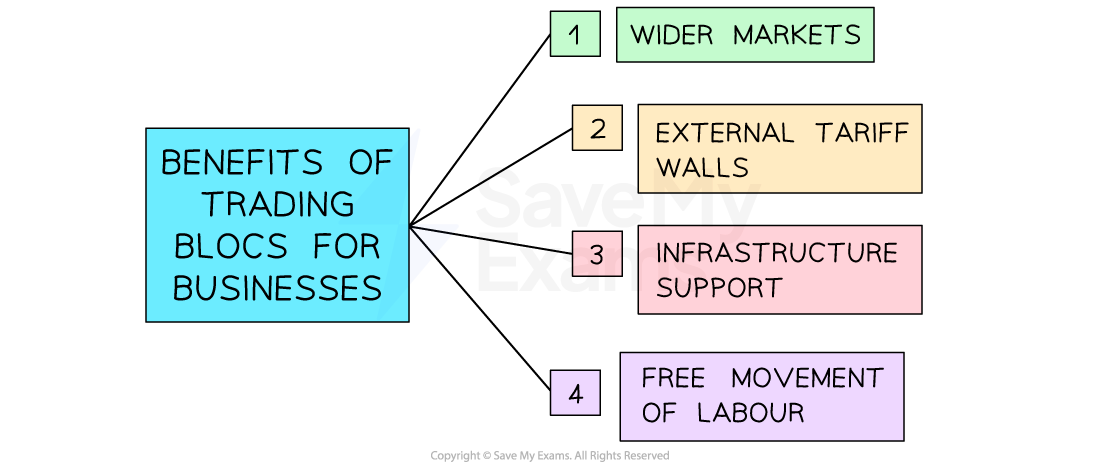
Access to more markets
Businesses are able to sell to more customers due to the free movement of goods
External tariff walls
An external tariff wall is a tax applied to imported goods by a group of countries that have formed a trade agreement
This protects businesses within the trading bloc from competition from businesses outside of the trading bloc
Infrastructure support
Businesses may gain additional support from the government to enable them to maintain their competitiveness against businesses in countries within the trading bloc
Free movement of labour
Trading blocs may also have free movement of labour, allowing businesses to source workers from a wider pool
A higher supply of labour may push wages lower, leading to reduced costs for businesses
E.g. citizens of EU countries have the right to work in any member state and to be treated equally as citizens of that state
Drawbacks for businesses inside a trading bloc
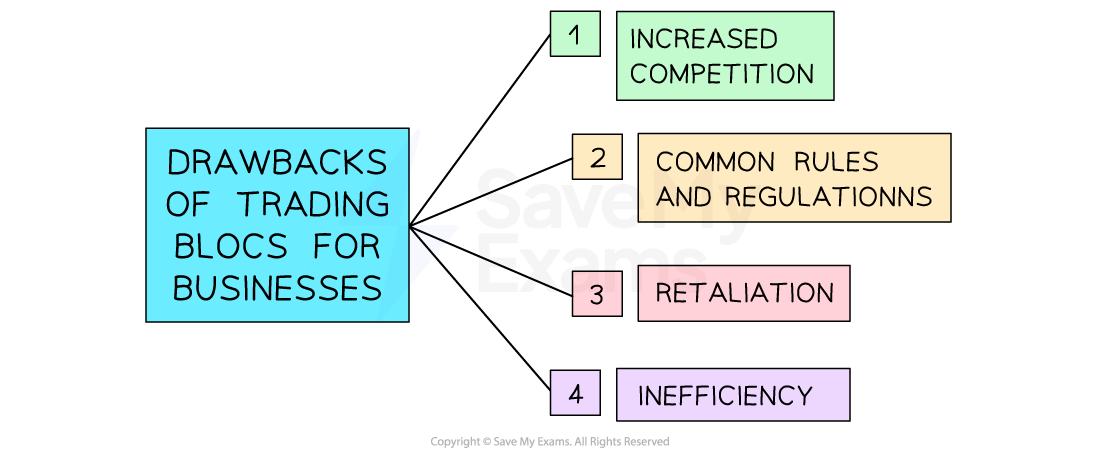
Increased competition
There is increased competition for businesses within the trade bloc, which may be more of an issue for small businesses, as they have fewer resources available with which to compete
Businesses with monopoly power can increase their monopoly by eliminating competitors in other countries within the bloc
E.g. the UK supermarket industry faced increased competition from the German supermarkets Aldi and Lidl when the UK was part of the EU
Common rules and regulations
In order to operate as one market, new rules and regulations may be put in place that all businesses must adhere to
E.g. the EU working time directive states that employees can only work a maximum of 48 hours per week
Retaliation
External tariffs set against countries outside of the trading bloc may lead to retaliation from these countries
Inefficiency
Although there is increased competition between countries within the bloc, there is less competition from businesses in countries outside of the bloc
This may reduce the incentive of businesses to be more efficient
Trading blocs also lead to trade diversion, which means trade is taken away from efficient producers that operate outside of the trade bloc and replaced by trade within the bloc
Examiner Tips and Tricks
Don't assume every business inside a trading bloc automatically benefits - small businesses often struggle most with the increased competition a bloc brings, while larger firms with monopoly power may actually consolidate their position. Always weigh the specific size and market position of the business in the case study

Unlock more, it's free!
Join the 100,000+ Students that ❤️ Save My Exams
the (exam) results speak for themselves:

Was this revision note helpful?
Build on this topic