Assessing a Country as a Production Location (Edexcel A Level Business): Revision Note
Exam code: 9BS0

Factors to consider before setting up production locations in other countries
Businesses may choose to set up production facilities in other countries
Production includes both manufacturing and any services associated with the business, such as call centres
This is a different process from choosing a country as a potential market for customers
Assessing production locations abroad
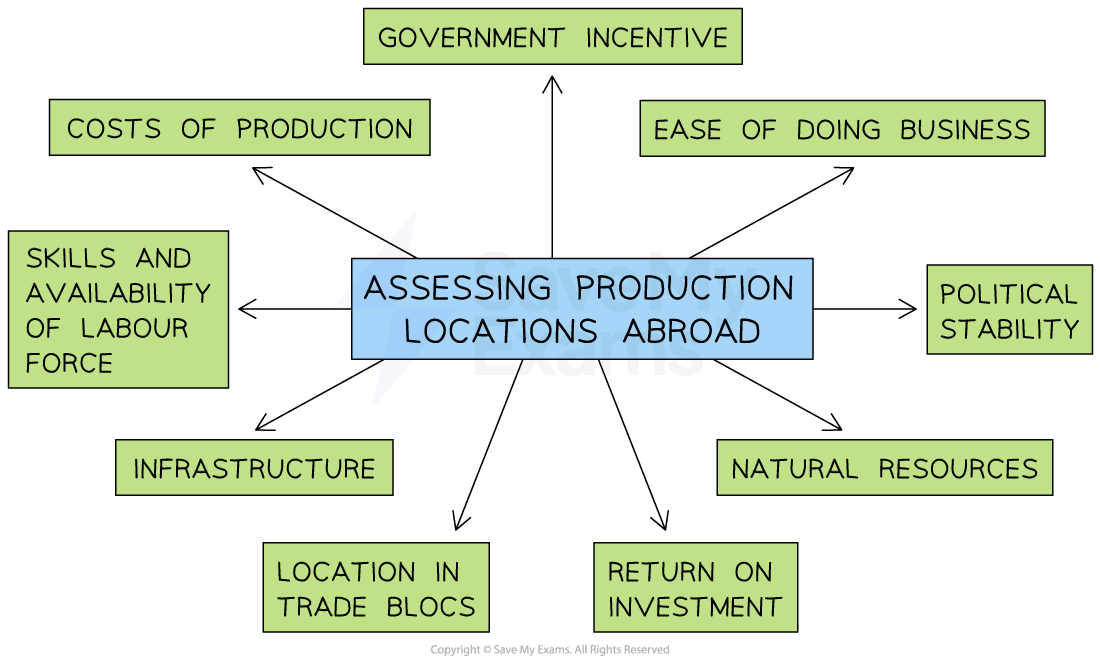
Costs of production
Businesses want to keep costs of production low, as doing so can help them increase their profit margin or allow them to sell at a lower price to gain a competitive advantage
Costs of production vary between countries due to differences in wage levels, the cost of land and premises, energy prices, and business taxation
E.g. many clothing manufacturers locate production in countries such as Bangladesh and Vietnam, where wage levels are significantly lower than in the UK, allowing goods to be produced more cheaply
Skills and availability of the labour force
The quality of the workforce is important, as this will directly impact the quality of the goods and services produced in an economy
Businesses will need to consider factors such as literacy rates and whether the workforce has the right skills needed for the business
Businesses may choose to locate production in a market where the labour costs are lower
Infrastructure
Infrastructure, such as roads, ports and electricity supply, affects the production process
Poor infrastructure can lead to delays in receiving raw materials or distributing finished goods, increasing costs and reducing a business's ability to meet demand on time
Strong infrastructure allows materials and products to move quickly and reliably, helping to reduce transportation costs
A business locating a factory in a country with poor rail and road links may face regular supply chain disruption
Strong port and logistics infrastructure allows raw materials to arrive on time and finished goods to be exported efficiently
Location in a trading bloc
A business located in a market in a trade bloc will be able to access many advantages, such as reduced protectionist measures
E.g. Japanese companies Nissan and Toyota invested in manufacturing facilities in the UK (prior to Brexit) to gain access to the EU market
Return on investment
Assessing the return on investment in different markets will reduce the risk of the initial investment not being paid for
Investment appraisal techniques (payback method, average rate of return and discounted cash flow) can be used to estimate a business's potential return on investment
Natural resources
It is often important that a business has easy access to raw materials, as this can help to reduce transportation costs and reduce any potential delays to the production process
Political stability
Businesses may be at risk of not gaining a return on their investment in a country with political instability
A country with political instability will be subject to corruption, a lack of law enforcement and higher levels of crime
There are more likely to be disruptions to production
An economy with a stable economy and government is seen as a less risky investment for a business
Ease of doing business
A business will want to be located in an area where there is limited bureaucracy so the process of establishing production facilities is not delayed or does not incur high costs
Government incentives
Businesses may be offered incentives, such as grants, business loans and tax breaks) by the government
Governments offer these incentives because the investment can create jobs, boost tax revenue and improve the country's reputation as a place to do business
These incentives lower the cost of setting up, making the country more attractive compared with alternative locations
E.g. many countries offer reduced corporation tax rates or grants specifically to attract manufacturing or technology investment, competing with neighbouring countries for the same investment
Case Study
Corriemuir Cycles

Corriemuir Cycles is a Scottish manufacturer of electric bicycle motors, currently produced entirely at its factory near Glasgow. Facing rising costs and growing European demand, the directors are considering opening a second factory abroad.
Vietnam offers significantly lower labour costs and a young, increasingly skilled workforce, but Corriemuir's engineers are concerned about the country's less developed transport infrastructure, which could delay the delivery of components and finished motors to customers.
Poland, by contrast, has higher labour costs than Vietnam but offers modern road and rail links, political stability, and membership of the EU single market, meaning finished motors could reach European customers without tariffs. The Polish government has also offered Corriemuir a package of grants and reduced business rates to encourage the investment.
After calculating the expected return on investment for both options, Corriemuir's finance director recommends Poland, arguing that EU market access and lower long-term risk outweigh Vietnam's cheaper labour, particularly given how reliant the business already is on European sales
Examiner Tips and Tricks
In Paper 3, you may have a question with different location options. You will need to evaluate the financial and nonfinancial factors to determine which location would be the best option for a particular business. This may also involve performing calculations for an investment appraisal or quantitative sales forecasting (Theme 3).
Remember, there is a difference between whether a business is choosing a location as a potential market or for production facilities.

Unlock more, it's free!
Join the 100,000+ Students that ❤️ Save My Exams
the (exam) results speak for themselves:

Was this revision note helpful?
Build on this topic