Organic Growth (Edexcel A Level Business): Revision Note
Exam code: 9BS0

Organic business growth
Organic growth is growth that is driven by internal expansion using reinvested profits or loans
This is different from inorganic growth, which occurs through mergers, takeovers or joint ventures with other businesses
Unlike inorganic growth, organic growth does not involve combining with another business, so it tends to be slower but lower risk, and allows the original owners to retain full control
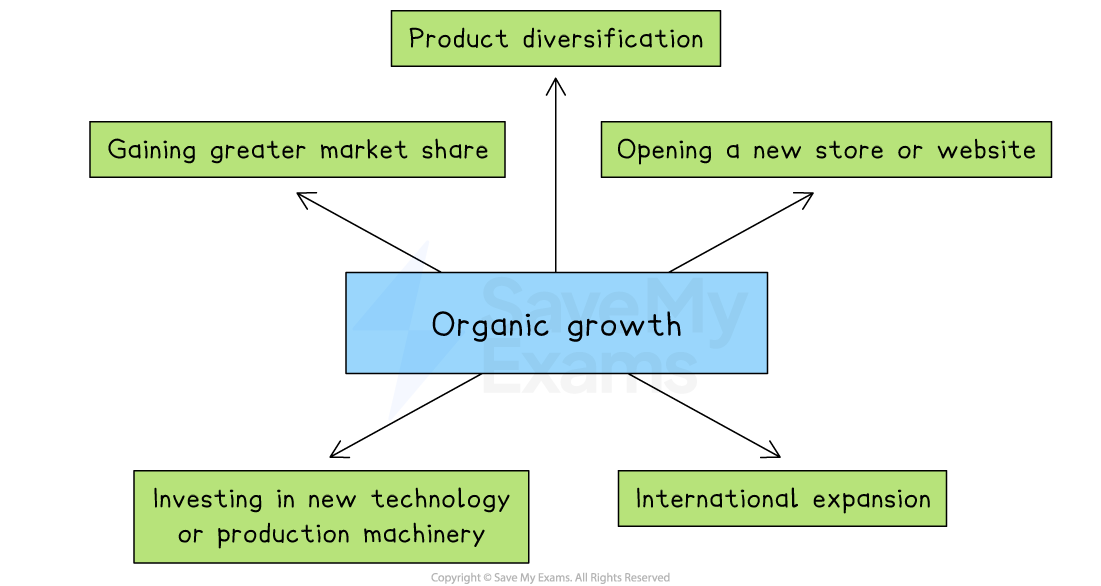
Types of organic growth
Gaining greater market share
By attracting more customers from competitors or increasing sales to existing customers, a business can grow its revenue without merging or acquiring another firm
E.g. Aldi has gained UK market share by offering low prices and expanding its product range
Product diversification
Launching new products allows a business to target new customer needs, increase sales and reduce reliance on just one product
E.g. Innocent has moved from smoothies into fruit juices and snacks
Opening a new physical or online store
Expanding the number of physical locations helps a business reach more customers and grow sales in new areas
E.g. Greggs has opened new outlets across the UK high street and within travel hubs such as railway stations
Launching an online store helps a business reach more customers and grow sales in new areas or through new channels
E.g. Primark launched its online click-and-collect service to reach more customers while keeping its focus on physical stores
International expansion
Selling products in other countries allows a business to access larger markets and benefit from new customer bases
E.g. WH Smith has expanded internationally into airport and travel locations, having sold its entire UK high street business in 2025 to focus solely on travel retail
Investing in new technology or production machinery
Improving production efficiency can increase output and reduce costs, allowing a business to meet rising demand and grow
E.g. Jaguar Land Rover invested in robotics and automation at its Solihull factory to boost production of electric and hybrid vehicles, helping it grow in the fast-changing automotive market
Evaluating organic growth
Advantages |
|
|---|---|
Disadvantages |
|
Case Study
Thistle Aromas
Thistle Aromas is a candle and home fragrance business founded eight years ago in Edinburgh by two friends selling candles at local markets. Rather than seeking outside investment, the founders chose to reinvest their profits into growing the business step by step.
They first expanded their product range beyond candles into reed diffusers and soaps, then used retained profits to open a second shop in Glasgow once the original store was consistently profitable. A modest loan later funded new equipment, allowing them to pour candles faster and meet growing demand without lowering quality.
Thistle also launched an online store, gradually building a loyal customer base across the UK without ever taking on external shareholders or merging with another company. The founders have kept full control of decisions and preserved the relaxed, creative culture that first attracted their staff.
However, growth has been slower than a newer rival that took private equity funding and opened twenty stores in two years. Thistle's founders now face a difficult decision: keep growing steadily, or risk losing further market share to faster-moving competitors
Examiner Tips and Tricks
When a case study describes a business growing steadily using its own profits, resist the urge to jump straight to "this is safe" - a top-mark answer also considers whether organic growth is fast enough for that business's specific market conditions, since slow growth can itself be a competitive risk

Unlock more, it's free!
Join the 100,000+ Students that ❤️ Save My Exams
the (exam) results speak for themselves:

Was this revision note helpful?
Build on this topic