Mergers & Takeovers (Edexcel A Level Business): Revision Note
Exam code: 9BS0

Reasons for mergers and takeovers
Firms often grow organically (opens in a new tab) to the point where they are in a financial position to integrate with others
Merging with or taking over other businesses results in rapid business growth and is referred to as inorganic growth
A merger occurs when two or more companies combine to form a new company
The original companies cease to exist, and their assets and liabilities are transferred to the newly created entity
A takeover occurs when one company purchases another company, often against its will
The acquiring company buys a controlling stake in the target firm's shares (more than 50%) and gains control of its operations
Why firms integrate with others
Strategic fit
A company may acquire another company to expand into new markets, diversify its product offerings or gain access to new technology
E.g. in 2010, Kraft Foods purchased Cadbury's to increase its product offering and expand business sales in the UK
Economies of scale
Growth creates economies of scale
Consolidation of two or more businesses typically reduces costs and increases efficiency
Synergies
Synergies are the benefits that result from the combination of two or more companies, such as increased revenue, cost savings or improved product range
Elimination of competition
Takeovers are often used to eliminate competition, and the acquiring company increases its market share
E.g. Meta, the parent company of Facebook, purchased WhatsApp in 2014, as it was a major competitor of its own Facebook Messenger
Shareholder value
Mergers and takeovers can also be used to create value for shareholders
By combining companies, shareholders can benefit from increased profits, dividends and share prices
Types of integration
Horizontal integration
A merger or takeover of a firm at the same stage of the production process
E.g. an ice cream manufacturer takes over another ice cream manufacturer
Evaluating horizontal integration
Advantages |
|
|---|---|
Disadvantages |
|
Vertical integration
A merger or takeover of another firm in the supply chain or different stage of the production process
E.g. an ice cream manufacturer merges with a dairy farm
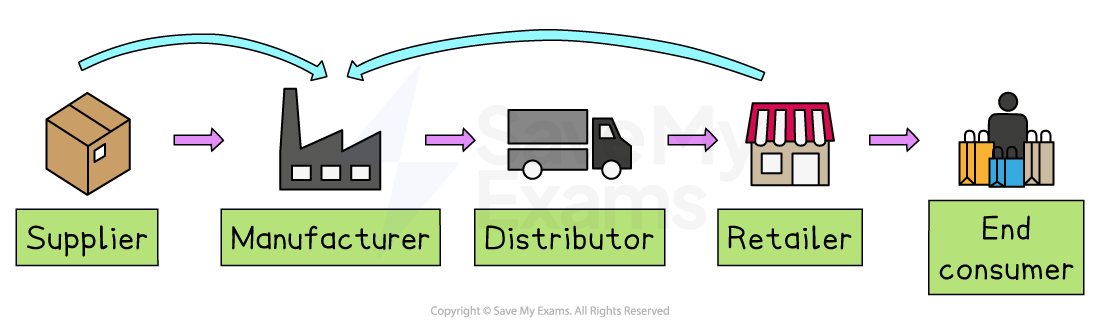
Forward vertical integration involves a merger or takeover with a firm further forward in the supply chain
E.g. a dairy farmer merges with an ice cream manufacturer
Backwards vertical integration involves a merger or takeover with a firm further backwards in the supply chain
E.g. an ice cream retailer takes over an ice cream manufacturer
Evaluating vertical integration
Advantages |
|
|---|---|
Disadvantages |
|
Examiner Tips and Tricks
Don't just label integration as "horizontal" or "vertical" - explain why that specific type suits the business in the case study, and be ready to weigh the stated advantages against realistic risks like culture clash or overpayment, rather than listing benefits in isolation
The financial risks and rewards of mergers and takeovers
Inorganic growth carries both risks and rewards for a business
Risks
Overpayment
If the acquiring company pays too much for the target company, it may not be able to recoup the investment through increased revenue or cost savings
Integration challenges
Integrating two companies can be complex and costly
There are likely to be disruptions to operations and a loss of key staff
Cultural differences
Mergers and takeovers can result in clashes of company cultures, impacting productivity
Opposition
Mergers and takeovers may face opposition from regulators or other stakeholders, such as shareholders
Debt
Acquiring companies may take on debt to finance the integration, which can increase financial risk and reduce flexibility
Rewards
Increased market share
By acquiring another company, an increase in market share may lead to increased sales revenue and profitability
Synergy
Mergers may result in cost savings through the elimination of duplicate functions and increased efficiency
Diversification
Selling a wider variety of goods and services reduces the risks associated with selling a single product
Access to new markets
Acquiring a company with a strong presence in a new market increases the customer base and sales revenue
Increased value
Mergers may increase the overall value of the combined company, benefitting shareholders
Problems of rapid growth
Inorganic growth often increases the size of the business significantly in a very short period of time
This rapid growth can bring success, but if not managed well, it can lead to financial pressure, lower quality, unhappy customers and internal conflict
Businesses must plan growth carefully to avoid these issues
Problems caused by rapid growth
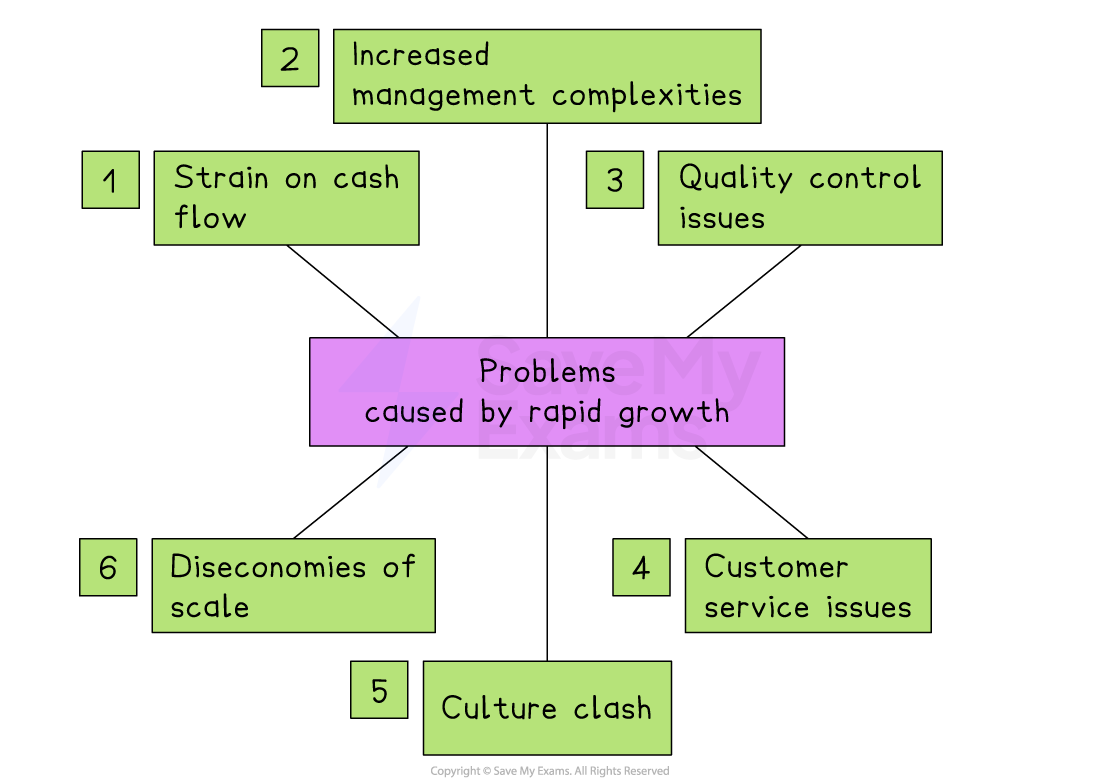
Strain on cash flow
Rapid growth often means higher spending before extra revenue comes in
A business may need to:
Hire more staff
Invest in stock and equipment
Open new locations
This puts pressure on cash flow
If the business doesn’t have enough working capital, it may struggle to pay suppliers or wages on time
Increased management complexities
As a business grows, operations become harder to control
Managers might:
Be given too many tasks
Lose track of team performance
Struggle to make decisions quickly
This can lower productivity and delay key actions
E.g. a technology company that suddenly triples in size may find that decision-making slows down and projects are delayed
Quality control issues
When a business expands quickly, its existing systems may not be able to cope
This can lead to:
Mistakes in production
Poor-quality products
Inconsistent service
E.g. a bakery that rushes to open new branches may find its cakes vary in quality between stores
Customer service issues
With more customers and not enough trained staff, service levels can fall
Problems might include:
Longer waiting times
Missed orders
Poor communication
E.g. an online retailer experiencing a sudden surge in orders may send out the wrong products or delay responses to customer complaints
Culture clash
If growth happens through mergers or takeovers, employees from different businesses may have different ways of working
This can cause:
Disagreements
Lower morale
Poor teamwork
E.g. if a relaxed, creative business merges with a more hierarchical, corporate one, staff may feel uncomfortable or confused about expectations
Diseconomies of scale
When a business becomes too large, average costs can rise
This is often due to:
Poor communication
Slow decision-making
Loss of motivation
See the detailed revision notes on diseconomies of scale

Unlock more, it's free!
Join the 100,000+ Students that ❤️ Save My Exams
the (exam) results speak for themselves:

Was this revision note helpful?
Build on this topic