Marketing (Edexcel A Level Business): Revision Note
Exam code: 9BS0

Glocalisation
Global marketing strategy is the process of planning, producing, placing and promoting a business’s product or service in the global market
Glocalisation is a strategy where businesses aim to reach customers globally and also take into consideration the needs of the local market
The saying "think global, act local" is used to describe the strategy of glocalisation
Example
Domino's Pizza uses a consistent global brand, restaurant format and ordering system worldwide but adapts its menu significantly to local tastes.
In India, it offers India-exclusive pizzas such as Tandoori Paneer and Paneer Makhani, with a menu that leans far more vegetarian and spicier than in Western markets
Advantages and disadvantages of glocalisation
Advantages |
|
|---|---|
Disadvantages |
|
Different marketing approaches
There are several marketing approaches that a business can take when it comes to expanding its operations to other countries or regions
Domestic/ethnocentric approach
Businesses see the domestic market and foreign markets as very similar
This approach is based on the belief that the company's home country culture and marketing practices are superior to those of other countries
There will be no changes to the products for overseas customers, and marketing of the product will be the same
Example
Apple sells standardised products across global markets, e.g. iPhones and iPads, which helps the company reduce costs, as it can benefit from economies of scale
Advantages and disadvantages of the ethnocentric approach
Advantages |
|
|---|---|
Disadvantages |
|
Polycentric/international approach
Businesses adapt their marketing strategy by tailoring their products to the local market
A business treats each country as a unique market and develops a customised marketing mix for each market
Example
Nestle has developed different adaptations of KitKat to reach different consumers in the international market
Packaging of KitKats in Japan includes cherry blossoms, a symbol of good luck
Additional flavours, such as purple sweet potato and matcha powder, were included to appeal to the tastes of the local market
Advantages and disadvantages of the polycentric approach
Advantages |
|
|---|---|
Disadvantages |
|
The geocentric/mixed approach
This strategy is a mix of the polycentric and ethnocentric approaches
This approach utilises the benefits of standardised products but also tailors products to meet the needs of local markets overseas while maintaining a consistent brand image across markets
Example
McDonald's does not offer beef or pork in India due to religious reasons. However, in the majority of Western countries, McDonald's has standardised products such as the Big Mac
Advantages and disadvantages of the geocentric approach
Advantages |
|
|---|---|
Disadvantages |
|
Examiner Tips and Tricks
The question can ask you to recommend which type of approach a business should take when expanding abroad. You should take into account the best approach for the type of business that is being considered in the extracts.
Adapting and applying the marketing mix to global markets
The marketing mix is the set of controllable marketing tools that a company uses to promote its brand or product in a market
Businesses adapt their marketing mix to overseas markets to ensure the success of their product/service
By adapting the marketing mix to meet local needs, companies can effectively penetrate global markets and build a strong global brand
Adapting the marketing mix to global markets
Element | Adaptations |
|---|---|
Place |
|
Product |
|
Price |
|
Promotion |
|
Adapting and applying Ansoff's matrix to global markets
Ansoff's matrix is a strategic planning tool that helps businesses identify potential growth opportunities by analysing their product and market strategies
The matrix consists of four growth strategies - market penetration, market development, product development and diversification
Expanding outside domestic markets generates risks for a business, so it needs to ensure that it adopts the right strategy
By doing so, businesses can effectively penetrate global markets and achieve long-term success
Ansoff’s matrix
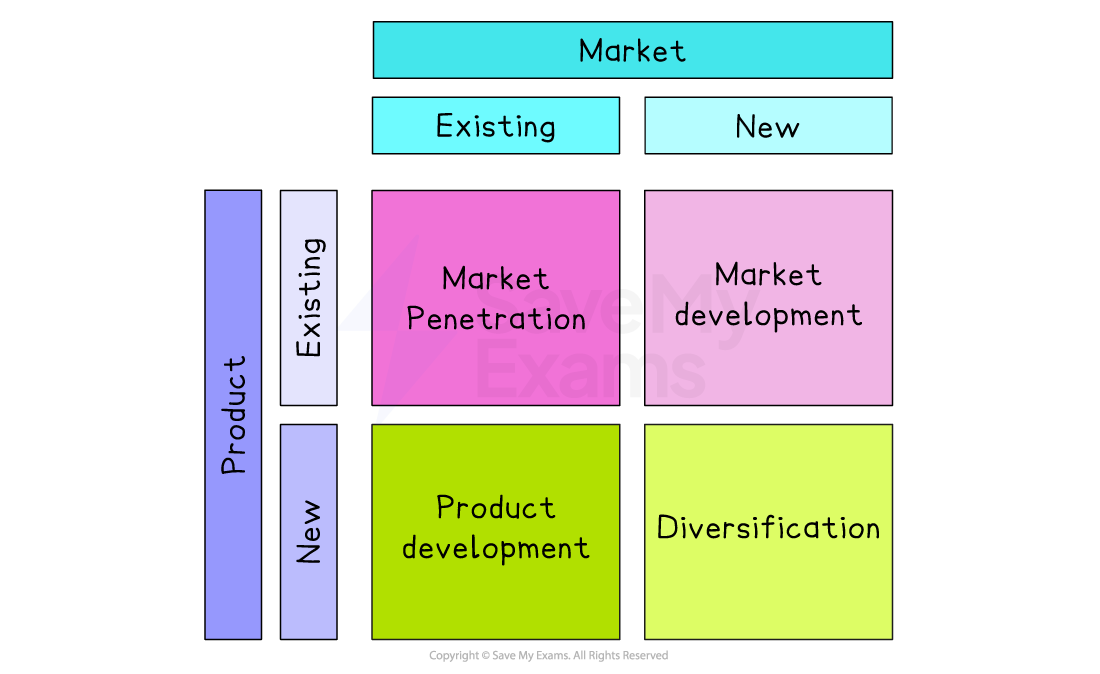
Market penetration
In a global context, this means increasing sales of existing products within a market the business already operates in abroad, rather than entering for the first time
This might involve increased localised marketing spend, loyalty schemes tailored to that country's culture, or strengthening relationships with existing local distributors
Because the business is not entering unfamiliar territory, this remains the lowest-risk global growth strategy
Product development
Globally, this usually means adapting or creating new product variations specifically for an existing overseas market, rather than developing entirely new product lines
This links closely to glocalisation, as businesses use local market research to identify what changes will make a product more appealing in that country
Example
KFC's menu in China includes congee (rice porridge), soy milk and youtiao, developed specifically to suit local breakfast preferences rather than offering its standard Western menu
Market development
This strategy involves entering entirely new countries with a business's existing products
Success depends on understanding local consumer habits, culture and regulations before entry
A lack of local market knowledge is a common reason global expansion fails
Example
Tesco opened stores in China but later withdrew from the market, as the company lacked understanding of Chinese consumer habits
Diversification
Global diversification is the highest-risk strategy, as a business enters an unfamiliar country and launches an unfamiliar product at the same time
Businesses attempting this need a very deep understanding of local market conditions, since they can't rely on existing knowledge of either the product or the market to reduce risk
Many businesses use a joint venture or partnership with a local company to reduce this risk, gaining local market knowledge they would otherwise lack
Examiner Tips and Tricks
In Paper 1, you are often required to make links between Theme 1 and Theme 4. When you have questions on marketing, refer to the marketing strategies and concepts from other sections of the course to explain the different approaches a business may undertake when expanding into an international market.

Unlock more, it's free!
Join the 100,000+ Students that ❤️ Save My Exams
the (exam) results speak for themselves:

Was this revision note helpful?
Build on this topic