14 marks
Explain how one of Ansoff's generic strategies might be applied to Taco Bell's decision to enter the Brazilian market
Was this exam question helpful?
Exam code: 9BS0
Explain how one of Ansoff's generic strategies might be applied to Taco Bell's decision to enter the Brazilian market
Was this exam question helpful?
Explain one benefit to Uber of adopting a glocalisation marketing strategy for its ridesharing services in India
Was this exam question helpful?
Using the information in Extract D, explain one cultural difficulty Live the Adventure may face when setting up its new centre for winter activity holidays in Europe
Was this exam question helpful?
Explain one implication for Taco Bell of adapting the product element of its marketing mix to target customers in Brazil
Was this exam question helpful?
Explain why Spotify may consider the Asian market for music streaming to be a 'problem child'.
Was this exam question helpful?
Explain one reason why global niche markets may be important to a games developer, such as Sukeban Games.
Was this exam question helpful?
Extract C
Elvaston Skincare Ltd
Elvaston Skincare Ltd makes natural skincare products and sells them through UK pharmacies and its own website. It holds 4% of the UK natural skincare market, which is growing slowly.
In 2026 it began selling its existing range, unchanged, through pharmacies in Germany and the Netherlands. It spent £310,000 on translation, regulatory approval and a launch campaign, but did not reformulate a single product.
The board rejected an alternative plan to develop a new range of men's grooming products for the UK, judging it too risky.
Marketing Director Aisha Rahman said: "Same products, new customers. We already know the products work."
Using Extract C, explain one benefit to Elvaston Skincare Ltd of choosing market development rather than product development
Was this exam question helpful?
Extract A
Whitmoor Greetings Ltd
Whitmoor Greetings Ltd designs and prints greetings cards at a site in Shropshire. In 2026 it began exporting to the United Arab Emirates, Japan and Mexico.
Its UK bestsellers did not transfer. In Japan, retailers refused its multipacks because Whitmoor sold cards in packs of four, a number widely avoided there because the word for "four" sounds like the word for "death".
In the UAE, around 40% of Whitmoor's range was Christmas cards, for which there was limited demand, while Eid - the largest card-buying occasion of the year - was not covered at all.
Whitmoor now designs 60% of its overseas range locally, using designers based in each market.
Head of Design Cerys Lloyd said: "We thought we were selling paper. We were selling meaning."
Using Extract A, explain one way in which cultural diversity has affected Whitmoor Greetings Ltd's marketing
Was this exam question helpful?
Extract E
Stanedge Optics Ltd
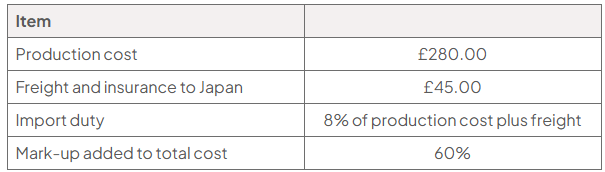
Stanedge Optics Ltd hand-builds high-specification birdwatching binoculars in Cumbria. It sells to a small, knowledgeable global niche and competes on optical quality rather than price.
It is setting the price for its new model in Japan. Costs and pricing policy per pair:
Using the data in Extract E, calculate the price per pair that Stanedge Optics Ltd will charge its Japanese distributor. You are advised to show your working
Was this exam question helpful?
Extract A
Ravenhead Kitchens Ltd
Ravenhead Kitchens Ltd sells flat-pack kitchens in 14 countries. Every kitchen uses the same cabinet frame, hinges and assembly system, made in a single factory in Portugal.
Beyond that, the product changes. In Japan, Ravenhead sells cabinets 60mm shallower to fit smaller apartments. In India, it offers a separate ventilated unit for storing dry spices. In Sweden its bestselling worktop is pale birch; in Spain it is dark stone.
Its advertising slogan is translated but never rewritten, and the logo is identical everywhere.
Chief Executive Tomas Ek said: "One chassis, fourteen kitchens."
Using Extract A, explain one benefit to Ravenhead Kitchens Ltd of a glocalisation strategy
Was this exam question helpful?
Extract A
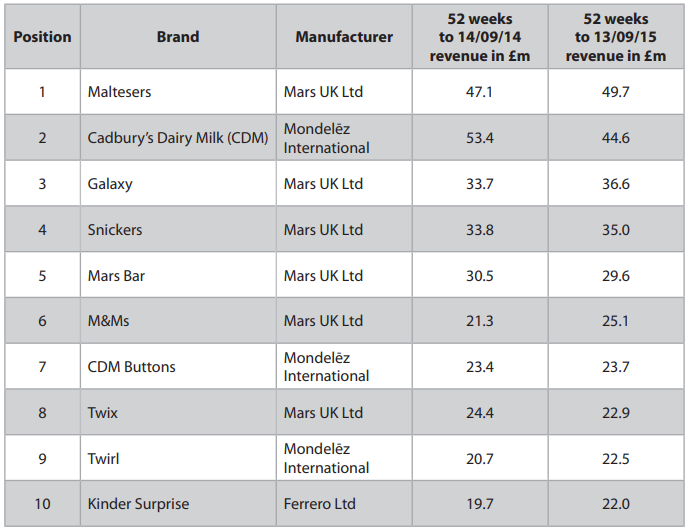
Maltesers take top spot in UK chocolate market in 2015
(Source: © Carnyx Group Ltd 2017)
Extract B
Flexible working at Nestlé UK
Nestlé is a truly multicultural company operating in 197 countries. It has 339 000 employees worldwide. Job roles range from engineering, production and technical, to research and development, finance, marketing and purchasing, with some employees working across different departments.
Nestlé has introduced a number of measures to help staff achieve the right work-life balance. These measures include allowing people to work flexible hours as opposed to common start and finish times, working from home and creating a dog friendly office at Gatwick HQ.
(Source: adapted from © Société des Produits Nestlé S.A. 2004)
Extract C
Global dark chocolate market 2015–2019
Global dark chocolate sales are expected to rise from 34.25bn US dollars to 51.7bn US dollars by 2019, an average 9% each year up to 2019, according to market research company, Technavio.
'A growing awareness of the health benefits of dark chocolate (improved blood flow, enhanced cognition and better metabolism) is likely to lead to a considerable rise in consumer demand in the next five years,' states Technavio's report.
'There is also a growing demand for dark chocolate in developing countries, driven by a rise in incomes and changes in eating habits with growing urbanisation.'
India is the fastest growing chocolate market in the world, partly driven by rising demand for dark chocolate, such as a dark chocolate version of Nestlé's Kit Kat Senses.
Europe makes up 45% of the global dark chocolate market, followed by 32% in the Americas, 12% Asia-Pacific and 11% for the rest of the world.
(Source: adapted from © William Reed Business Media Ltd 2017)
Extract D
Thorntons sold
Thorntons has failed to revive its chocolate manufacturing business, despite opening more of its own stores and increasing sales through supermarkets.
Ferrero International, with global revenues worth over £8bn (2015), has purchased Thorntons for £112m to expand its operations in the UK, a market estimated to be worth £6bn in sales.
The takeover marks the loss of another British chocolate business to an overseas buyer. Cadbury and Green & Black's were sold to the US business Kraft Foods Inc (now Mondelēz International) in 2010, while Rowntree was sold to Nestlé in 1988.
In 2014, Ferrero International purchased the world's largest hazelnut processor, the Oltan Group for an undisclosed sum. Hazelnuts are one of Ferrero's key commodities, which it uses for its luxury Ferrero Rocher chocolates, Nutella and Kinder Bueno.
The Oltan Group, based in Trabzon, Turkey, was previously under family ownership. It has five production facilities exporting to the EU and global markets, with an annual turnover of £600m.
(Source: adapted from © Guardian News and Media Limited 2014 and © William Reed Business Media Ltd 2017)
Assess the cultural and social factors that may affect the sales of dark chocolate in emerging economies, such as India
Was this exam question helpful?
Extract D
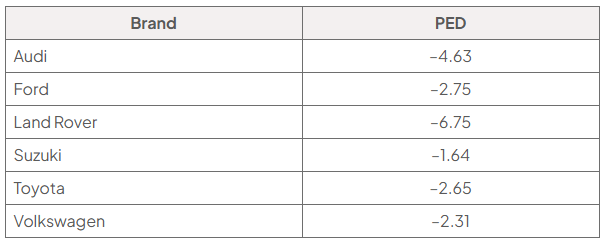
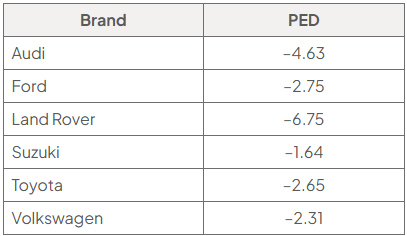
Estimates of price elasticity of demand (PED) of car brands
(Source: adapted from https://repository.library.northeastern.edu/ files/neu:349589/fulltext.pdf)
Extract E
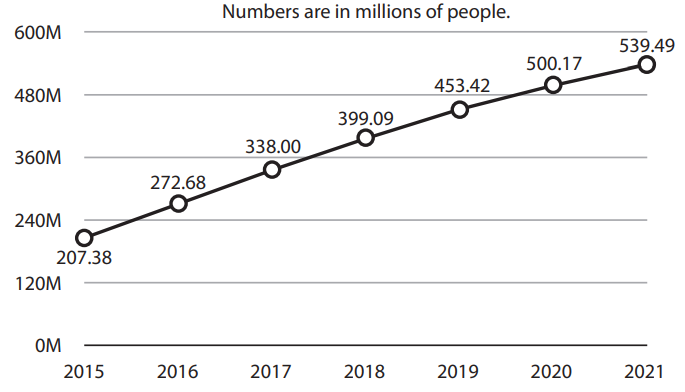
Current and projected number of ridesharing users, globally
Ridesharing is an arrangement in which a passenger travels in a private vehicle driven by its owner for a fee by a means of a website or app.
(Source: from https://www.statista.com/outlook/368/100/ (opens in a new tab) ride-hailing/worldwide#market-revenue)
Extract F
Ridesharing businesses in India
Ola is an Indian ridesharing business. Its main competitor is American-owned Uber. Ola's strength is local knowledge; it has always accepted cash payments, while it took Uber nearly two years to do the same. Ola's app also supports nine regional languages for drivers, which is important as only 10% of Indians speak English. Ola offers three different services: premium, low-cost and car-pooling. Ola's auto rickshaws, which have their own safety standards, are successful in smaller cities where distances are shorter.
After its exit from China, Uber said it would divert a 'significant portion' of its planned 1 billion US dollar marketing budget to India. This led to calls from Indian businesses for government laws to limit investment by non-Indian businesses into the market.
In one of Uber's other markets, the USA, a former Uber engineer alleged sexual harassment by her manager, and one of the founders of Uber was caught swearing at an Uber driver. Other questions about Uber's business practices have been raised: trade unions have requested drivers receive basic rights such as a living wage and unemployment insurance; Uber classifies its drivers as independent contractors and so they are not eligible for benefits such as overtime and health insurance.
Uber's pricing structure has also been criticised, after allegations it routinely overcharges customers. It was recently sued for not providing enough vehicles accessible to wheelchair users.
(Source: from https://qz.com/1200878/ (opens in a new tab) with-uber-in-crisis-ola-zooms-ahead-in-indias-taxi-wars/ and https://www.theverge.com/2017/6/30/15904510/uberopen-letter-board-ethical-recommendations)
Extract G
Ford and Mahindra joint venture
Mahindra, an Indian-based car manufacturer, and Ford have signed a deal to develop a new Sports Utility Vehicle (SUV) for the Indian market. These will have a Ford body and badge, but will be based on a car chassis (frame) that will be made by Mahindra.
The deal will see Mahindra and Ford cooperate with each other for a period of three years. While Ford may gain economies of scale and a lower cost structure from Mahindra's new car chassis, Mahindra will get access to Ford's engineering knowledge. Mahindra will also get support in global emerging markets, including Ford's manufacturing and car distribution network. The Managing Director of Mahindra Ltd said, "Both teams are working together and building on mutual strengths. We are excited about the synergies unveiled through this joint venture and the potential opportunities it will bring."
(Source: adapted from https://auto.ndtv.com/news/ford-and-mahindraconfirm-jointly-developed-suvs-electric-car-for-india-1827425)
Assess two cultural factors that may affect Uber's successful entry into the Indian ride sharing market.
Was this exam question helpful?
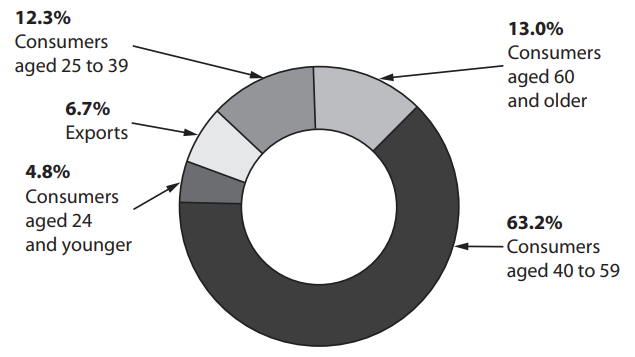
Extract D
The US coffee market 2016
(Source adapted from: Industry Insider Copyright © 2018)
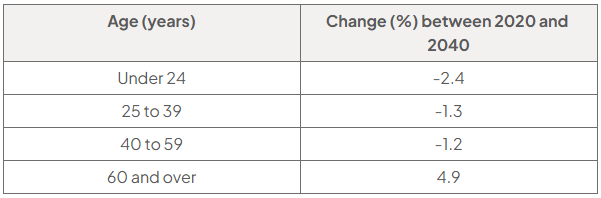
Extract E
Estimated change in USA population by age group
(Source adapted from: https://www.census.gov/)
Extract F
Canadian coffee roaster sold to Lavazza
For more than 120 years, Lavazza has been a major business in Europe's coffee market. It focuses on selling coffee through small specialised outlets. Lavazza has recently bought an 80% stake in Canada's Kicking Horse Coffee. Lavazza stated 'we are interested in NAFTA. Kicking Horse has a strong presence in the fast-growing organic and fairtrade segments of the Canadian coffee market. It fits well in Lavazza's brand portfolio'.
Under NAFTA, member states must treat each other's goods, services, and investors as they treat their own. Foreign investors can purchase any company incorporated in Canada, knowing they have secure access to markets in the USA and Mexico.
(Source based on: ©2018 CBC/Radio-Canada)
Extract G
Staffing approaches at Starbucks
North Star is a Starbucks initiative created to focus its North American employees on what makes a good Starbucks' customer experience.
Some employees are unhappy about how North Star has affected them. Their concerns include: workers struggling with high workloads; less support and reduced management; understaffing because organisational structures in stores and regions have been made flatter. One employee said: "They cut our labour in half last year, and often there'd only be one coffee server on at a time. Staff are simply treated as a cost".
Kris Engskov, new Head of US Retail, said: "Staff are our biggest asset; how we staff our stores is the most important thing we do. Our managers have great autonomy".
In the USA, Starbucks' baristas are paid 9.50 US dollars an hour on average, compared to McDonald's employees who are paid 8.49 US dollars an hour. Other Starbucks staff benefits include university tuition assistance, flexible working hours and Starbucks shares at a discounted price.
(Source adapted from: © 2018 Insider Inc)
Assess the likely importance to a business, such as Lavazza, of adapting its marketing mix to global markets
Was this exam question helpful?
Extract D
Nimbus Sports Equipment plc
Nimbus Sports Equipment plc is a UK-based manufacturer of specialist running shoes. The business designs and produces performance footwear for endurance runners and sells its products in the UK and a range of international markets. Nimbus positions itself as a premium, performance-focused brand, competing on quality, innovation and technical design rather than low prices.
Nimbus currently sells the same core running shoe design in all markets but adapts colours and sizing to reflect local preferences. Senior managers are considering whether to move towards a more standardised global product strategy in order to reduce production and design costs.
However, there are concerns that a fully standardised product may fail to meet local customer preferences in some international markets. Nimbus's managers must decide whether the potential cost savings from standardisation outweigh the risk of reduced customer satisfaction.
Extract E
Selling Nimbus products online
Nimbus sells its products through specialist sports retailers and via its own online sales platform. Online sales have grown rapidly in recent years, particularly in international markets where Nimbus does not have a strong retail presence.
The business believes that its online platform allows it to reach niche groups of endurance runners worldwide. However, selling footwear online can increase delivery and returns costs, particularly when customers order multiple sizes.
Extract F
Global competition in the running footwear market
The global market for running footwear is highly competitive. Large multinational brands compete aggressively on innovation, marketing and sponsorship of elite athletes. Consumers are often willing to switch brands if performance, comfort or value for money improves.
Nimbus's senior managers believe that long-term success in global markets will depend on balancing cost efficiency with the ability to meet the needs of different customer groups.
Assess the benefits to Nimbus Sports Equipment plc of adapting its products for different international markets.
Was this exam question helpful?
Extract D
Nimbus Sports Equipment plc
Nimbus Sports Equipment plc is a UK-based manufacturer of specialist running shoes. The business designs and produces performance footwear for endurance runners and sells its products in the UK and a range of international markets. Nimbus positions itself as a premium, performance-focused brand, competing on quality, innovation and technical design rather than low prices.
Nimbus currently sells the same core running shoe design in all markets but adapts colours and sizing to reflect local preferences. Senior managers are considering whether to move towards a more standardised global product strategy in order to reduce production and design costs.
However, there are concerns that a fully standardised product may fail to meet local customer preferences in some international markets. Nimbus's managers must decide whether the potential cost savings from standardisation outweigh the risk of reduced customer satisfaction.
Extract E
Selling Nimbus products online
Nimbus sells its products through specialist sports retailers and via its own online sales platform. Online sales have grown rapidly in recent years, particularly in international markets where Nimbus does not have a strong retail presence.
The business believes that its online platform allows it to reach niche groups of endurance runners worldwide. However, selling footwear online can increase delivery and returns costs, particularly when customers order multiple sizes.
Extract F
Global competition in the running footwear market
The global market for running footwear is highly competitive. Large multinational brands compete aggressively on innovation, marketing and sponsorship of elite athletes. Consumers are often willing to switch brands if performance, comfort or value for money improves.
Nimbus's senior managers believe that long-term success in global markets will depend on balancing cost efficiency with the ability to meet the needs of different customer groups.
Assess the likely importance of online sales platforms to the global expansion of Nimbus Sports Equipment plc.
Was this exam question helpful?
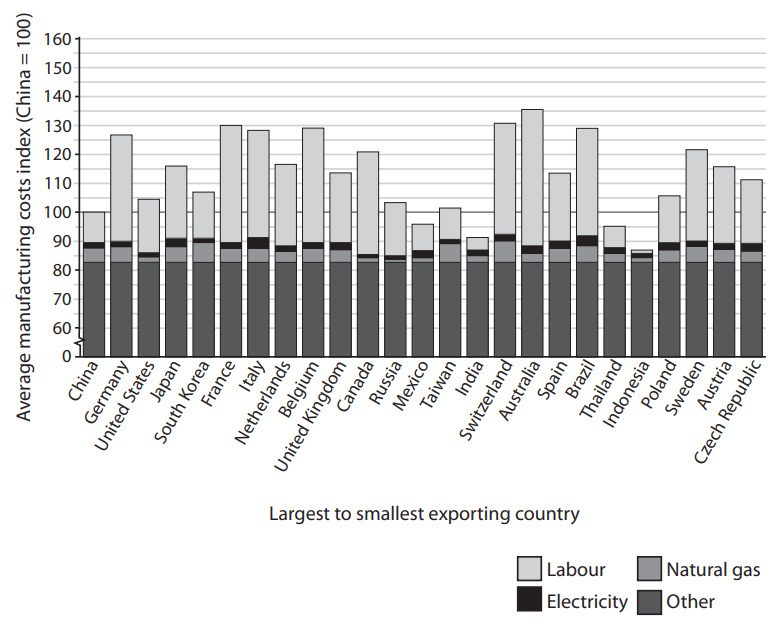
Extract E
Comparison of the average manufacturing costs in 2014 (China = 100)
(Source: adapted from © 2017 The Boston Consulting Group)
Extract F
Ebac Ltd
Ebac Ltd is Europe's leading manufacturer of bottled water coolers and domestic dehumidifiers. It is a privately owned, family-run, company. Ebac Ltd has been the market leader in Western Europe for water coolers since the mid-1990s. For the past 30 years Ebac Ltd has continued to expand its UK operations.
Ebac Ltd employs over 200 people in the North East of the UK, where labour costs are below the UK average. Ebac Ltd retains a strong export focus with 70% of its turnover coming from sales to Continental Europe. In late 2015 Ebac Ltd began a £7m expansion project that would make it the only UK-based maker of washing machines, filling a gap left behind when Indesit moved production of Hotpoint machines to Italy. Ebac Ltd's washing machines will be sold in the UK only.
Ebac Ltd develops innovative quality products to meet customer needs. Its employees help make this happen.
The Ebac Ltd Foundation was set up in 2012. Its principles include the commitment that all profits are invested back into the company to generate growth and more jobs, and into the community to sponsor training, education and sport.
(Source: adapted from © Ebac.com)
Extract G
The Haier road to growth
The Tianzun is an air conditioner with a wind tunnel that draws air through it. Haier's rapid introduction of this product is typical of the China-based company's track record since the late 1990s. Since 2011, it has held the largest worldwide market share in white goods*.
Unlike Western consumers, many Chinese people hand-washed their underclothes every day at home. They found it more hygienic and socially discreet to wash underclothes separately from other clothes and not use public washing machines. In response, Haier launched a small, low-energy washing machine that could easily fit into a small, crowded urban apartment.
In 1997, recognising the needs of college students in dormitory rooms, Haier launched mini-refrigerators in the United States; it followed with wine refrigerators in 2004. Meanwhile, in Pakistan, Haier sold extra-large washing machines designed for heavy robes.
Haier is a company worth 38 billion US dollars with upmarket brands in China. Haier is growing in the mass markets of the United States, Europe and Japan, which are dominated by multinationals such as Bosch and Whirlpool.
*'White goods' refers to household appliances such as washing machines, tumble driers, fridge-freezers etc.
(Source: adapted from © 2017 PwC. All rights reserved
Haier is aiming to continue its global expansion in the white goods market. It could do this by focusing on either global niche markets or global mass markets for white goods
Evaluate these two options and recommend which approach is most suitable for Haier
Was this exam question helpful?
Extract D
Estimates of price elasticity of demand (PED) of car brands
(Source: adapted from https://repository.library.northeastern.edu/ files/neu:349589/fulltext.pdf)
Extract E
Current and projected number of ridesharing users, globally
Ridesharing is an arrangement in which a passenger travels in a private vehicle driven by its owner for a fee by a means of a website or app.
(Source: from https://www.statista.com/outlook/368/100/ ride-hailing/worldwide#market-revenue)
Extract F
Ridesharing businesses in India
Ola is an Indian ridesharing business. Its main competitor is American-owned Uber. Ola's strength is local knowledge; it has always accepted cash payments, while it took Uber nearly two years to do the same. Ola's app also supports nine regional languages for drivers, which is important as only 10% of Indians speak English. Ola offers three different services: premium, low-cost and car-pooling. Ola's auto rickshaws, which have their own safety standards, are successful in smaller cities where distances are shorter.
After its exit from China, Uber said it would divert a 'significant portion' of its planned 1 billion US dollar marketing budget to India. This led to calls from Indian businesses for government laws to limit investment by non-Indian businesses into the market.
In one of Uber's other markets, the USA, a former Uber engineer alleged sexual harassment by her manager, and one of the founders of Uber was caught swearing at an Uber driver. Other questions about Uber's business practices have been raised: trade unions have requested drivers receive basic rights such as a living wage and unemployment insurance; Uber classifies its drivers as independent contractors and so they are not eligible for benefits such as overtime and health insurance.
Uber's pricing structure has also been criticised, after allegations it routinely overcharges customers. It was recently sued for not providing enough vehicles accessible to wheelchair users.
(Source: from https://qz.com/1200878/ with-uber-in-crisis-ola-zooms-ahead-in-indias-taxi-wars/ and https://www.theverge.com/2017/6/30/15904510/uberopen-letter-board-ethical-recommendations)
Extract G
Ford and Mahindra joint venture
Mahindra, an Indian-based car manufacturer, and Ford have signed a deal to develop a new Sports Utility Vehicle (SUV) for the Indian market. These will have a Ford body and badge, but will be based on a car chassis (frame) that will be made by Mahindra.
The deal will see Mahindra and Ford cooperate with each other for a period of three years. While Ford may gain economies of scale and a lower cost structure from Mahindra's new car chassis, Mahindra will get access to Ford's engineering knowledge. Mahindra will also get support in global emerging markets, including Ford's manufacturing and car distribution network. The Managing Director of Mahindra Ltd said, "Both teams are working together and building on mutual strengths. We are excited about the synergies unveiled through this joint venture and the potential opportunities it will bring."
(Source: adapted from https://auto.ndtv.com/news/ford-and-mahindraconfirm-jointly-developed-suvs-electric-car-for-india-1827425)
Uber aims to become the market leader in Indian ridesharing. To achieve this Uber could either focus on adapting its service to the needs of Indian consumers or improve its business ethics
Evaluate these two options and recommend which one Uber should choose to become market leader
Was this exam question helpful?
Extract D
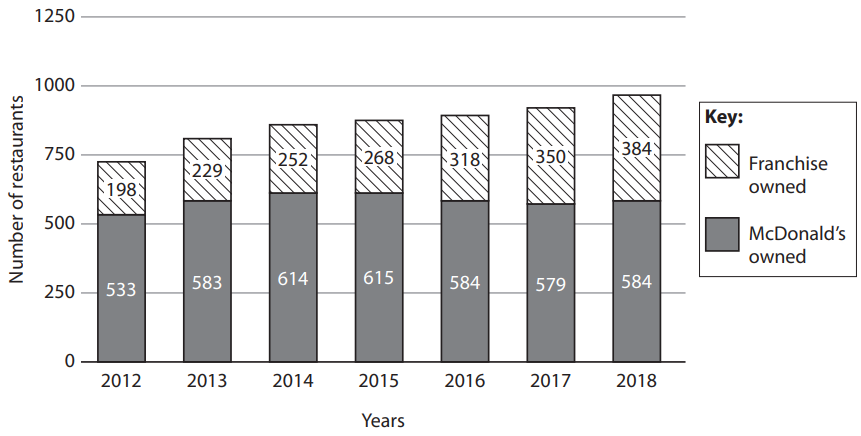
Total number of McDonald's restaurants in Brazil
(Source: adapted from https://www.statista.com/statistics/812580/number-mcdonaldsrestaurants-type-brazil/)
Extract E
Taco Bell opens first Rio de Janeiro location
American fast-food business, Taco Bell, has joined an already crowded market.
"Brazil has great potential both in terms of its geography and its food consumption," said Taco Bell's Director of Operations in Brazil. She added, "Operating on a larger scale is important, because it allows us to reduce the cost of inputs and services." The company's current goal is to have up to 200 locations by 2027.
As well as Taco Bell's popular Tex-Mex dishes, including the 'Crunchwrap Supreme' and the 'XXL Grilled Stuft Burrito,' Taco Bell has made sure to add local flavour to its traditional menu. For example, in São Paulo, it added the local drink maté.
Currently, all the branches in Brazil will be company-owned, but Taco Bell is considering franchising in the future.
(Source: adapted from https://riotimesonline.com/brazil-news/rio-business/taco-bell-opensfirst-rio-location-in-barra-da-tijuca/)
Extract F
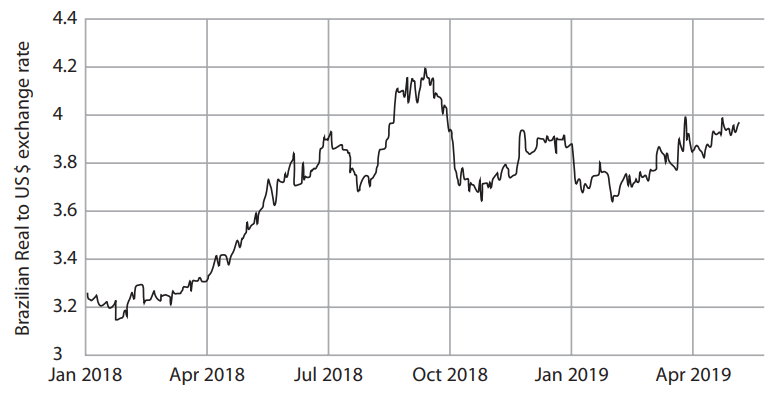
Brazilian Real to US dollar exchange rate 2018–19
(Source: adapted from https://tradingeconomics.com/brazil/currency)
Extract G
Multinationals in Brazil
Food and beverage multinationals provide a range of benefits to the Brazilian economy. They are responsible for 10% of Brazil's economic output and together employ 1.6 million people. Specifically, Nestlé employs 21,000 people in Brazil and has started an apprenticeship programme training 7,000 people under the age of 30.
However, in 2006, the Brazilian government, recognising the health problems caused by some multinational food businesses, introduced regulations to curb obesity and disease. These measures included advertising to warn consumers about foods high in sugar, salt and saturated fats. There were also marketing restrictions on sugary drinks aimed at children. The new rules also stopped brands such as Pepsi and KFC from sponsoring sports and cultural events.
Brazilian business, Citrosuco, exports 50% of the total orange juice exported to the USA, a total market worth 1.4 billion US dollars. One of the American companies Citrosuco sells to is Tropicana, owned by PepsiCo.
However, a report in 2015, from the pressure group Supply Cha!nge, criticised working conditions in the Brazilian orange juice industry. The report alleged that high pesticide use led to unsafe working conditions and even deaths. It also stated workers were sometimes unpaid for weeks and trapped in employment contracts that kept them in debt.
(Source: adapted from https://www.nytimes.com/interactive/2017/09/16/health/brazilobesity-nestle.html and https://www.cnbc.com/2018/08/23/brazil-florida-orange-juice-tarifftrade-war.html)
Taco Bell entered the Brazilian market in 2018, with limited success. To increase sales, Taco Bell could either adopt a polycentric, or an ethnocentric approach to marketing
Evaluate these two options and recommend which one is most suitable for Taco Bell to increase its sales in Brazil
Was this exam question helpful?
Extract D
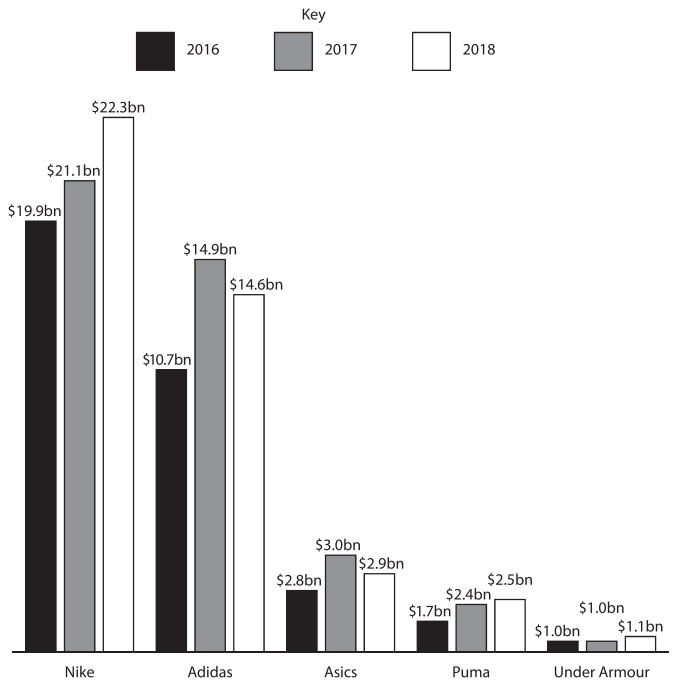
Worldwide sports footwear sales in billions of US dollars, selected leading brands
Sales value of all other sports footwear brands not included in the chart = 16.7bn US dollars in 2018
Extract E
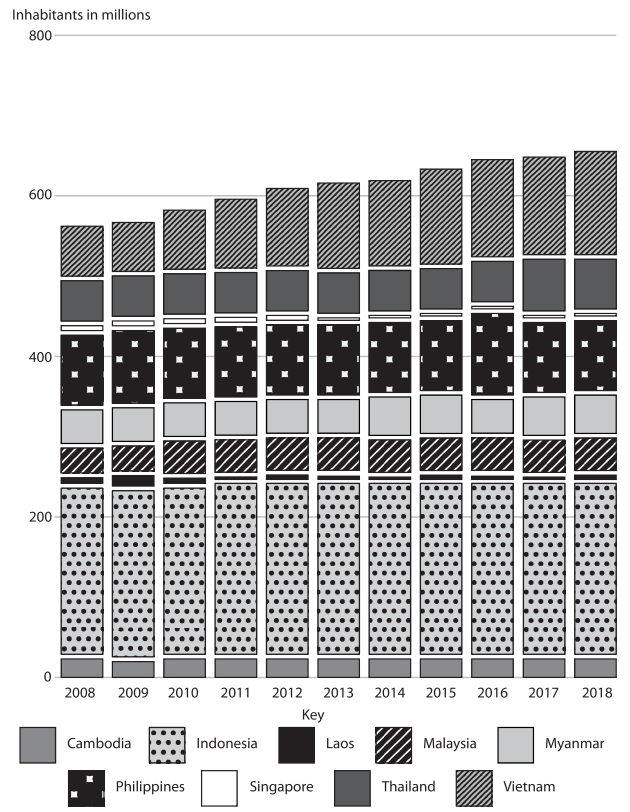
Populations of The Association of Southeast Asian Nations (ASEAN) member states
Extract F
ASEAN opportunity
The Association of Southeast Asian Nations (ASEAN) was founded in 1967 by five countries: Thailand, Indonesia, Philippines, Malaysia, and Singapore. Its aim is to promote free trade between members, by reducing trade barriers between them. In 2010 ASEAN joined China in the ASEAN-China free trade area, reducing tariffs on 70% of goods.
With over 260 million people, Indonesia possesses both a large workforce and a young population. It has a stable and growing economy. Furthermore, increasing urbanisation eases the cost of doing business for foreign companies. These businesses, such as Nike, manufacture their goods in Indonesia and sell their products to the country's growing middle class.
The Indonesian Government has also realised the importance of developing the country's manufacturing sector to increase economic growth and create employment opportunities. The government has released several policy packages since September 2015 aimed at easing the cost of doing business in Indonesia. This should increase foreign direct investment (FDI).
Nike, Toyota, Nestle, LG, and Samsung are some of the major multinational corporations that have set up factories in Indonesia. These corporations benefit from low labour costs and relatively skilled workers.
Growing urbanisation makes businesses closer to their customers. However, there are also land shortages, which can make it difficult and expensive for firms to build new manufacturing facilities in Indonesia.
Extract G
Nike announces new partnership with Flex
Nike's manufacturing involves mass production in a range of low-wage economies, such as Indonesia, Thailand, and Vietnam. These production locations also tend to be close to materials needed, such as textiles and rubber.
In 2016 Nike announced a new partnership in North America with Flex, a design and manufacturing company. This enabled Nike to move towards differentiating its products. Before this new agreement Nike had its NikeID website, which customers could use to design aspects of their own shoes. However, these orders took up to four weeks to reach the customer.
Nike aims to reduce the time from design to delivery for customer orders from weeks to days. To do this it is working with Flex to develop efficient methods for making orders of one, rather than 1,000 shoes. Flex is experimenting with new laser cutting technology, that allows one-off production. The machine can go from cutting size 13 shoes to size 7 shoes without interrupting production. "We think that unlocks a lot of growth, by differentiating our products from competitors, and getting customised orders to our customers more quickly," said Nike's Head of Marketing.
Nike is aiming to achieve competitive advantage in the global sports footwear market. In order to do this Nike could focus on cost competitiveness or differentiation.
Evaluate these two options and recommend which one is most suitable for Nike to maintain its global competitiveness.
Was this exam question helpful?
Extract D
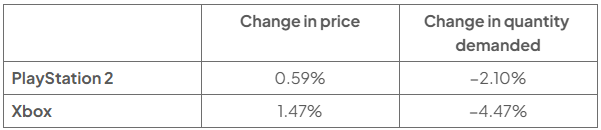
Estimated effects of price changes on quantity demand for games consoles in 2004
Extract E
Globalisation in the games market
Computer games are produced and enjoyed all over the globe. In 2020 China's market was worth approximately 24.4 billion US dollars and the US market 23.6 billion US dollars. Japan, South Korea, Germany, and the UK were the next largest markets.
Games were originally played on non-internet connected devices, such as the original Nintendo console. Consoles and games were manufactured in countries, such as Japan and China, and transported to consumers around the world. Games targeted small niche markets, often close to the developers' physical location, with different versions of games for each country.
Games producers now take a global approach and release each game in different languages to customers all over the world at the same time.
In 2020 an estimated 2.2 billion customers played computer games. Growth comes partially from mobile gaming, which anyone with a phone or tablet can play. Other factors include the rise of online communities, where people play and share tips; a gamer in the US can play Call of Duty with a friend in Japan at the push of a button.
Gamers no longer need to buy a console and spend lots of money on games. The rise of digital distribution, via the internet, has made purchases more accessible. Cloud storage has been another factor as the servers located around the world do most of the computing work. Gamers no longer need expensive equipment to play.
Global niche markets have grown with digital distribution. For example, Sukeban Games develop visual novels where players make decisions about characters and solve puzzles.
Extract F
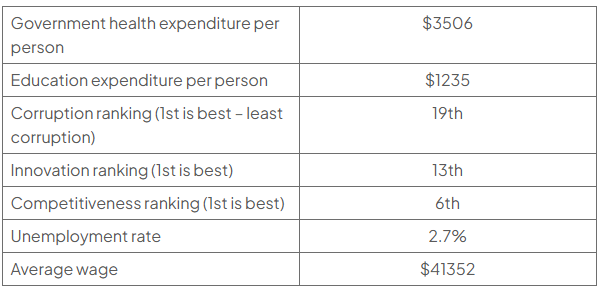
Country data – Japan
Extract G
PlayStation 5
The circle symbol is used widely in Japanese culture, from recycling guidelines to teachers' marks on children's homework. It means yes, OK, good or correct. The cross tells you something is wrong, bad, against the rules, or to be avoided.
When Sony produced its first PlayStation games console in 1994 and needed symbols for the two most important buttons on its controller, this was what it chose. However, although the symbols may have clear uses in Japan, they can mean something else in other countries. For example, people vote in elections by putting a cross against their preferred candidate's name.
Sony decided to adapt its controller to the culture of each market. In Japan, the circle button would agree with things or cause some positive action in a game, while the cross would cancel, reverse, or stop. In some markets, that function was switched, and the cross was the symbol of action, positivity, and advance. For 25 years, and three generations of PlayStations, these two different systems were kept. Global PlayStation users grew beyond 100 million.
Sony is now considering standardising the buttons on the PlayStation 5 in all markets. With the launch of the PlayStation 5, Sony will go head-to-head with Microsoft's new console in a contest on which Sony's fortunes heavily depend.
Sony could have either produced a standardised controller for sales in all countries or adapted the controller to the culture of local markets in order to maximise PlayStation 5's sales.
Evaluate these two options and recommend which one Sony should have taken to maximise PlayStation 5's sales.
Was this exam question helpful?
Extract E
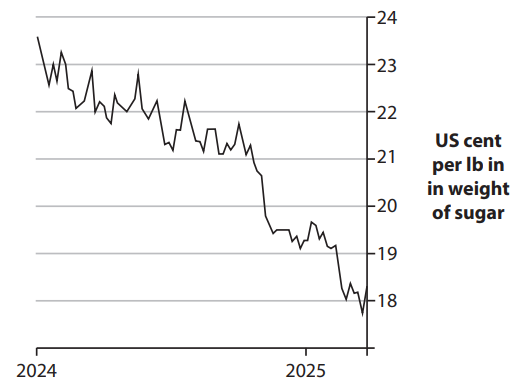
Monthly sugar price in US cents per lb (pound in weight)
(Source: adapted from https://tradingeconomics.com/commodity/sugar)
Extract F
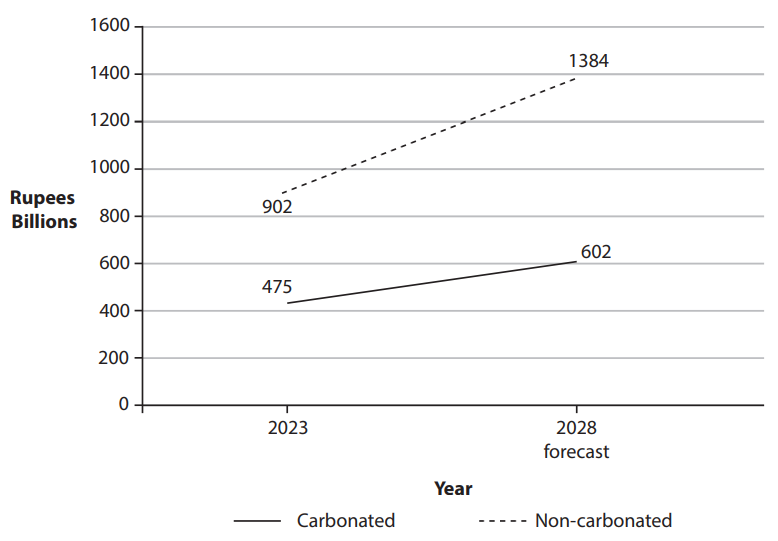
Trends in the Indian soft-drinks market
(Source: adapted from https://www.enterpriseappstoday.com/stats/soft-drinksales-statistics-2023-facts-trend-and-demand-analysis.html)
Extract G
Fever-Tree
In 2004, Fever-Tree began as a UK-based startup selling high quality tonic water. They now sell a variety of 14 different flavoured mixers.
It began exporting to markets, particularly in India, by building brand reputation. It recognised the importance of understanding local markets. Market research helped ensure compliance with local regulations, food safety standards, labelling requirements and import-export laws, including tariffs and duties.
Fever-Tree built relationships by connecting with local bartenders, chefs and other spirits brands operating in its target markets, Mumbai and Delhi.
Sourcing ingredients from India is important. Indian consumers prefer local ingredients. India's cocktail culture has traditional and modern influences, with a growing appreciation for premium, innovative products. India's rapidly growing middle class offers new opportunities.
One way Fever-Tree could overcome the challenges posed by trade barriers, such as tariffs, would be to set up a production facility in India.
(Source: adapted from https://www.ft.com/partnercontent/departmentfor-business-and-trade/savouring-success-finding-exportopportunities-in-indias-evolving-market.html)
Extract H
Coca-Cola in India
The Coca-Cola Company entered the Indian market in 1956.
In 2004, after years of protests by local villagers, a Coca-Cola bottling plant was forced to close as it allegedly contaminated groundwater with toxins. The villagers also suffered crop failures due to lack of irrigation water, as the bottling plant was causing water shortages.
As a result of the closure of the bottling plant, the Coca-Cola Company has adapted its business model. It now uses independent Indian bottling partners, often family-owned businesses, which employed local workers. Coca-Cola is distributed through local retailers.
Coca-Cola supports communities through The Coca-Cola Foundation. These address environmental and social priorities like education, economic empowerment, recycling, and disaster relief.
(Source: adapted from https://www.historyoasis.com/post/coca-cola-history-india and https://esgnews.com/the-coca-cola-system-refreshing-local-economies-and-communities-worldwide/)
Extract I
India Cola market
The per capita consumption of soft drinks in India is 4-5 litres per year; the global average is 30 litres.
Indian brand Campa Cola sells 200 ml bottles for 10 rupees, half the price of a similar sized Coca-Cola or Pepsi product. Campa Cola's product range is limited compared to its competitors. It is investing in bottling plants, which will increase production capacity.
Coca-Cola's portfolio includes brands like Thums Up, Maaza (fruit beverage), and Kinley (water). Coca-Cola's sales have grown in rural markets compared to urban areas. It aims to ensure different products are priced simply for rural areas, such as pricing products at either 10, 20, or 50 rupees, to make cash transactions easy. This is important in regions where physical cash is the most popular method of payment.
Coca-Cola aims to sell more to middle-class urban markets, maximising the potential to charge premium prices.
(Source: adapted from https://economictimes.indiatimes.com/industry/cons-products/food/coca-cola-cracks-the-most-elusive-market-in-india-the-countrys-hinterlands/articleshow/105199454.cms and https://altiusinvestech.com/blog/pepsi-coca-cola-campa-cola-battle-indias-soft-drink-market/)
Coca-Cola aims to increase its market share of the Indian soft drinks market. In order to do this, it could either focus on the pricing of its products or improving its ethical behaviour.
Evaluate these two options and recommend which one is most suitable for increasing Coca-Cola's market share in India.
Was this exam question helpful?
Extract A
Universal Music Group
Universal Music Group (UMG) is the world's largest music label, responsible for producing and distributing music. It has the largest market share, with 33.90%, followed by Sony Music Entertainment with 26.91%, Indies with 23.21% and Warner Music Group with 15.98%
UMG's artists include American and British acts: Taylor Swift, Kendrick Lamar, Elton John, and Sabrina Carpenter. UMG receives a proportion of each artist's sales of music.
In 2024 its revenue increased by 14.4%, helped by the strong sales for The Tortured Poets Department by Taylor Swift. In the UK alone the album has moved 255,515 copies on physical formats.
However, the potential of Artificial Intelligence (AI) to use artist material owned by UMG and TikTok's global influence on music consumption, provide challenges to UMG.
(Source: adapted from https://www.universalmusic.com and https://www.musicbusinessworldwide.com)
Extract B
Rough Trade Records
Rough Trade is an independent record store, with 7 shops in cities including London and Liverpool.
Its owners are happy to remain small. They avoid locating in areas that already have a strong independent record shop, so as not to create competition for that store. The owners recognise that there are probably 5 or 6 cities where it could open a new Rough Trade record store.
For the year ending December 31, 2022, Rough Trade’s Sales Revenue was £14 348 884, Gross Profit of £5 210 500, and Operating Profit was £528 330. Rough Trade’s cost of sales and operating expenses both increased significantly during 2022.
Rough Trade pay its staff well above the minimum wage. It makes sure its staff have a good working environment and have the support they need to give great customer service. It also paid out a profit bonus to all staff.
Rough Trade increased its share of the UK market for vinyl to 8.4% (up from 7%). Sales of books and turntables also increased.
(Source: adapted from https://www.musicweek.com/labels/read/rough-trade-retail-reportsrecord-revenue-amid-vinyl-sales-boom
Extract C
Emerging markets and the global music industry
The music industry's focus has slowly moved towards emerging markets. Labels such as UMG brought Western music influences into these markets through international marketing of global artists. However, regional scenes and local artists are taking on global sounds. K-pop, Reggaeton and Afrobeats are examples of this influence. Sales of artists, such as Tiara Andini in Indonesia and Chris Mj in Chile, are expected to grow.
Emerging markets are vital for streaming services and major labels. Spotify and Apple Music were late to realise the potential of emerging markets. This allowed local streaming services such as JioSaavn in India to provide local consumers with easier access to local music. It also enabled local artists to find new opportunities to become superstars in their home markets. These local streaming services lack a global presence, but successfully focus on regional music.
European and North American artists who are looking for global relevance are turning to local sounds and cultures to differentiate their music.
(Source: adapted from https://www.midiaresearch.com/blog/emerging-market-music-cultures-are-shaping-the-global-music-industry)
Universal Music Group has the business objective of profit maximisation. To achieve this, it is considering following either an ethnocentric or polycentric approach to its global marketing strategy.
Evaluate these two options and recommend which one is most likely to achieve profit maximisation for UMG.
Was this exam question helpful?
Extract D
BT Sport agrees joint venture with Discovery Eurosport
On September 1, 2022, BT Group and Discovery Eurosport announced completion of their 50:50 joint venture. The deal involves Discovery Eurosport giving BT Sport's existing customers the rights to view its content, creating a stronger competitor to Sky Sports in the UK. The joint venture would combine a wide catalogue of sports broadcast rights. This includes the English Premier League and UEFA Champions League football matches in the UK, cycling's Grand Tours and the tennis Grand Slams, as well as other major sporting events.
In 2022 BT Sport had 4 million subscribers, while Eurosport had approximately 157 million subscribers. The basic BT Sport subscription was £18 a month in the UK. Eurosport was €5.99 a month, converted to pounds (£), for UK customers. After the joint venture the price for both channels is £29.99 a month, which also includes access to many additional Discovery channels.
Eurosport is already owned by the Discovery channel group, so BT's decision to form a joint venture makes sense for both businesses. The deal helps Discovery to compete in the TV streaming wars. It sees sports as a way to differentiate itself from competitors, such as Disney and Netflix that don't currently offer sports coverage.
(Source: adapted from Copyright The Financial Times Limited 2023. All rights reserved.)
Extract E
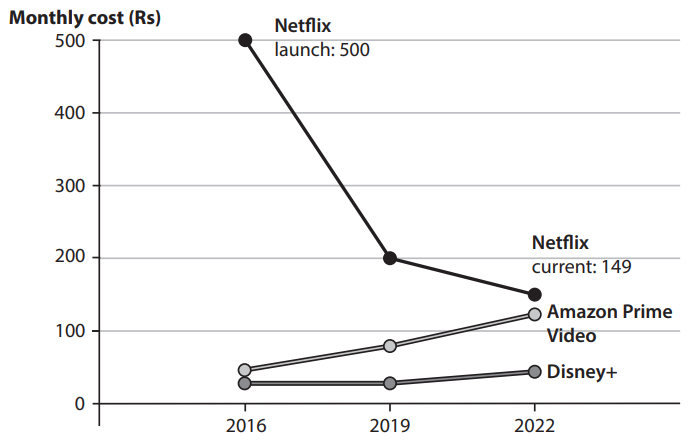
Monthly subscription prices for streaming services in India, 2016 to 2022
In 2016 Netflix had 0.35 million subscribers. In 2019 it had 2 million and by 2022, 5.5 million, an increase of 175%.
(Source: adapted from Copyright The Financial Times Limited 2023. All rights reserved.)
Extract F
Netflix in India
Since 2021 businesses such as Netflix and multinational media companies operating in India have been expected to follow a code of ethics, drafted by the government. This requires businesses to exercise 'due caution and discretion' when showing content that may threaten India's security or be detrimental to the country's foreign relations.
The government is also considering extending existing legislation affecting online content to TV streaming. The code requires businesses such as Netflix to improve the accessibility of content to persons with disabilities, and requires parental controls to limit children's access to content aimed at older viewers. Multinational streaming businesses are also expected to consider the impact of content on matters of caste (social class), race, gender, religion, or sexuality.
(Source: adapted from Copyright The Financial Times Limited 2023. All rights reserved. and https://www.hindustantimes.com/india-news/govt-mulls-code-of-ethics-what-ott-platforms-may-have-to-follow-101614147645811.html)
Extract G
Streaming market in India
Between 2019 and 2020, Netflix spent 400 million US dollars on content made in India. "We're quite optimistic that India isn't fundamentally different in some way from our other markets," said Greg Peters, Netflix's Chief Operating Officer. Critics pointed out that Netflix was slow to address various issues, from pricing and distribution to the importance of commissioning more shows in regional languages, such as Tamil. Amazon Prime Video has been faster to offer more content in regional languages.
In 2023, 46% of drama programmes made by streaming platforms watched in India were on Disney+, whereas only 5% were made by Netflix.
Disney+ has catered more successfully to a mass-market audience. Netflix has not identified its target audience in India.
(Source: adapted from Copyright The Financial Times Limited 2023. All rights reserved. and https://www.hindustantimes.com/india-news/govt-mulls-code-of-ethics-what-ott-platforms-may-have-to-follow-101614147645811.html)
To increase its market share in India, Netflix could adapt its marketing mix. It could do this either by adapting its pricing policy or adapting its product to the Indian market.
Evaluate these two options and recommend which one Netflix should choose in order to improve its market share in India.
Was this exam question helpful?
Extract D
Nimbus Sports Equipment plc
Nimbus Sports Equipment plc is a UK-based manufacturer of specialist running shoes. The business designs and produces performance footwear for endurance runners and sells its products in the UK and a range of international markets. Nimbus positions itself as a premium, performance-focused brand, competing on quality, innovation and technical design rather than low prices.
Nimbus currently sells the same core running shoe design in all markets but adapts colours and sizing to reflect local preferences. Senior managers are considering whether to move towards a more standardised global product strategy in order to reduce production and design costs.
However, there are concerns that a fully standardised product may fail to meet local customer preferences in some international markets. Nimbus's managers must decide whether the potential cost savings from standardisation outweigh the risk of reduced customer satisfaction.
Extract E
Selling Nimbus products online
Nimbus sells its products through specialist sports retailers and via its own online sales platform. Online sales have grown rapidly in recent years, particularly in international markets where Nimbus does not have a strong retail presence.
The business believes that its online platform allows it to reach niche groups of endurance runners worldwide. However, selling footwear online can increase delivery and returns costs, particularly when customers order multiple sizes.
Extract F
Global competition in the running footwear market
The global market for running footwear is highly competitive. Large multinational brands compete aggressively on innovation, marketing and sponsorship of elite athletes. Consumers are often willing to switch brands if performance, comfort or value for money improves.
Nimbus's senior managers believe that long-term success in global markets will depend on balancing cost efficiency with the ability to meet the needs of different customer groups.
Evaluate whether Nimbus Sports Equipment plc should adopt a standardised global product strategy or a more adapted product strategy.
Was this exam question helpful?