Cultural & Social Factors (Edexcel A Level Business): Revision Note
Exam code: 9BS0

Factors to consider in global marketing
Global businesses must consider various cultural and social factors to effectively market their products/services in different countries and regions
Cultural and social considerations
By understanding cultural differences, businesses can build strong relationships with their global customers and achieve long-term success
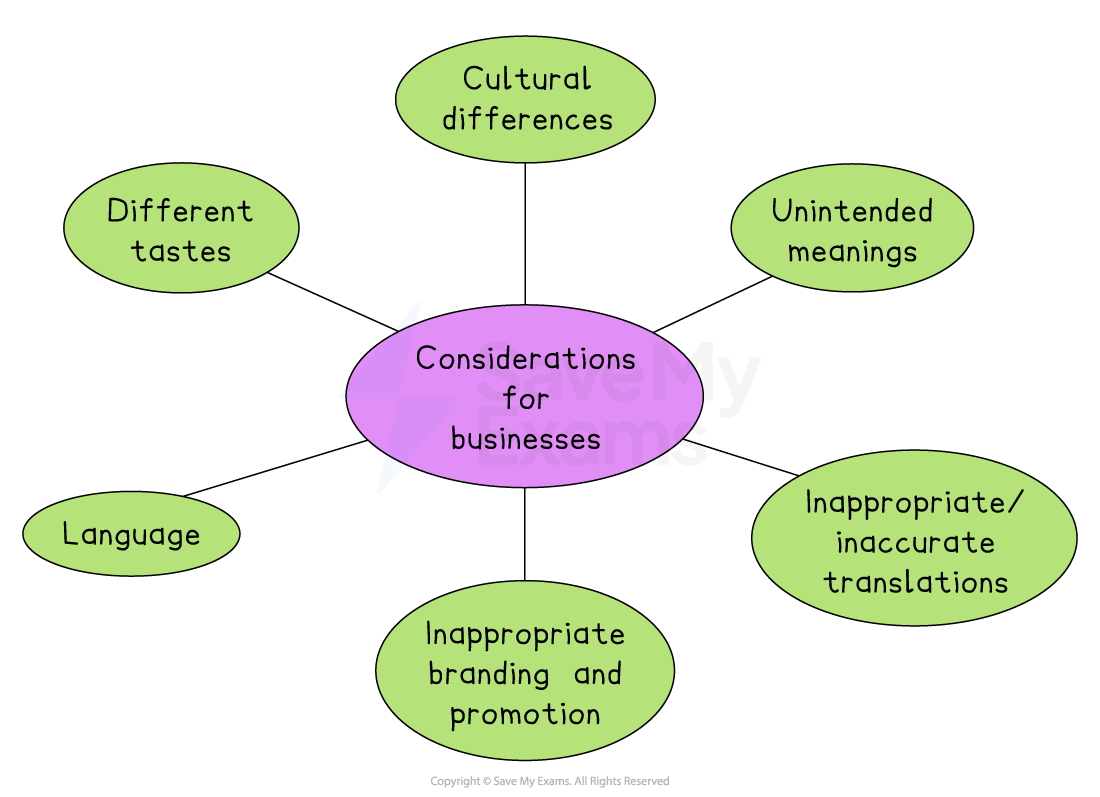
Cultural differences
Businesses must be aware of how businesses and customers interact in new global markets
Businesses need to understand cultural differences in areas such as values, beliefs, customs and traditions and adapt their marketing strategies accordingly
Example
Business meetings in Japan often begin with the formal exchange of business cards (meishi) using both hands, and failing to observe this custom can be seen as disrespectful by Japanese business partners
Different tastes
Tastes and preferences vary greatly between cultures and regions
Some businesses adapt their products and services to meet local preferences
Example
McDonald's sells a McSpicy Paneer burger in India and a Teriyaki McBurger in Japan, adapting its core menu to match distinct regional flavour preferences
Language
Businesses must ensure that their marketing messages are translated accurately and appropriately
This involves understanding language nuances and idioms
Example
When KFC entered the Chinese market, it translated its slogan "Finger-Lickin' Good" into Chinese as "Eat Your Fingers Off", which had negative connotations in the Chinese culture
Unintended meanings
Unintended meanings can arise when businesses use images, symbols or language that have different connotations in different cultures
Example
The colour white symbolises purity and innocence in Western cultures, but it represents death and mourning in some Asian cultures
Inappropriate or inaccurate translations
Inappropriate or inaccurate translations can lead to serious consequences for businesses, including loss of credibility, legal implications and damage to brand reputation
Businesses must use professional translation services and consult with local experts to ensure that their messages are accurately translated and culturally appropriate
Example
HSBC had to spend $10 million rebranding its "Assume Nothing" campaign after it was mistranslated as "Do Nothing" in several countries, damaging the intended message
Inappropriate branding or promotion
Inappropriate branding and promotion can occur when businesses use images, symbols or language that are offensive or inappropriate in different cultures
Example
In 2018, a Dolce & Gabbana advert showed a Chinese model attempting and failing to eat various Italian dishes with chopsticks. People were outraged over the depiction of Chinese people as lacking refinement and an understanding of culture
Case Study
Hartley & Vine

Hartley & Vine is a premium British tea company that decided to expand into the Chinese market after strong growth at home. Confident in its classic English Breakfast and Earl Grey blends, the company initially launched with the exact same product range and packaging used in the UK, including boxes decorated predominantly in white to convey a clean, premium feel.
Sales were disappointing. Local distributors explained that white packaging is strongly associated with funerals and mourning in Chinese culture, making customers reluctant to buy the tea as a gift, which is how much of the market is sold. At the same time, market research revealed that Chinese consumers preferred lighter, more floral tea flavours than Hartley & Vine's traditional strong black blends.
The company's Chinese slogan, translated directly from English by a head-office employee rather than a professional translator, also used a phrase that came across as awkward and slightly comical to native speakers.
After redesigning its packaging in red and gold, developing a jasmine-infused blend specifically for the market, and hiring a local translation agency, Hartley & Vine's sales in China began to recover within six months
Examiner Tips and Tricks
When a case study describes a marketing failure abroad, don't just identify which cultural factor was misjudged - explain the specific consequence for the business (lost sales, reputational damage, cost of correction) to move from description into genuine analysis

Unlock more, it's free!
Join the 100,000+ Students that ❤️ Save My Exams
the (exam) results speak for themselves:

Was this revision note helpful?
Build on this topic