Human Resources (Edexcel A Level Business): Revision Note
Exam code: 9BS0

An introduction to human resources
In common with all resources, a business's employees - its human resources - need to be managed
Staff costs can make up a large proportion of a business's costs, so objective monitoring of employee performance is a key element of effective financial and operational control
Businesses commonly monitor the following human resources metrics:
Labour productivity
Labour turnover
Labour retention
Absenteeism
Labour productivity
Labour productivity is a measure of output per employee
It is calculated using the formula
Figures used in this formula are for a specific time period such as week, month or year
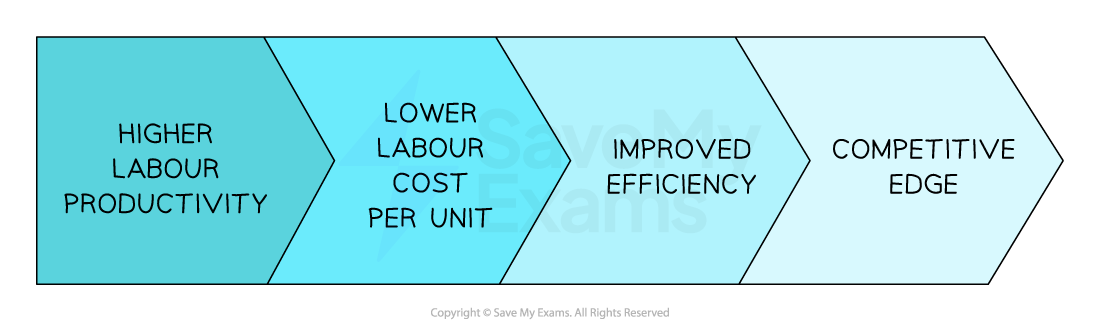
Businesses aim to increase the level of labour productivity to improve competitiveness
Labour productivity and competitiveness
Worked Example
Last year, Marinka Homewares made 424,000 lava lamps with a production workforce of 350 employees. This year, it forecasts that 480,000 lava lamps will be made with a production workforce of 365 employees.
Calculate the percentage increase in annual labour productivity per worker between last year and this year's forecast.
(4)
Step 1: Apply the labour productivity formula to calculate the labour productivity for both years
Labour productivity last year
Labour productivity this year
Step 2: Calculate the percentage increase between last year and this year
Labour turnover and retention
Labour turnover
Labour turnover measures the proportion of employees leaving a business during a specific time period
It is expressed as a percentage and is calculated using the formula
A rising rate of labour turnover can signal internal human resource management problems, such as:
Poor management, leading to workers losing commitment
A poor recruitment and selection approach, leading to staff leaving soon after starting their job
Low wage levels compared to those that could be earned elsewhere
External factors can also increase labour turnover in a business
A buoyant local economy in which workers are attracted to employment opportunities elsewhere
Improved transport links that provide an opportunity for workers to seek work across a wider geographical area
Problems of high labour turnover
Increased recruitment and selection costs
Increased induction and training costs
Lower productivity levels as workers settle into new roles
Opportunities of high labour turnover
Workers with existing skills can be recruited to reduce the need for training
New ideas and creativity introduced to the business
New perspectives and approaches to problem-solving can improve business performance
Examiner Tips and Tricks
Don't treat high labour turnover as automatically bad - some businesses genuinely benefit from a degree of turnover (fresh ideas, avoiding overstaffing), so evaluative answers should weigh the specific costs and opportunities against each other rather than assuming turnover is always a problem to be minimised
Worked Example
In 2022, Domus Construction Ltd employed an average of 7,200 workers, six per cent of whom worked at the head office.
During 2022, fifty-four head office employees left the business.
Calculate the labour turnover of Domus Construction's head office in 2022.
(3)
Step 1: Calculate the number of head office workers
Step 2: Apply the labour turnover formula
Labour retention
Labour retention measures the proportion of employees remaining with a business during a specific time period
It is expressed as a percentage and is calculated using the formula
A high level of labour retention means that few staff are leaving the business during a given period
Worked Example
In 2022, the University of West Surrey employed an average of 4,240 employees, 265 of whom left the university during the year.
Calculate the University of West Surrey's staff retention rate in 2022.
(2)
Step 1: Calculate the number of employees not leaving
(1)
Step 2: Calculate the retention rate using the formula
Absenteeism
The absenteeism rate is a measure of the proportion of staff who were absent from work during a specific period of time (e.g. a day, week or month)
It is expressed as a percentage and is calculated using the formula
High levels of absenteeism can cause several problems for a business, including:
Absence due to illness requires sick pay to be paid
Hiring temporary staff to cover for those absent increases costs
Output is likely to be temporarily reduced if staff are key to the production process
Other staff may become demotivated if they have to constantly cover for absent workers
A wider culture of absenteeism may develop
Worked Example
On January 16, twenty-two of Belling Stoneworks Ltd's 189 employees were absent.
Calculate Belling Stoneworks Ltd's absenteeism rate on January 16.
(2)
Step 1: Substitute the values into the formula
Human resources strategies to improve employee performance
Raising the labour productivity rate, as well as reducing staff turnover and absenteeism rates, are key human resource management objectives
Increased labour productivity lowers the labour cost per unit and contribute to improved competitiveness
More output is produced, so there is more output to sell - potentially increasing revenue
Money is saved on recruitment, selection and training costs, and a positive group spirit may emerge
Strategies to improve employee performance
Offering financial rewards
Examples of financial rewards include:
Increased pay rates
Profit-sharing schemes
Bonuses and commission
Performance-related pay
Attendance rewards
Loyalty bonuses
Paying workers more or sharing profits may increase commitment and effort, leading to higher output and productivity
If financial rewards are greater than those of other employers, staff are less likely to want to leave
Bonuses and commissions are only paid when they have been earned or if targets have been met
Attendance and loyalty rewards may improve the intrinsic motivation of workers as they feel valued
Offering employees shares in the company
Rewarding senior executives and managers with shares may increase their commitment to achieving objectives
Employees who own shares in the business may work harder and take less time off as they have a financial stake in the success of the business
Share ownership is often structured through formal schemes
Save As You Earn (SAYE) is where employees save monthly towards buying shares at a fixed price
Share Incentive Plans (SIPs) are where employees are given or can buy shares directly
Example
The John Lewis Partnership is jointly owned by its employees, who receive an annual share of profits as a bonus, often cited as contributing to strong staff engagement
Consultation
Consultation involves managers obtaining the views of employees when making decisions
Workers are likely to feel more involved within the business and may be less likely to take days off work or leave the business
Consultation can take place through works councils, regular team briefings, suggestion schemes or elected employee representatives who feed staff views back to management
Involving employees, particularly in decisions that directly affect their own roles, can improve the quality of decision-making
Employees often have first-hand knowledge of problems managers may not see
E.g. A business planning to change shift patterns might consult staff representatives first, helping to identify practical problems before the change is implemented
Empowerment
Empowerment means employees are encouraged to make use of their own knowledge and experience and develop their own solutions
Workers must be properly trained and equipped with the necessary resources to be properly empowered
Leaders need to be prepared to hand over authority and focus on providing encouragement, praise and feedback

Unlock more, it's free!
Join the 100,000+ Students that ❤️ Save My Exams
the (exam) results speak for themselves:

Was this revision note helpful?
Build on this topic