Radioactive Decay (Cambridge (CIE) A Level Physics): Exam Questions

Exam code: 9702

2 hours8 questions
1a
6 marks

Radioactive decay is often described as a spontaneous and random process.

State what is meant by

(i) radioactive decay

[2]

(ii) a spontaneous process

[2]

(iii) a random process

[2]

1b
2 marks

The graph in Fig. 1.1 shows the count rate of a radioactive substance measured by a Geiger-Müller tube.

7-1-q2d-question-sl-sq-easy-phy

Fig. 1.1

State the feature of Fig. 1.1 which provides evidence for  

(i) the random nature of radioactive decay

[1]

(ii) the spontaneous nature of radioactive decay 

[1]

1c
6 marks

The element neptunium has at least 24 isotopes. One of the isotopes is neptunium-231 (Np93231), which has a half-life of 49 minutes.

(i) State what is meant by isotopes and circle the possible isotopes of neptunium

Np93239

Np94231

Np93219 

Np90231 

Np93244

[3]

(ii) Define half-life and circle the correct expression for calculating the probability per second of decay of a nucleus of neptunium-231.

490.693

  0.69349

0.69349×60 

49×600.693

[3]

1d
3 marks

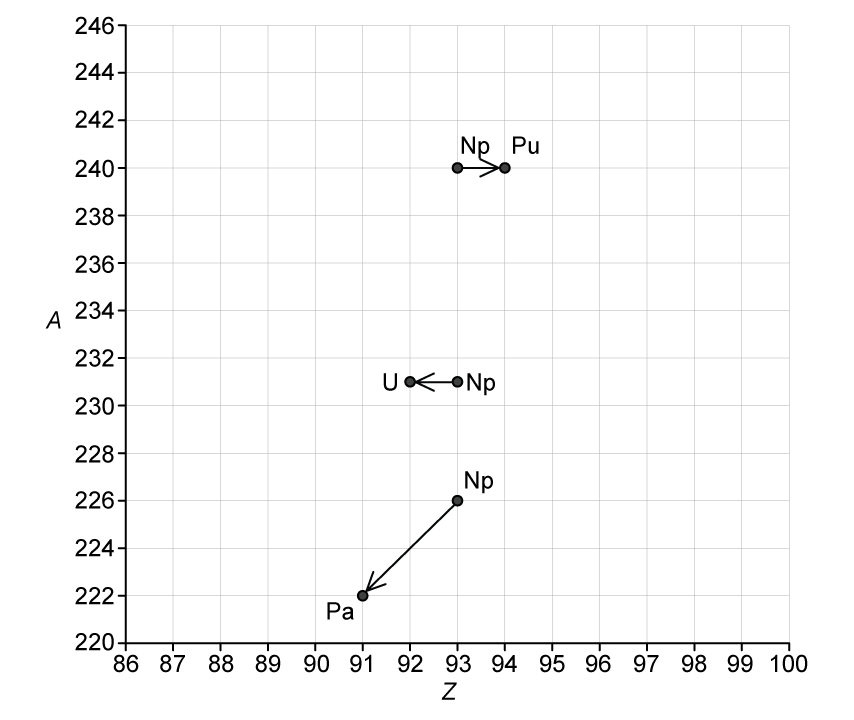
Fig. 1.2 shows a diagram in which nucleon number A is plotted against proton number Z.

The diagram shows the position of three isotopes of neptunium and their respective decay products.
23-2-1d-e--23-2-e-a-z-nucleon-proton-graph-cie-ial-sq

Fig. 1.2

Use Fig. 1.2 to complete the following nuclear decay equations

Np......  Pu...... + .....................

Np......  U...... + .....................

Np......  Pa...... + .....................

2a
2 marks

Define half−life.

2b
5 marks

A student investigates the half−life of technetium with time. This list shows the variables in the experiment.

time

size of sample

distance from the detector to the sample

same material for the sample 

activity of the sample

Using variables from the list, state

(i) the independent variable

[1]

(ii) the dependent variable

[1]

(iii) the control variables for the experiment

[3]

2c
4 marks

The experiment uses a variety of apparatus. 

Draw lines on Table 1.1 below to match the apparatus with its correct use. 

Table 1.1

7-1-q5c-question-sl-sq-easy-phy
2d
3 marks

Fig. 1.1 shows the graph that the student obtains from their results.

7-1-q5d-question-sl-sq-easy-phy

Fig. 1.1

Using Fig. 1.1, determine the half−life of the sample.

3a
3 marks

An isotope of polonium-213 (Po84213) first decays into an isotope of lead-209 (Pb82209) and then decays into the stable isotope of bismuth (Bi).

Fig. 1.1 shows two arrows on a neutron number N against proton number Z chart to illustrate these two decays.

23-2-3a-e-23-2-e-a-z-neutron-proton-number-graph-cie-ial-sq

Fig. 1.1

Use Fig. 1.1 to complete the nuclear decay equations for

(i) the polonium isotope

Po84213  Pb82209 + .....................

[1]

(ii) the lead isotope

Pb82209  Bi83..... + e10 + .....................

 [2]

3b
5 marks

A pure sample of polonium-213 is produced in a research laboratory.

The half-life of Po84213 is very small compared with the half-life of Pb82209. After a very short time, the ionising radiation detected from the sample is mainly from the beta-minus decay of the lead-209 nuclei.

The half-life of Pb82209 is 3.3 hours.

(i) State what is meant by the decay constant of a radioactive isotope.

[2]

(ii) Calculate the decay constant, in s−1, of lead-209.

[3]

3c
2 marks

The activity of the sample of Pb82209 after 7.0 hours is 12 kBq.

Calculate the initial activity of the sample of polonium-213.

3d
3 marks

(i) State the relation between the activity A of a sample of a radioactive isotope containing N atoms and the decay constant λ of the isotope.

[1]

(ii) Determine the number of lead-209 nuclei in the sample initially.

[2]

1a
4 marks

A student sets up a radioactive source and a Geiger counter to investigate how the count rate of the source varies with time.

State and explain how the student could demonstrate 

(i) the spontaneous nature of radioactive decay,

[2]

(ii) the random nature of radioactive decay.

[2]

1b
3 marks

Technetium-101 (Tc43101) decays by beta-minus emission to form a stable isotope of Ruthenium (Ru).

Complete the equation for this decay.

Tc43101  Ru............ + β............ + ......

1c
8 marks

The variation with time t of the number N of technetium-101 nuclei in a sample of radioactive material is shown in Fig. 1.1.

23-2-1c-m-23-2-technetium-decay-curve-cie-ial-sq

Fig. 1.1

(i) Use Fig. 1.1 to determine the activity, in Bq, of the sample of technetium-101 at time t = 14.0 minutes.

[4]

(ii) Use your answer in (c)(i) to calculate the decay constant λ of technetium-101.

[2]

(iii) On Fig. 1.1, sketch a line to show the variation with t of the number of ruthenium nuclei in the sample.

[2]

1d
4 marks

Each decay releases a beta particle with energy 487 keV. 

(i) Calculate, in J, the total amount of energy given to beta particles that are emitted between time t = 10 min and time t = 30 min.

[3]

(ii) Suggest why the total amount of energy released by the decay process between time t = 10 min and time t = 30 min is actually greater than your answer in (d)(i).

[1]

2a
2 marks

A source of water is found to be contaminated with the radioactive isotope radium-228 (Ra88228).

This isotope of radium has a half-life of 5.75 years.

Explain the meaning of half-life in this context.

2b
2 marks

Calculate the decay constant, in s–1, of radium-228.

2c
4 marks

A sample is taken of the contaminated water. The activity of radium-228 in a sample of 1.0 kg of water is found to be 20 mBq.

The mass of water in 1.0 mol is 18 g.

Calculate

(i) the number of radium-228 atoms in 1.0 kg of the contaminated water

[2]

(ii) the ratio 

number of molecules of water in 1.0 kg of waternumber of Ra228 atoms in 1.0 kg of water

[2]

2d
3 marks

The maximum safe limit for the activity of radium-228 in water has been set as 18.5 mBq kg−1

Calculate the time, in days, for the activity of the contaminated water to be reduced to the safe limit.

3a
2 marks

State what is meant by radioactive decay.

3b
4 marks

A radioactive sample consists of an isotope with a half-life T that decays to form a stable product. Only the isotope and the stable product are present in the sample. 

At time t = 0, the sample has an activity of A0 and contains N0 nuclei of the isotope. 

(i) On Fig. 1.1, sketch the variation with t of the number N of nuclei of the isotope present in the sample from time t = 0 to time t = 3T.

23-2-3b-m-23-2-number-of-nuclei-time-graph-blank-cie-ial-sq

Fig. 1.1

[3]

(ii) State the name of the quantity represented by the gradient of the graph in Fig. 1.1.

[1]

3c
3 marks

(i) On Fig. 1.2, sketch the variation with N of the activity A of the sample for values of N between N = 0 and N = N0.

23-2-3c-m-23-2-activity-number-of-nuclei-graph-blank-cie-ial-sq

Fig. 1.2

[2]

(ii) State the name of the quantity represented by the gradient in Fig. 1.2.

[1]

3d
2 marks

Calculate the fraction of undecayed nuclei N remaining relative to N0 at time t = 1.25T.

1a
4 marks

The radioisotope uranium-238 (U92238) decays through a decay chain to the radioisotope lead-206 (Pb82206), which is stable. 

During the decay chain, 8 alpha particles are emitted, and X beta particles are emitted. 

Calculate the value of X.

1b
4 marks

The half-life of uranium-238 is so long in comparison to any of the isotopes in its decay chain that we can assume the number of lead-206 nuclei, NPb at any time is equal to the number of uranium-238 that have decayed. 

The number of uranium-238 nuclei NU at time t is given by the equation: 

                  NU=N0eλt 

where N0 is the number of uranium-238 nuclei at t = 0. 

Show that the ratio NPbNU is given by: 

                  NPbNU=eλt1

1c
3 marks

Enriched uranium fuel is a mixture of the fissionable uranium-235 with the more naturally abundant uranium-238. Mixtures of radioactive nuclides such as this are very common in the nuclear power industry.  

Two samples of radioactive nuclides X and Y each have an activity of A0 at t = 0. They are subsequently mixed together. 

Show that the total activity of the mixture at time t = 48 years is equal to 964A0.  

The half-life of X and Y are 16 and 8 years respectively.

2a
2 marks

Rubidium (Rb) was found in samples of moon rock which were retrieved from the Apollo missions. The isotope R3787b is known to have a half-life of 4.90 × 10¹⁰years.

One of the moon rock samples contains 1.2 mg of R3787b

Show that the mass of R3787b that the rock sample contained when the moon was formed 4.47 ×10⁹ years ago was about 1.3 mg.

2b
3 marks

Calculate the activity of 1.2 mg of R3787b.

2c
4 marks

Radioactive carbon dating is a method for determining the age of samples containing organic material. This is a commonly used method for terrestrial objects. 

Pieces of ancient wood found in a fireplace at an archaeological site can be dated by measuring the activity of carbon-14. A sample contains one carbon-14 atom per 8.0 × 10¹⁰ carbon-12 atoms. In living wood, the concentration of carbon-14 atoms is greater at one carbon-14 atom per 3.0 × 10¹⁰ carbon-12 atoms.

The half-life of carbon-14 is 1.8 × 10¹¹ s. 

Explain why the concentration of carbon-14 is greater in living wood and calculate the age, in years, of the sample taken from the archaeological site.