1a8 marks
Analyse the importance of inventory management to a retail business.
1b12 marks
Discuss the factors which could infl uence the successful operation of Just-in-Time (JIT) inventory management.
Was this exam question helpful?
Exam code: 9609
Analyse the importance of inventory management to a retail business.
Discuss the factors which could infl uence the successful operation of Just-in-Time (JIT) inventory management.
Was this exam question helpful?
Explain one purpose of JIC (Just in Case) inventory management.
Was this exam question helpful?
Samira's Whiteboards (SW)
Samira left school at the age of 18 in country H. She had a small amount of savings and an idea to create a flexible, removable and reusable whiteboard. Samira created a prototype and received small orders from local retailers.
A local manufacturer batch produces stock when required. There is a two-week lead time for a minimum order of 500 units. Samira started to sell her whiteboards on her website and at trade shows. She has been trading for seven months. She has good cashflow but little working capital as production costs are high.
Samira has heard that OS, a large business that sells office equipment, is planning to sell their own version of Samira's whiteboard. She is keen to increase production quickly to take advantage of being first to market. However, Samira's manufacturer cannot supply enough product to meet the growth in potential demand for whiteboards.
Fig. 1.1 shows an inventory control chart for the first seven months of trade.
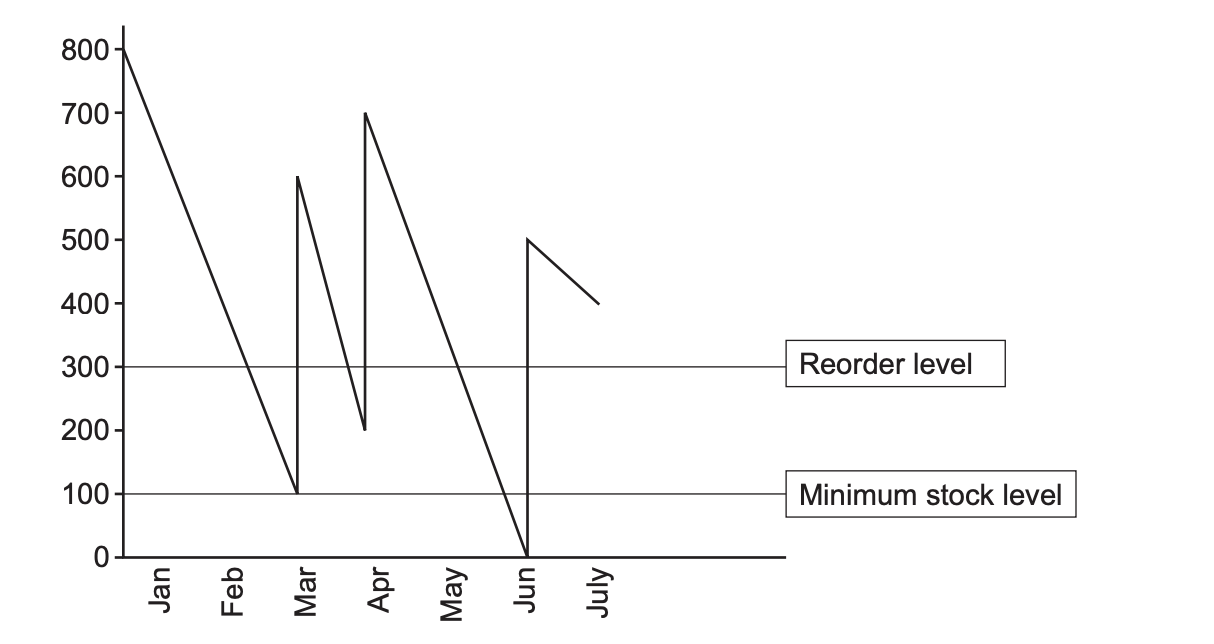
Fig. 1.1 is an inventory control chart showing SW's stock level (in units) over the first seven months of trade, January to July. The reorder level is 300 units and the minimum stock level is 100 units. Stock falls steadily as whiteboards are sold, then rises by 500 units (the minimum order quantity) each time a delivery is received. The stock level at each turning point of the chart is:
Point on the chart | Stock level (units) |
|---|---|
Opening stock (January) | 800 |
First low point, before delivery | 100 |
After first delivery | 600 |
Second low point, before delivery | 200 |
After second delivery | 700 |
Third low point, before delivery | 0 |
After third delivery | 500 |
Closing stock (July) | 400 |
Lara, a venture capitalist with experience of manufacturing, has approached Samira about making an investment. She would invest $100 000 to build a local mass production facility for SW. The facility would have a maximum output of 50 000 units per month. Lara wants to own 40% of the business.
Refer to Fig. 1.1. Calculate the total number of whiteboards sold between January and July.
Samira's Whiteboards (SW)
Samira left school at the age of 18 in country H. She had a small amount of savings and an idea to create a flexible, removable and reusable whiteboard. Samira created a prototype and received small orders from local retailers.
A local manufacturer batch produces stock when required. There is a two-week lead time for a minimum order of 500 units. Samira started to sell her whiteboards on her website and at trade shows. She has been trading for seven months. She has good cashflow but little working capital as production costs are high.
Samira has heard that OS, a large business that sells office equipment, is planning to sell their own version of Samira's whiteboard. She is keen to increase production quickly to take advantage of being first to market. However, Samira's manufacturer cannot supply enough product to meet the growth in potential demand for whiteboards.
Fig. 1.1 shows an inventory control chart for the first seven months of trade.
Fig. 1.1 is an inventory control chart showing SW's stock level (in units) over the first seven months of trade, January to July. The reorder level is 300 units and the minimum stock level is 100 units. Stock falls steadily as whiteboards are sold, then rises by 500 units (the minimum order quantity) each time a delivery is received. The stock level at each turning point of the chart is:
Point on the chart | Stock level (units) |
|---|---|
Opening stock (January) | 800 |
First low point, before delivery | 100 |
After first delivery | 600 |
Second low point, before delivery | 200 |
After second delivery | 700 |
Third low point, before delivery | 0 |
After third delivery | 500 |
Closing stock (July) | 400 |
Lara, a venture capitalist with experience of manufacturing, has approached Samira about making an investment. She would invest $100 000 to build a local mass production facility for SW. The facility would have a maximum output of 50 000 units per month. Lara wants to own 40% of the business.
Explain one cost for SW of holding inventory.
Was this exam question helpful?
Analyse two benefits to a business of holding high levels of inventory.
Evaluate whether supply chain management is the most important operational activity to the success of a manufacturer of electric cars.
Was this exam question helpful?
Cobblestone Shoes (CS)
Yazeem is a highly skilled shoemaker. He opened CS in 1975, as a sole trader, to design and repair shoes. When Yazeem set up CS the main target market was professional people who wanted shoes to wear to work or to dress smartly. He produced the shoes using batch production and sold them in his own shop. Each design of shoe was made in a range of sizes and colours.
Recently there has been an increase in low-priced shoes produced for the mass market, which has reduced Yazeem's sales of new shoes. It has also reduced the demand for shoe repairs.
Yazeem's daughter, Abir, is keen to take over the running of CS. She has been fully trained in making shoes and feels that it is time for Yazeem to retire.
Abir thinks that the business should be targeting niche markets. She would like to design and produce unique shoes and use price skimming to increase the profitability of the business.
Abir is also concerned about the contribution made on each batch of shoes. Table 2.1 shows some break-even data for a recent batch of shoes.
Table 2.1 Break-even data about a recent batch of shoes
Item | Value |
|---|---|
Break-even level of output | 400 units |
Margin of safety | 100 units |
Total variable costs | $18 750 |
Total costs | $23 750 |
Total revenue | $25 000 |
Abir has suggested that CS should adopt a just in time (JIT) approach to inventory management. By using JIT, she argues, CS would be able to increase its working capital and avoid having money tied up in inventory that might not be used or sold. CS currently has a large number of shoes on display in the shop. There is also a large amount of their main raw material, which is leather and must be kept in a climate-controlled storage area.
Abir has already found a new local supplier which is happy to deliver inventory as required.
Analyse two disadvantages to CS of adopting a JIT approach to inventory management.
Was this exam question helpful?
Discuss the importance to a hotel of having effective inventory control.
Was this exam question helpful?
'Supply Chain Management is the most important operations factor for the success of a large internet retailer.'
Evaluate this view.
Was this exam question helpful?
Explain why a business might choose to hold low levels of inventory.
Was this exam question helpful?
Motorcycle Components (MC)
MC is a large public limited company that produces a range of components used by motorcycle manufacturers. MC’s mission statement is ‘to be the world leader in delivering quality motorcycle components to our customers’.
The motorcycle component industry is very competitive and MC’s customers expect high quality and a short lead time. MC operates a Just in Time (JIT) inventory control system. MC’s good relationships with its suppliers ensure that JIT operates efficiently. The production workers at MC are highly skilled and the business benefits from a low labour turnover.
Liquidity management is very important in the motorcycle component industry. The industry average for the acid test ratio is 1. A summary of some key data for MC has been prepared by the Finance Director, as shown in Table 2.1.
Table 2.1: Summary financial data as at 30 April 2022 ($ million)
Trade receivables | 26 |
Cash | 19 |
Inventory | 1 |
Trade payables | 30 |
Other current liabilities | 20 |
The Operations Director, Jay, is proposing new capital expenditure of $4 million. Jay thinks that automation of the production process will have significant financial benefits for MC. He wishes to gain approval from the Board of Directors to implement a process innovation project. Jay believes that, with good communication and the involvement of employees, he can effectively manage the project.
Analyse two benefits to MC of Just in Time (JIT) inventory control.
Was this exam question helpful?
Analyse the advantages for a business of a Just in Time (JIT) system of inventory management.
Was this exam question helpful?
Quality Furniture (QF)
QF is a public limited company in country S. It manufactures furniture for cafés. The number of cafés in country S has increased by more than 50% over the last 5 years. This has meant that QF has been able to expand and achieve internal economies of scale. However, the growth of the café market has attracted new firms supplying café furniture and increased competition for QF.
An extract from QF’s income statement is shown in Table 1.1.
Table 1.1: Extract from QF’s income statement for 2020
$m | |
Revenue | 300 |
Cost of sales | 120 |
Gross profit | 180 |
Expenses | 150 |
Although QF has been successful so far, Javid, the Managing Director, has identified two problem areas: inventory and human resources.
Inventory
QF’s inventory includes raw materials, work in progress and finished tables and chairs. QF buys 80% of its materials from country T and there is a long delivery lead time. This means that QF holds a high level of buffer inventory which has a high value.
Human resources
QF’s production employees are unhappy that they have not received any benefit from the company’s expansion. Profit has doubled over the past three years but employees have not received any pay increases or bonuses. The employees have all been trained by QF and have specialist skills which had ensured that customer expectations were met. However, customers are starting to complain about a fall in the quality of the furniture, which could be the result of the low morale of the employees. Some highly trained employees have left QF to work for competitor firms.
Define the term ‘buffer inventory’ (line 18).
Analyse two disadvantages to QF of holding a high level of inventory.
Was this exam question helpful?
Explain why it is important for a manufacturing business to manage its inventory effectively.
Was this exam question helpful?
Flight Food (FF)
FF is a large secondary sector business that supplies airlines with in-flight meals. Meals are manufactured using batch production. A different variety of meal is made each hour with a five minute changeover time between batches. FF makes use of Just in Time (JIT) to manage inventory wherever possible. Trucks arrive each hour and deliver the materials needed for production.
The market for airline meals is very competitive. FF uses market segmentation when deciding which meals are most likely to appeal to different airlines. FF must adapt to changes in tastes and the demands of each airline.
FF is a labour intensive business. The workers are employed with short-term (six month) employment contracts. They are only offered new contracts if they meet their production targets. Table 2.1 shows some production data for FF’s two work teams.
Table 2.1: Worker data for FF
Team A | Team B | |
Number of workers | 100 | 50 |
Productivity (per worker per day) | 300 meals | 240 meals |
The Board of Directors of FF is considering changing the manufacturing process to flow production. This would require purchasing Computer Aided Manufacturing (CAM) equipment and using a capital intensive production process. Production targets would no longer be used for employees because the machinery would be set at a specific production rate.
Sabrina, the Operations Director, has put forward the following advantages for moving to flow production:
more products made each hour
lower employment costs
improved quality.
Ben, the Human Resource Director, is worried about the change from a labour intensive process to a capital intensive process.
Analyse two possible disadvantages for FF of using Just in Time (JIT) to manage inventory.
Was this exam question helpful?
‘Effective inventory management is the most important function of the operations management department in a manufacturing business.’
Discuss the extent to which you agree with this view.
Was this exam question helpful?