Motivation: Human Relationships (DP IB Psychology: HL): Exam Questions

Syllabus Edition

First teaching 2025

First exams 2027

1 hour8 questions
1
3 marks

Source 1

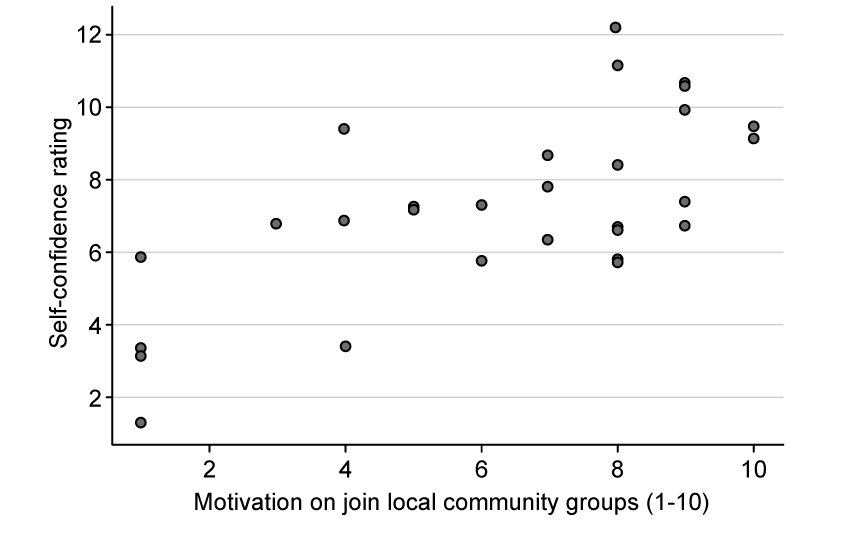
A researcher was interested to see if social identity (measured as motivation to join local community groups) correlated with self-confidence.

Figure 1 shows the findings of this study.

Figure 1: Correlation between motivation to join local community groups and self-reported level of self-confidence.

Scatter plot showing self-confidence ratings versus motivation to join local community groups, with points generally dispersing upwards.

Explain one issue that limits the interpretation of the data in source 1.

2
6 marks

Source 2

A quantitative study was conducted to investigate whether the strength of social identity is related to motivation to engage in collective action regarding public transport policy. Participants were grouped according to their level of social identification (low, moderate, or high). Motivation to participate in group-based activities and collective behaviours was measured on a scale from 1 to 7, with higher scores indicating greater motivation.

Mean motivation scores and standard deviations were calculated for each level of social identification.

The findings are shown in Table 1.

Table 1: Relationship between social identity strength and motivation for collective action

Level of social identification

Mean motivation score (1–7)

Standard deviation

Low identification

3.1

0.9

Moderate identification

4.4

1.0

High identification

5.9

0.8

Analyse the findings from source 2 and state a conclusion linked to the claim that a strong sense of group identity increases motivation to engage in collective action and support ingroup members.
3
6 marks

Source 3

A researcher conducted a focus group interview with eight participants aged 18–35 to explore how motivation influences group membership and self-esteem. The discussion focused on why individuals identify with groups and how group belonging may shape attitudes and behaviour. A thematic analysis identified the following themes:

  • Participants reported that feelings of belonging, security, and self-esteem motivated them to identify with social groups such as sports teams, workplaces, or community organisations

  • Some participants described being motivated to follow group norms and values in order to be accepted as a legitimate group member

  • Several participants noted that they were willing to invest effort or make sacrifices to strengthen their group membership, which they felt reinforced their sense of identity and self-worth

Discuss how the researcher could improve the credibility of the findings in source 3.

4
15 marks

To what extent can we claim that a strong sense of group identity increases motivation to engage in collective action and support ingroup members? In your answer, use your own knowledge and at least three of sources 2-5 (opens in a new tab).

5
3 marks

Source 1

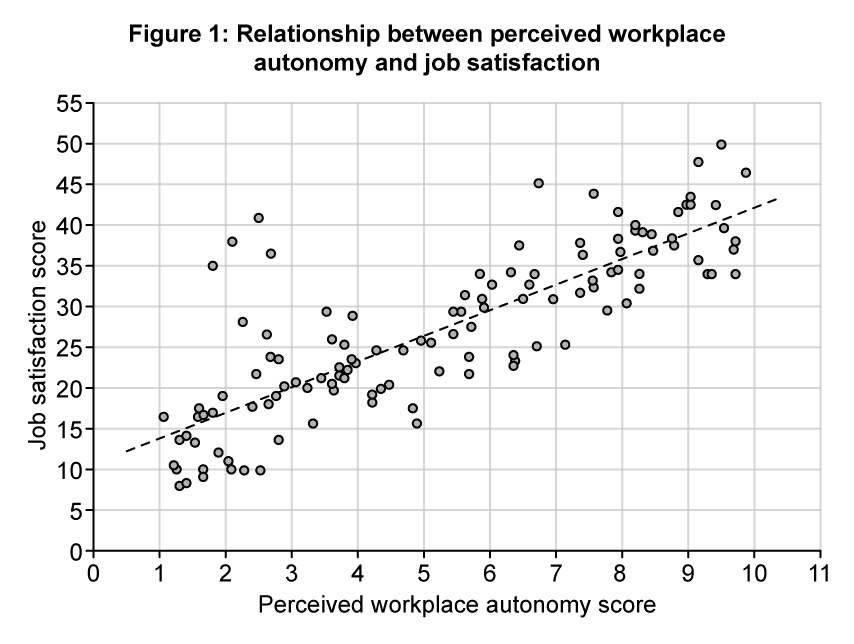
A researcher was interested to see if perceived workplace autonomy correlated with job satisfaction.

Figure 1 shows the findings of this study.

Scatter plot showing positive correlation between perceived workplace autonomy and job satisfaction, with a trend line and labelled axes.

Explain one issue that limits the interpretation of the data in source 1.

6
6 marks

Source 2

A study investigated whether the type of workplace motivator is related to employee satisfaction and task performance. 240 employees across three organisations (80 per group) were grouped by their employer's primary motivator:

  • Financial incentives: e.g. bonuses, commission

  • Recognition-based: e.g. employee of the month, verbal praise from managers

  • Autonomy-based: e.g. flexible working, choice over projects

Employee satisfaction was measured on a self-report scale (0–50) and task performance on supervisor ratings (1–10). Table 1 shows the mean scores and standard deviations for each motivator type.

Table 1: Mean employee satisfaction and task performance scores by motivator type

Motivator type

Mean satisfaction score

SD (satisfaction)

Mean performance score

SD (performance)

Financial incentives

28.4

6.2

6.1

1.8

Recognition

33.7

5.1

7.2

1.5

Autonomy

37.2

4.3

7.4

1.2

Analyse the findings from source 2 and state a conclusion linked to the claim that motivators play a significant role in leading to greater employee satisfaction and performance.

7
6 marks

Source 3

A researcher conducted unstructured interviews with employees to explore their experiences of workplace motivation. 18 participants from a range of industries, including healthcare, education, and retail, took part in the study. 

Thematic analysis identified the following themes:

  • Several employees described feeling more satisfied when their work felt purposeful and made a meaningful contribution

  • Many reported that regular praise and recognition from managers made them feel valued and willing to put in extra effort, even when financial rewards were modest

  • Some noted that financial incentives such as bonuses were motivating in the short term but created pressure rather than sustaining long-term engagement

  • Others felt that micromanagement lowered their satisfaction and undermined their sense of competence, even when other rewards were available

Discuss how the researcher could avoid bias in source 3.

8
15 marks

To what extent can we conclude that motivators play a significant role in leading to greater employee satisfaction and performance in the workplace? In your answer, use your own knowledge and at least three of sources 2–5 (opens in a new tab).