The Curious Incident of the Dog in the Night-Time (playscript) (WJEC Eduqas GCSE English Literature): Exam Questions

Exam code: C720

3 hours4 questions
1
40 marks

In the play The Curious Incident of the Dog in the Night-Time Christopher discovers a number of truths. Write about some of the times truths are discovered and how this is presented in the play.

In your response you should:

  • refer to the extract and the play as a whole

  • show your understanding of characters and events in the play.

5 of this question’s marks are allocated for accuracy in spelling, punctuation and the use of vocabulary and sentence structures.
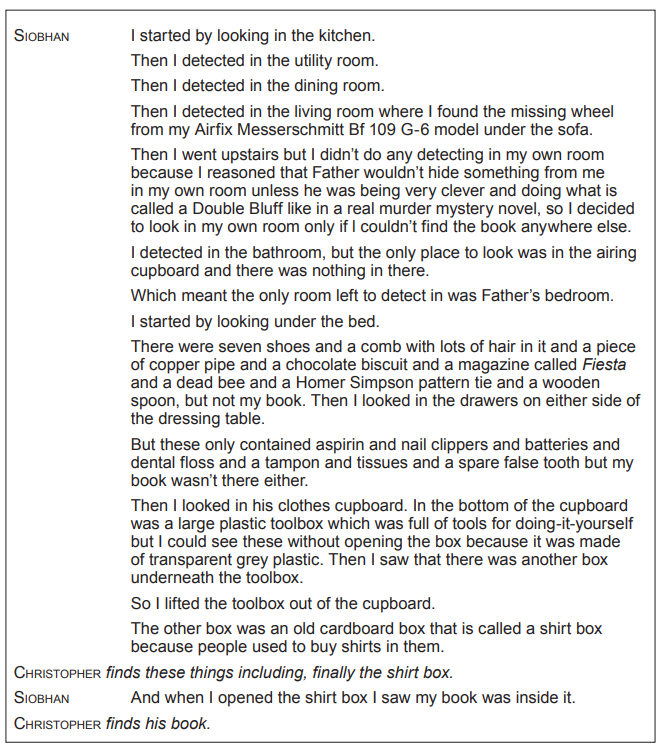
Text excerpt showing Siobhan and Christopher searching for a book. They check various rooms and items until Christopher finds the book in a shirt box.
2
40 marks

Write about Christopher’s relationship with his mother, Judy, and how Stephens presents this at different points in the play.

In your response you should:

  • refer to the extract and the play as a whole

  • show your understanding of characters and events in the play.

5 of this question’s marks are allocated for accuracy in spelling, punctuation and the use of vocabulary and sentence structures.

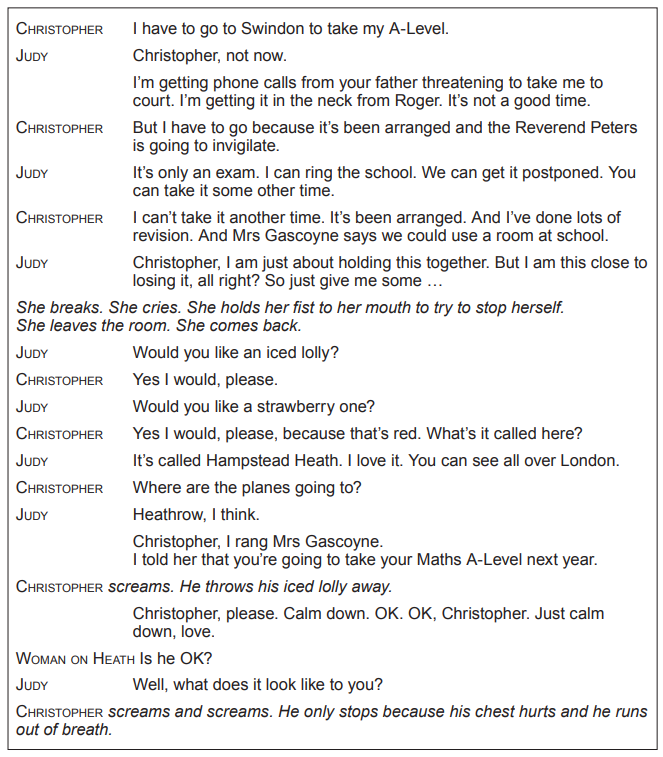
Transcript of a dialogue between Christopher and Judy discussing an A-Level exam amidst tension; contains emotional distress and a reference to Hampstead Heath.
3
40 marks

There is a lot of conflict between the characters in The Curious Incident of the Dog in the Night-Time. Write about some of the times there is conflict and how this is presented at different points in the play.

In your response you should:

  • refer to the extract and the play as a whole

  • show your understanding of characters and events in the play

5 of this question’s marks are allocated for accuracy in spelling, punctuation and the use of vocabulary and sentence structures.

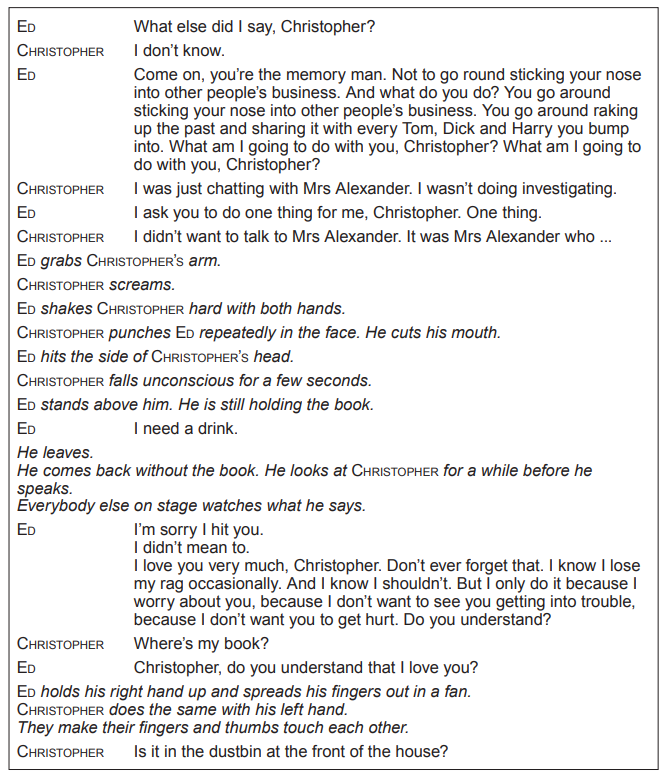
Script excerpt showing a tense dialogue between Ed and Christopher, where Ed confronts Christopher about his behaviour, leading to physical conflict and eventual reconciliation.
4
40 marks

Read the following extract from The Curious Incident of the Dog in the Night-Time and then answer the question that follows. In this scene, Christopher has reached London and is trying to find the Underground train alone. Ed is the voice of his father in his head.

Ed

looks at him for a while.

Ed

Go to the left.

Christopher

I know.

Ed

The train will be very noisy.

Christopher

I know.

Ed

It’ll really scare you.

Christopher

I know.

Ed

Try not to let it. Watch what the people do. Watch how they get on and off.

Christopher

Yes.

The company stand with Christopher on the platform.

Ed

Count the trains. Figure it out. Get the rhythm right.

Train coming. Train stopped. Train going. Silence. Train coming. Train stopped. Train going. Silence.

Christopher

Train coming. Train stopped. Train going. Silence. Train coming. Train stopped. Train going. Silence.

*[Christopher goes into his pocket. He can’t find Toby.]*

Christopher

Toby?

[He looks more. He can’t find him. He panics. He stands up.]

Toby? Where are you?

[He explores the stage. He calls for Toby. He stays calm.]

Toby? Toby? Toby. What are you doing down there?

[He climbs down on to the tracks to rescue Toby.]

Man with Socks

Jesus. What are you doing?

Christopher

My rat is on here.

Man with Socks

Get out of there, for fuck’s sake.

Christopher

Toby . . . Toby . . . Toby . . .

*[The Man pulls Christopher off the tracks. Christopher screams for being touched. He calms. He puts Toby back in his pocket.]*

Man with Socks

What the fuck do you think you were playing at?

Christopher

I was finding Toby. He’s my pet rat.

‘Christopher shows great courage.’ Write about some of the times Christopher shows courage and how Stephens presents this in the play.

In your response you should:

  • refer to the extract and the play as a whole

  • show your understanding of characters and events in the play. [40]

5 of this question’s marks are allocated for accuracy in spelling, punctuation and the use of vocabulary and sentence structures.